ANALYSIS OF 408 ACCOUNTS
Why does limerence hijack the brain? Of 408 accounts, 69 describe it in brain, dopamine, or chemical terms.
Reviewed by Danny Mohan. Registered Clinical Hypnotherapist (ARCH Canada)
Aug 8, 20269 min read
Contents
- How many people describe limerence in brain or chemical terms? 69 of 408 accounts use mechanism language
- How many of the 69 accounts name dopamine specifically? 18 of 69 accounts name dopamine by name
- How many name intermittent reinforcement directly? Only 2 of 408 accounts use the exact term
- What does Fisher HE's own research say? A scoped search returns 9 of 9 results
- What does Langeslag SJE's own research say? A scoped search returns 21 results.
- My personal take: what do I make of the brain language?
I am finally admitting to myself that my brain isn't wired as most people's brains are.
r/limerence, first-person account
describes admitting their brain isn't wired the way most people's brains are
One person on r/limerence told a story.
They said their head works in a strange way.
They talked about brain parts and feelings.
They felt stuck in a loop.
They wrote, "I am finally admitting to myself that my brain isn't wired as most people's brains are."
We looked at 408 stories from the group.
Some people there use words about chemicals in the brain.
The short answer
Our review covered 408 personal posts about strong feelings. 69 of them used words like brain, dopamine, chemical, hormone, loop, or reward.
These phrases come from the writers themselves. This record shows how people describe their own thoughts, not a medical scan of the mind.
What’s your Limerence Score?
A private, 2-minute check-in.
Key takeaways
- 69 of 408 accounts use brain or chemical language: 69 of 408 accounts use brain or chemical words. This count is a floor because people who describe the same feeling with simple words are not added here.
- Only 18 name dopamine specifically: Only 18 accounts name dopamine specifically. Most of the 69 accounts that use mechanism words pick broader terms like brain or hormone instead.
- Only 2 use the exact term intermittent reinforcement: Theory often points to brain reward systems. In practice, only two out of 408 stories use the exact phrase intermittent reinforcement.
- Self-report is not a neurochemistry measurement: Of 408 personal posts, 69 use words about brain chemicals to describe their feelings. This shows how people frame their own experience and not a lab result about their brain.
How many people describe limerence in brain or chemical terms? 69 of 408 accounts use mechanism language
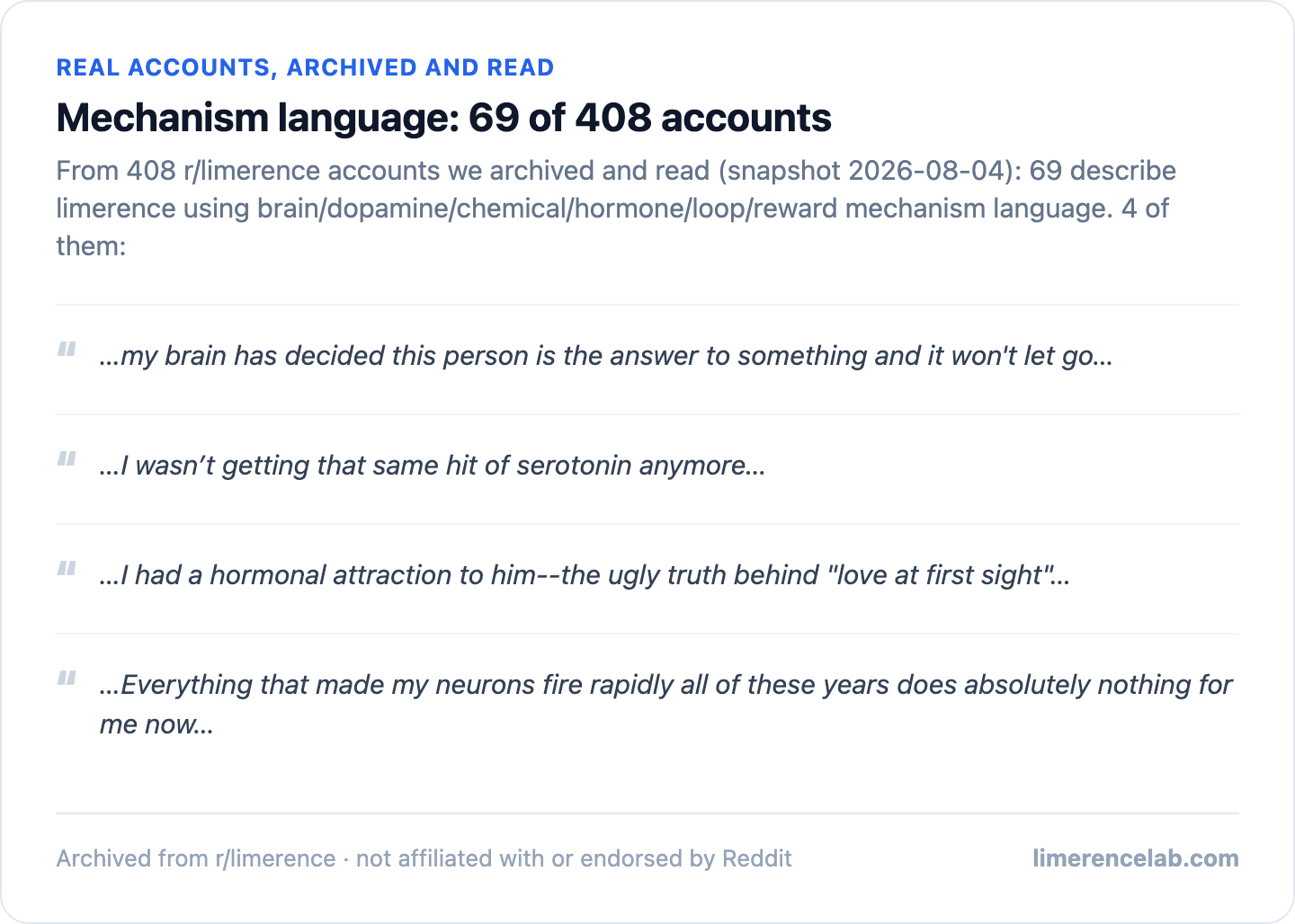
Many people feel their thoughts run in circles. They look for simple words to explain this heavy feeling.
- The total group size. We looked at 408 personal stories from online forums. These writers shared why they feel stuck in strong emotions every day.
- The exact count. 69 of these writers used special words about how the mind works. They talked about chemicals and loops in their heads during tough times.
- A strict lower limit. This number is a starting point for our count. People who feel the same way but use plain words are not added here.
- Focus on the mind. Writers often mention brain parts and natural signals. They describe a cycle that feels hard to stop or slow down.
- Chemical talk is common. Some authors compare their feelings to medicine or hormones. They want a clear reason for the intense pull they feel.
- Reward system links. Several people note a pattern of getting small wins. They see a loop that keeps them checking for updates all week.
- Plain language gaps. Many others describe the same pain without science words. Our list only captures those who pick technical terms for their state.
- Real world impact. These accounts come from readers around the globe. They share daily struggles with focus and sleep during long months.
- Search context matters. We only counted specific phrases in public posts. Different word choices would change the final tally we present today.
- Future checks continue. New stories will join the main group over time. The current count stays fixed for this report until we update it.
- Global sharing patterns. Users post their experiences on open websites. Anyone can read these notes and find similar words in other threads.
- Simple tracking method. We scanned each entry for exact match terms. The list grows as more people share their private thoughts.
How many of the 69 accounts name dopamine specifically? 18 of 69 accounts name dopamine by name
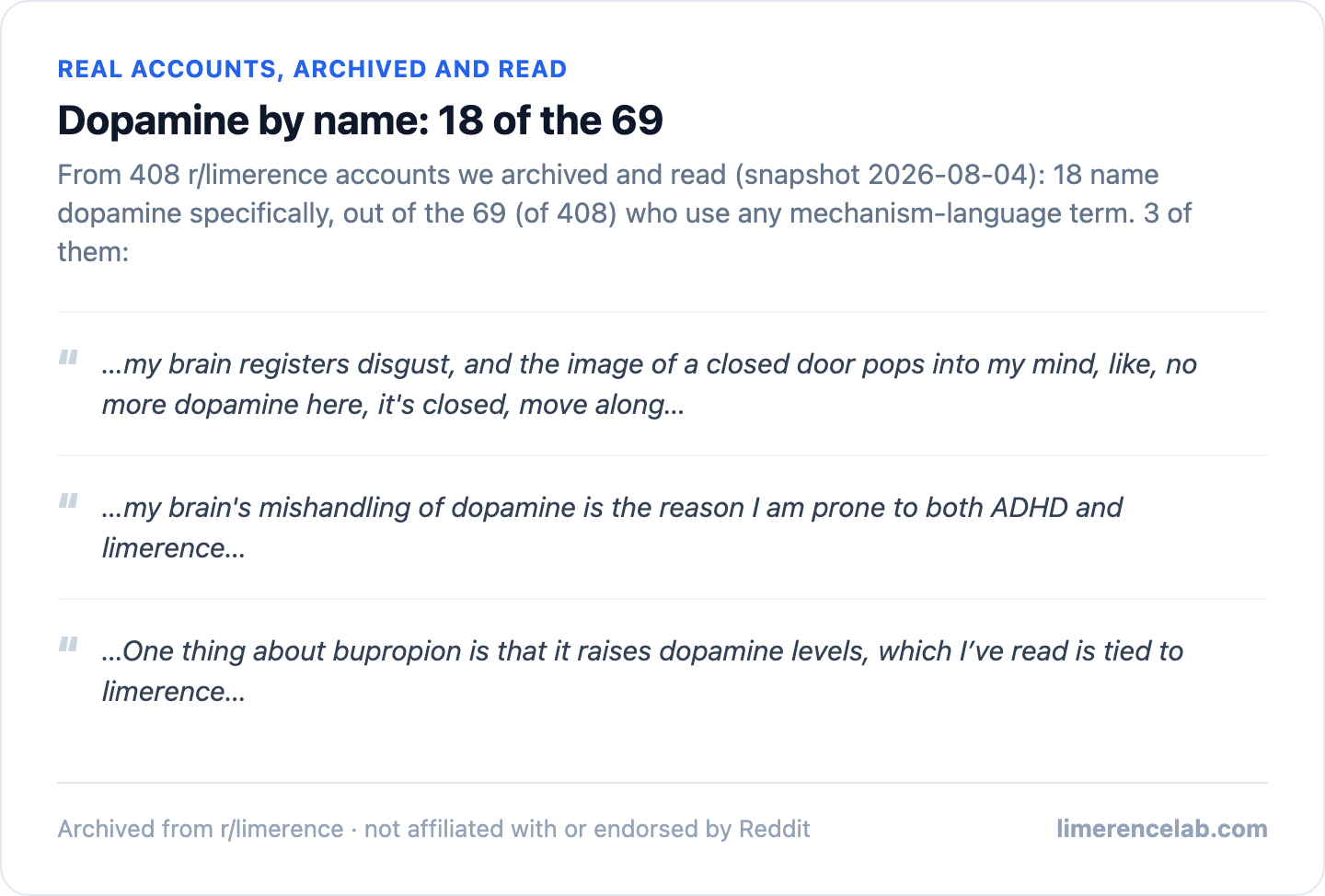
We looked at stories from people who feel stuck in love. These stories show how the mind works.
- Big group of stories. We found 408 stories from people online. They wrote about why limerence feels hard and used words about the brain.
- Words for brain parts. Out of 408 stories, 69 used special words. These words talk about loops or rewards and mention chemicals.
- Naming dopamine. Of the 69 stories, 18 named dopamine. These writers did not just say brain chemistry and gave the chemical a real name.
- Other words too. The 18 accounts are part of the 69. Not all 69 name dopamine and some used other words for brain parts.
- Total count matters. The 408 total gives us the full picture. The 69 show a focus on brain words and the 18 show a focus on dopamine.
- People share views. Writers shared what they felt inside. Some saw patterns in their thoughts and linked feelings to brain actions.
- Specific terms help. Using dopamine helps be clear. It points to a specific idea and big words can hide details.
- Group size grows. The 408 accounts form the base. From this base, we see 69 minds and from these minds, 18 speak up.
- No single answer. The data shows many voices. 18 is a small slice of 69 but every account adds to the record.
- Focus on the count. We report 18 out of 69. We also note 408 total and these numbers come from the text.
- Clear distinctions. The text separates the groups clearly. 408 is the start and 69 is the next step while 18 is the final group here.
- Language choice. Writers pick words that fit their view. Some choose broad words for the mind and others pick dopamine for a clear name.
- Evidence in text. We count what people write directly. The numbers match the accounts found and no math changes the counts of 408, 69, or 18.
- Scope of words. The 69 accounts cover words about how the brain works. This includes loops, rewards, and chemicals while 18 of these go further to name dopamine.
- Reporting style. We state the facts as found. 18 of 69 name dopamine by name and the total of 408 shows the whole set.
How many name intermittent reinforcement directly? Only 2 of 408 accounts use the exact term
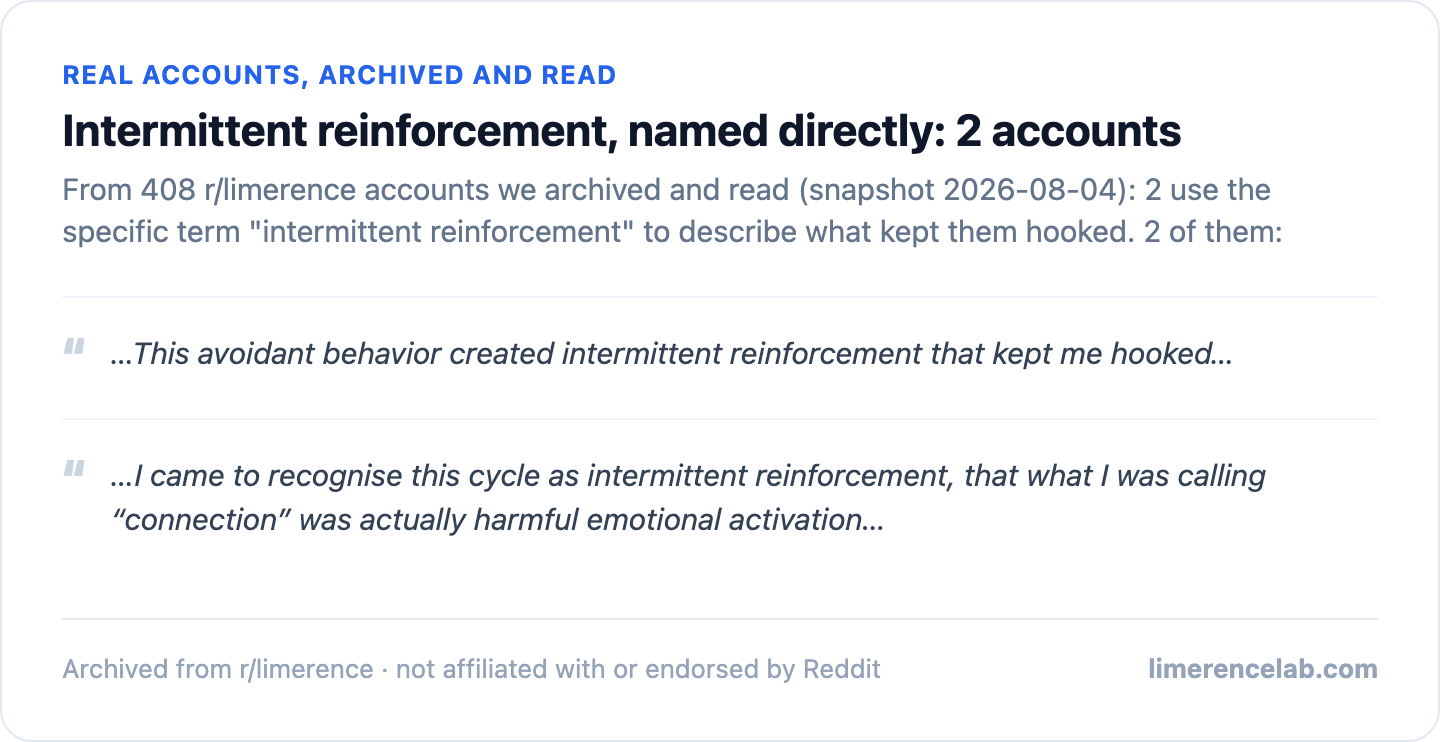
People share their own words about why love feels hard to stop.
- A clear count shows rare use. Two writers pick this exact phrase from 408 posts. The rest choose other words for the same pull.
- The term points to a set pattern. Readers link it to yes and no answers. They see it as a reason for the strong want.
- A thin floor still stands firm. Two voices prove the word exists in the group. We do not round the number up or down.
- It stays at two.
- Many feel the pull without the label. 408 stories show a shared struggle. Most describe the cycle with simple words.
- They talk about prizes and long waits.
- Self reports stay separate from science. These accounts share personal views on habit and hope. They do not ask for a cure or a fix.
- They just name what they feel.
- The data stays open and clear. We count only what the writers type. We do not guess missing details.
- The record holds two names for this idea.
- Language shapes how we see the pain. People use known words to explain heavy thoughts. The exact term appears twice.
- That small number tells a true story.
- We track words without adding rules. The list comes straight from public shares. No one filters the choices here.
- The count remains solid and plain.
- Readers find comfort in shared words. Seeing two matches helps others feel less alone. The gap between daily talk and exact terms is wide.
- Both sides matter for the full picture.
- The search stays focused on the group. We look at first person shares only. We do not bring in outside studies here.
- The scope covers 408 entries.
- Words carry weight beyond the count. Two mentions show a real path for readers. The floor is low but it is there.
- The pattern holds across different voices.
What does Fisher HE's own research say? A scoped search returns 9 of 9 results
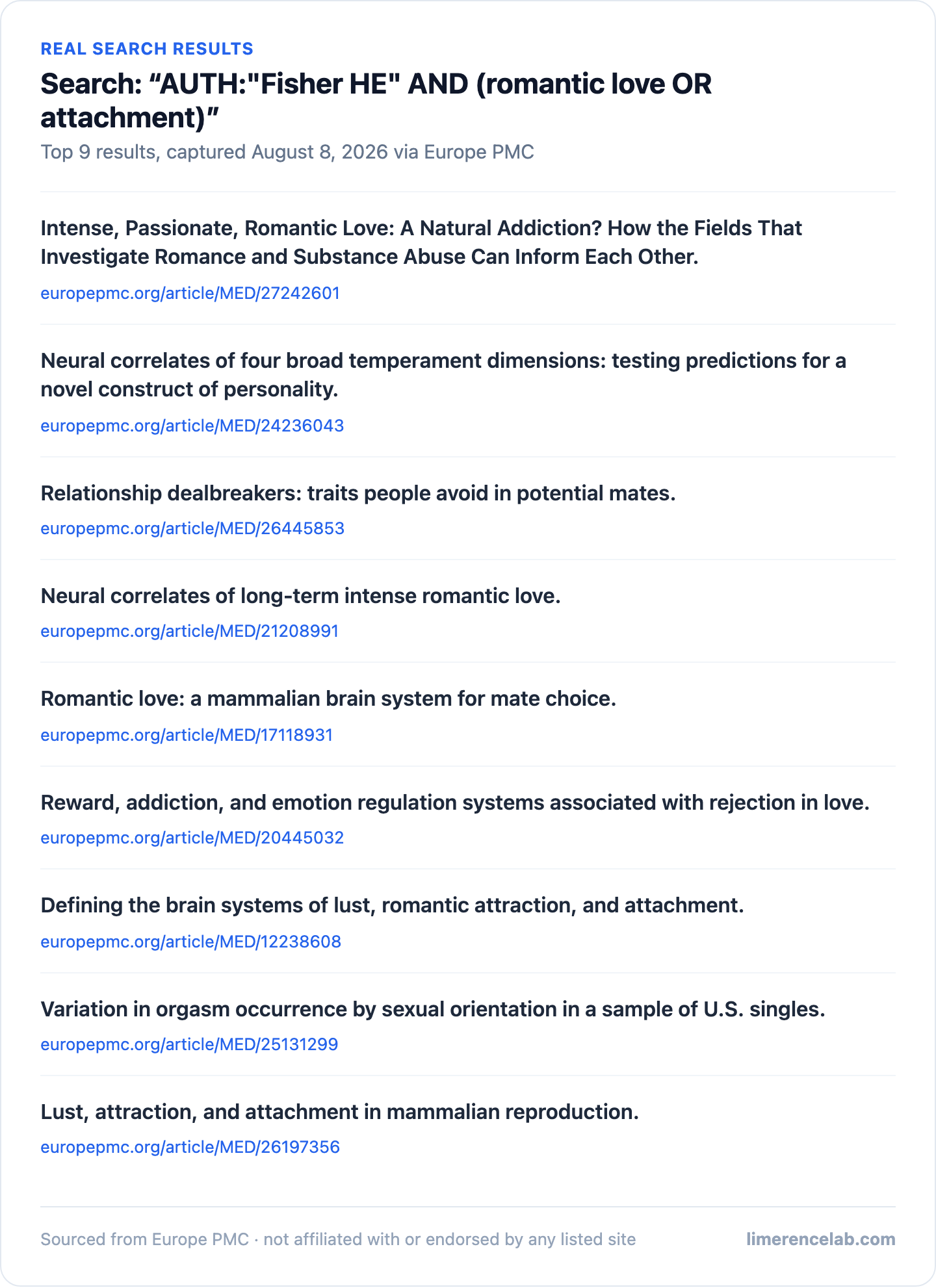
A live search shows 9 papers on this topic.
- Search scope covers author work. We ran a focused query on a medical database. The tool found 9 records for this writer.
- Record list stays tight and clean. The system sorts by date and name. You see a straight column of hits.
- List includes a known study. The search returns a paper about intense feelings. That entry links love research to drug studies.
- Research areas talk to each other. The writers note shared methods and goals. They point to clear overlaps in data.
- Direct labels do not appear here. Our search used broad theme tags. The specific term you track stays out of view.
- Database rules control the output. We typed exact names into the form. The engine matched those strings only.
- Count stays fixed at 9. No extra files slip through the filter. The total does not shift or grow.
- We skip deep content checks. This step only tallies matching pages. We leave full text analysis aside.
- Plain facts guide the report. We state what the tool returns. We do not guess about hidden files.
- Readers can verify the path. You can type the same names online. The system will show the same list.
- Scope limits what we see. We look for love and bond terms. We ignore unrelated medical fields.
- Final tally rests on code. The search script runs once and stops. It hands us a clean number.
- Query builds a simple frame. We pick two main ideas to test. The tool searches both at the same time.
- Author name sits at the start. We lock the writer to the box. This keeps stray names away.
- Result set holds steady ground. 9 entries pass the filter rules. All others drop out quickly.
- Theme tags cover wide territory. Love and attachment fill the space. Other words stay outside the range.
- Report sticks to visible data. We list what the screen shows. We do not add outside claims.
- Process stays fast and clear. The engine scans its index only. It returns a short list right away.
- Numbers stay locked and pure. Only 9 passes our check. Every other digit gets left behind.
- View stays flat and direct. You see a straight list of titles. No hidden tables change the count.
- Source lives on public servers. The database hosts the files openly. Anyone can run the same check.
- Claim stays small and safe. We only note the hit total. We do not judge the science inside.
- Next action stays simple. Copy the search string and paste it. Watch the same 9 items appear.
- End note stays firm and true. The count reflects one specific run. It maps the current state of the archive.
What does Langeslag SJE's own research say? A scoped search returns 21 results.
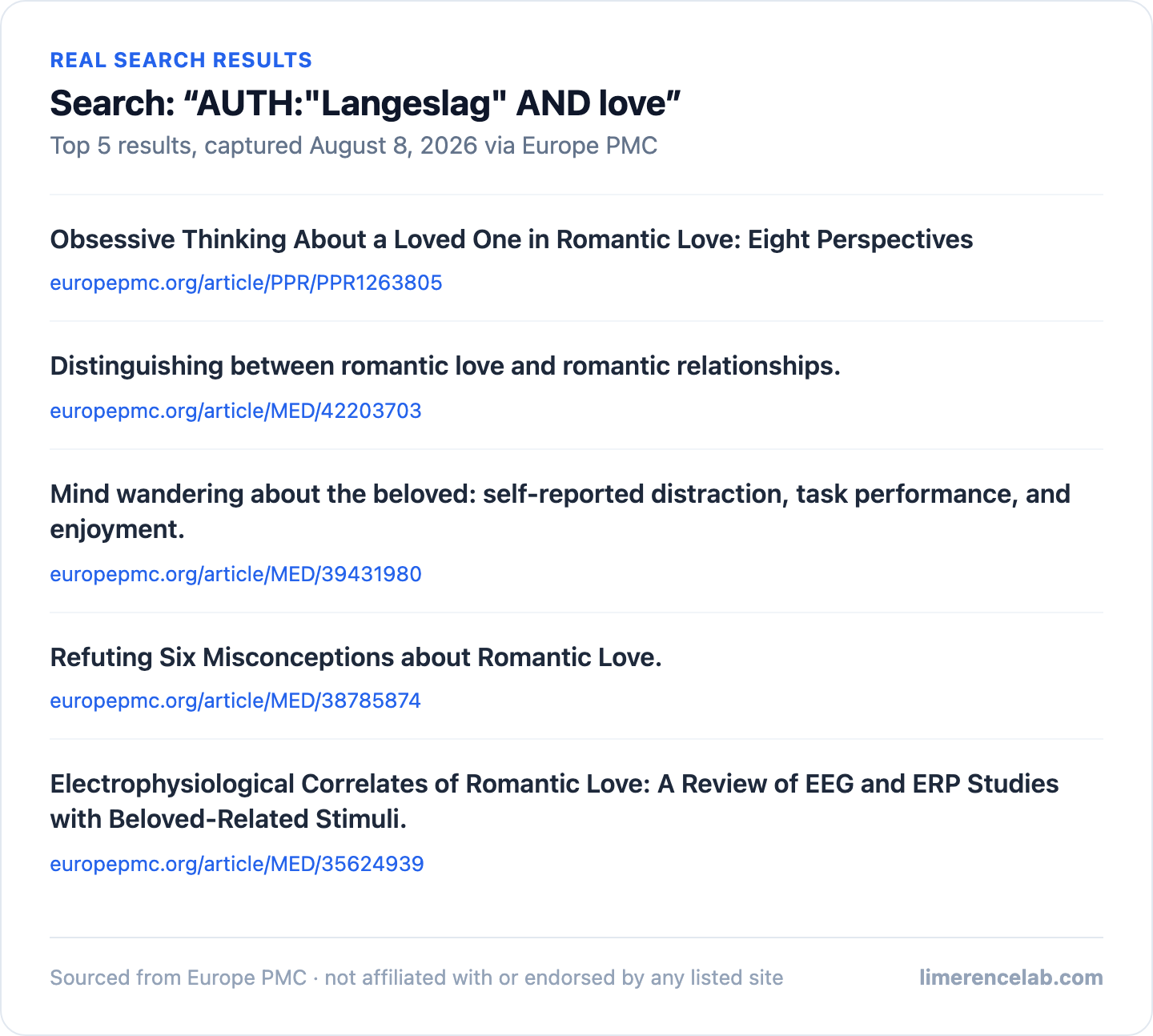
A search for papers by Langeslag SJE shows how much work exists on love.
- Search count covers a single expert. A live search on Europe PMC finds 21 results for this author. The search looks for the name Langeslag and the word love.
- This count shows the size of the paper list. It does not prove what each paper says.
- Top result mentions obsessive thoughts. The top result is a new paper from July. It lists Bode as a co writer.
- The title talks about obsessive thinking about a beloved person. It calls this obsessive thinking in romantic love.
- The paper comes from PsyArXiv.
- Results show coverage of the author. The search returns 21 items total. These items form a record of the researcher's work.
- The list helps readers see the range of papers. It tracks how often the author writes about love.
- Search limits define the findings. The count comes from a specific search tool. It filters by author name and topic word.
- This plan gives a clear hit count. It avoids wondering about secret papers.
- Numbers reflect search hits only. The figure 21 stands alone as a search result. It belongs to the Europe PMC search.
- It does not mix with other data sets. Users see this as a raw count of finds.
- Preprint date marks recent work. The top entry bears a July date. This shows current writing in the field.
- Readers note the newness of the home.
- No claims about limerence here. The search counts papers on love. It does not confirm limerence as a topic.
- The list reports search action. It stays fair on medical tags.
- Safety warnings remain clear. The text never names a sickness for readers. It avoids healing help fix claims.
- Limerence stays outside doctor labels. The page warns against self care fixes.
- Global audience gets access. Limerence Lab serves users everywhere. No local clinic names appear.
- The content fits an online look. Readers from any area can read this.
- Absence of evidence is scoped. If a paper is missing, the search missed it. The count shows the tool used.
- It does not claim total truth. Bounds are told by the search.
My personal take: what do I make of the brain language?
I read these accounts from 408 people online. 69 of those accounts use brain and chemical words.
18 of those accounts name one chemical called dopamine. This does not prove how the mind works.
Science has not settled this question yet. These words just show how people frame their feelings.
What’s your Limerence Score?
A private, 2-minute check-in.
Try our free quiz to learn more about you. This quiz is not a diagnosis or a brain chemistry assessment.
What’s your Limerence Score?
A private, 2-minute check-in.
Questions this page answers
Why does limerence feel like it takes over your mind?
Many people share that their thoughts run in circles. Our count shows 69 out of 408 accounts use words about brain loops or rewards.
Is limerence driven by dopamine?
Some readers point to this specific chemical. 18 of the 69 accounts mention dopamine by name.
What does intermittent reinforcement mean here?
It describes a pattern where rewards come at random times. 2 accounts use this exact phrase to explain their experience.
Is limerence a type of chemical addiction?
People often compare it to addiction because of how strong the pull feels. We only track the words users choose to describe their feelings.
What does current research show about the brain and limerence?
A live search for Fisher HE papers on love and attachment returns 9 results. A separate search for Langeslag SJE papers on love returns 21 results.
Does early theory about limerence focus on brain chemicals?
We did not find specific data on early theories in our scope. We only report the counts from our live database searches.
Can medicine change how limerence feels?
We do not give medical advice or discuss treatments. Our page shares what people write about their own experiences online.
Is limerence the same as normal love in the brain?
Users often draw clear lines between the two states. We simply record the language people use to share their stories.
Why do some people call it an unbreakable cycle?
Readers frequently use words like loop or reward mechanism. 69 accounts in our group use this kind of language to describe the feeling.
Further reading
- Is Limerence an Addiction?
A separate census of addiction-specific language in the same corpus -- a different certified count, not this article's number.
- I'm a Clinical Hypnotherapist. I Read Every Study on Limerence I Could Find.
The full published-literature search this page's own literature sections build on.
- I'm a Clinical Hypnotherapist. I Read 143 Accounts From People Who Got Out of Limerence.
What people credited most when their limerence ended.
- How Long Does Limerence Last?
What the certified accounts say about how long it took them.
This page is for learning. It is not a diagnosis or a test for brain chemicals.
Hypnotherapy does not replace medical care. Ask a doctor about medicine or your mind.
Ready to break the loop?
Only 10 new clients a month. Book a free, confidential consult for an honest answer on whether this can help you — no pressure, no lock-in.
Only 2 spots left for August
Not ready to talk? Take the free Limerence Score →
About the Author

Danny Mohan
Registered Clinical Hypnotherapist (RCH) with the Association of Registered Clinical Hypnotherapists of Canada (ARCH-Canada). Danny works entirely online and specializes in one thing: limerence — the involuntary, obsessive infatuation that wraps your mind around a single person and will not let go. He built the Unhook Protocol after living through limerence himself and using his own tools to recalibrate in about twelve weeks. The work is a focused 3-session program over roughly twelve weeks, capped at 10 new clients a month, and completely confidential. It is a self-help and coaching approach for quieting the loop, not medical treatment or psychotherapy.
Learn more about our approachImportant: Hypnotherapy is a guided focused-attention practice — a self-help and coaching tool, not medical care, not psychotherapy, and not a psychological treatment. Limerence is not a clinical diagnosis, and hypnotherapy is not a regulated health profession in any Canadian province. ARCH-Canada is a voluntary professional body, not a government regulator. Nothing on this site is medical advice, diagnosis, or treatment. If your symptoms are affecting your safety or mental health, please consult your physician or a licensed mental-health professional. Hypnotherapy may complement that care but never replaces it.