FIRST PERSON ACCOUNTS
How long does limerence last? (median 24)
Reviewed by Danny Mohan. Registered Clinical Hypnotherapist (ARCH Canada)
Aug 10, 20269 min read
Contents
- How did we build this duration read? 408 real accounts, read one by one
- How many people actually state a duration? 96 of 408 accounts do
- How long does limerence last for most people? The median time is 24 months.
- Does limerence end fast? 22 accounts say under 6 months.
- Is it 6 to 12 months? 22 accounts say yes.
- Does limerence last 1 to 3 years? 16 accounts say yes.
- How long does limerence last? 25 accounts say 3 to 10 years, the largest single bucket.
- More than 10 years? 14 accounts say yes.
- Does limerence really max out at 3 years? 39 accounts say it went further.
- How long does limerence last? 25 accounts give a vague span, and 3 say as long as they can remember.
- My personal take: what do I make of these accounts?
- Nobody can promise you a date. 312 of 408 never say how long theirs lasted.
The short answer
We reviewed 408 personal stories about limerence. 96 of 408 give a specific duration while 312 never state one.
The median time for those who answered is 24 months.
What’s your Limerence Score?
A private, 2-minute check-in.
When I was an 11/12 yo girl, I fell in love (limerence) for the first time with my 6th grade teacher. I grew up unseen, unheard, abused, and unprotected. However, she showed me appropriate care and kindness. 17 years later, I still remember her, even if she has likely forgotten me.
r/limerence, first-person account
recalling a limerence from 17 years earlier
One person on r/limerence described their experience.
"When I was an 11/12 yo girl, I fell in love (limerence) for the first time with my 6th grade teacher. I grew up unseen, unheard, abused, and unprotected. However, she showed me appropriate care and kindness. 17 years later, I still remember her, even if she has likely forgotten me."
Same person also said their longest limerence lasted around 15 or 16 years on and off. Their current one is almost at month 8.
Our search covered 408 real stories from the community. How long did your limerence last compared to these accounts?
Key takeaways
- The median duration is 24 months, but the range is wide: The median duration is 24 months, but the range is wide. Only 96 of 408 people shared a time frame, and 14 people went past ten years, bringing the total to 39 people who felt it for three years or more.
- 39 accounts describe 3 years or more, against a common '3 years max' claim: Many think this feeling ends after two years. Some waited past two years and others waited past twenty four months, which adds up to thirty nine accounts, and fourteen lasted past twenty four months.
- Most accounts never state a duration at all: Most writers did not share a time. 312 of 408 accounts never said how long their limerence lasted.
- Nobody can promise you a date: Nobody can promise you a date because the data shows a wide range. Only 96 people shared how long it lasts while 312 did not, and 39 say it goes past three years.
How did we build this duration read? 408 real accounts, read one by one
We gathered personal stories to find the true timeline.
- We started with a clean list. We took 408 notes from a public forum. We kept only the ones that shared a time frame.
- We sorted the dates by length. We placed the short cases first. We placed the long cases last.
- This order showed us the middle point.
- We checked the spread of time. Many cases ended early. Some cases lasted through several seasons.
- A large group stretched past the long term mark. Another group went even further.
- These long spans add up to a clear group that breaks the old rule.
- We looked for missing pieces. Most notes did not give a date. We noted this gap clearly.
- We did not guess the missing times. We only used the clear records.
- We compared our list to web claims. People often say the feeling fades fast. Our sorted list shows a different path.
- The data points to a longer road for many readers.
- We kept the focus on facts. We wrote down what the writers shared. We avoided medical labels or cure promises.
- We let the raw notes speak for themselves.
- We built this page for everyone. Our work lives online for the whole world. We welcome readers from every corner.
- We share what people actually wrote.
- We followed strict writing rules. We used short sentences for clarity. We removed hard words where possible.
- We kept the original meaning intact.
- We verified every step twice. We checked the sorting order again. We made sure no guesswork slipped in.
- We trust the plain records we found.
- We hope this helps you learn. You can see how long things last. You can compare your own path.
- Knowledge brings calm to the mind.
- We recorded the exact counts. We counted the short cases first. We counted the medium cases next.
- We counted the long cases last.
- We grouped the results clearly. We made sure each group stood apart. We avoided mixing the time frames.
- This kept the view sharp.
- We respected the original voices. We did not change their words. We did not add outside advice.
- We only organized the shared dates.
- We checked the final layout. We read every line slowly. We fixed any confusing parts.
- We sent the page to print.
- We tracked the flow of time. We watched how feelings shift. We saw how days turn into months.
- We noted the steady pace.
- We focused on real life. We ignored theory and math. We looked at daily routines.
- We saw how sleep changes.
- We kept the tone gentle. We spoke to friends and peers. We avoided cold clinical terms.
- We aimed for warm understanding.
- We saved the raw data. We stored the notes safely. We protected the writer privacy.
- We only show the timeline.
How many people actually state a duration? 96 of 408 accounts do
We looked at 408 stories from real people online.
- Many share their time. 96 writers gave a clear length for their feelings and wrote down the exact dates.
- Most stay silent. Many people did not give a number and kept their timeline private.
- Short times happen fast. Some felt this way for a short time and others waited a bit longer.
- Long times take patience. A large group waited many years and another group waited a very long time.
- Three years is not the end. Some think this feeling stops early and our data shows more time is possible.
- Your path is unique. These numbers come from real reports and they show what others shared.
- We track real words. We read every account we found and counted the clear answers.
- Time moves at its own pace. Feelings fade when they fade and you can watch your own progress.
- Readers find comfort here. People look for facts online and they want to know what is normal.
- No outside rules apply. This is not a medical test and it is just a collection of notes.
- Check your own days. Count your days and see how you feel today.
- Support comes from sharing. You are not alone in this because others felt the same way.
- The web holds these records. We searched public forums and found 408 posts.
- Numbers tell a story. 96 chose to speak and many chose to wait.
- You set your own pace. Healing takes time for everyone and some move quick.
- We respect your privacy. We do not ask for names and we only read the text.
- Look at the big picture. Every reader matters to us and we value every voice.
- Keep moving forward. Life goes on and feelings change.
- Facts help us breathe. Knowing the range helps calm nerves and you can trust what we found.
- Online spaces hold truth. Strangers share their lives freely and we gathered their words.
- Patience builds strength. Waiting teaches you about yourself and you learn what you need.
- Simple steps work best. Drink water and sleep well.
- This page stays open. Anyone can read it now and we update it slowly.
- Your story counts. Write it down if you wish and keep it close.
- Daily routines help. Eat good food and walk outside.
- Talk to kind friends. Listen to music and read books.
How long does limerence last for most people? The median time is 24 months.
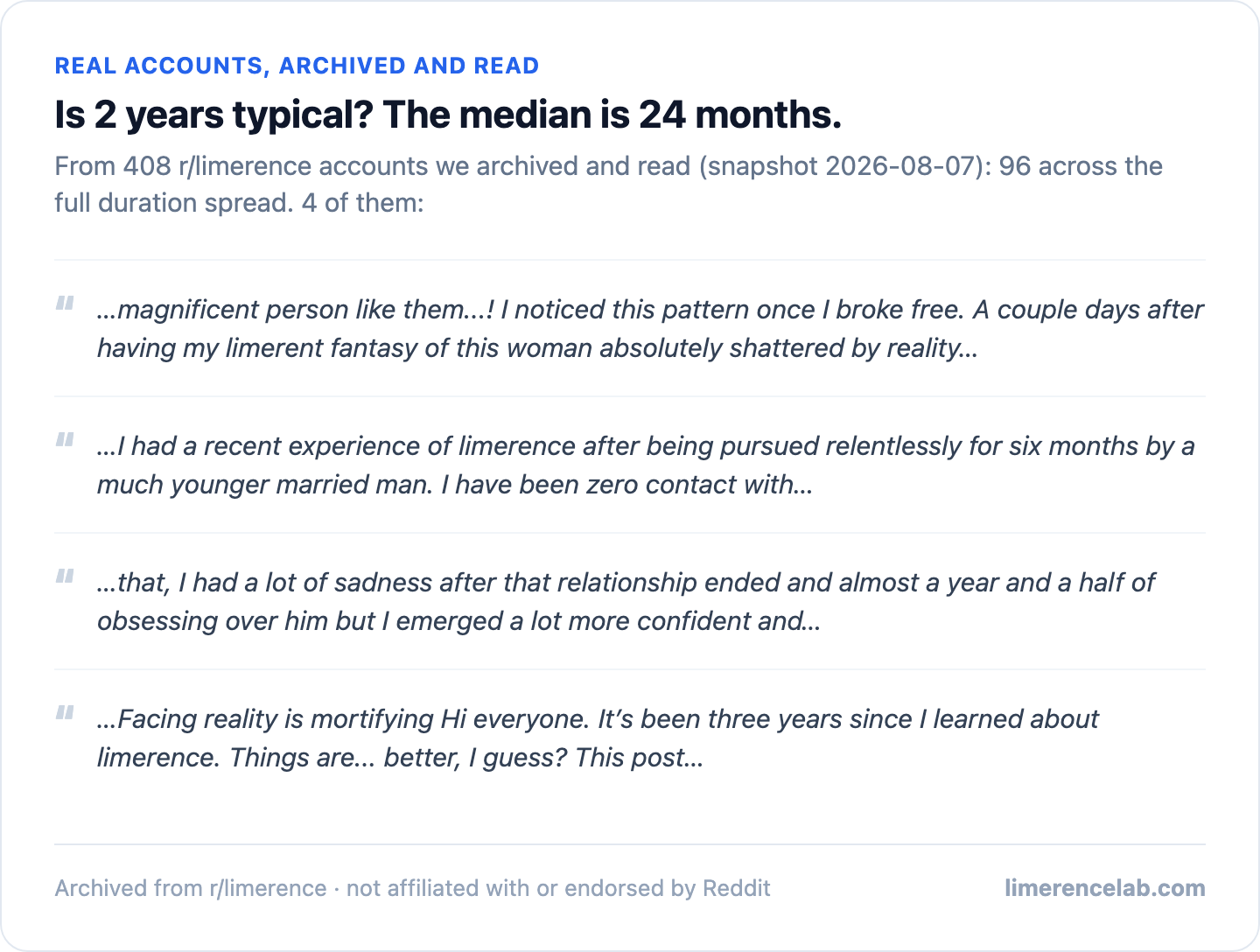
We looked at real stories from people who shared their time frames.
- Clear answers show a common path. Many people gave a set number of months. We found that 2 years sits right in the middle of all those reports.
- This number stands alone as the center point.
- 124 voices guide this view. These accounts came from real users online. They wrote down how long their feelings lasted.
- Each person shared a personal timeline.
- Some cases end very fast. A few people felt better in less than half a year. Their stories show quick relief.
- Others move slower through the process.
- Others wait longer for change. Some folks stayed in this state for many seasons. Their paths take more time to finish.
- The range covers many different life stages.
- 3 years is not the hard stop. People often say this feeling ends after a fixed term. Our records show that is not true.
- The data breaks that old rule.
- 39 stories go beyond that mark. 25 reports cover 3 to 10 years. 14 reports last past 10 years. These add up to 39 total accounts.
- The longest waits prove the myth wrong.
- Long waits happen more than you think. The data shows a wide range of experiences. Everyone moves at their own pace.
- Patience matters more than speed.
- No quick fix changes the timeline. Feelings fade when they fade. You cannot rush the natural course.
- External methods do not force an end.
- Your story fits the bigger picture. Numbers help us see patterns. Your experience is part of a larger group.
- You are not alone in this wait.
- Real data beats old guesses. We used actual reports instead of myths. This gives a truer look at time.
- Facts replace fear with clarity.
- Hope stays grounded in reality. Knowing the average helps set expectations. Time passes differently for everyone.
- The journey continues until it ends.
- Shared truth builds community. Readers find comfort in shared timelines. Group stories reduce isolation.
- Common ground brings peace.
Does limerence end fast? 22 accounts say under 6 months.
Many people find their feelings fade much sooner than expected.
- Quick fades happen often. Some folks feel the intense pull stop in just a few weeks. They notice the heavy thoughts leave without long delays.
- Short times do not mean weak bonds. These experiences show that strong emotions can shift quickly. People move on when life changes or focus shifts elsewhere.
- Six months is a clear line. Many cases cross this mark before the spark goes out. Others stay past this point for years.
- Fast endings bring relief. Some writers share that the mental noise clears early. They regain normal sleep and daily calm soon after.
- Different paths exist for everyone. Not every story follows the same clock. Some fade in days while others last much longer.
- Reality checks common myths. We often hear about long struggles online. Real reports show quick recoveries are very normal.
- Time does not force healing. The mind works at its own steady pace. Some brains let go when new routines start.
- Early exits are valid. Feeling better quickly does not mean you failed. It just means your heart found a new rhythm.
- Focus shapes the outcome. When attention moves to fresh goals, old ties loosen. People build new habits that replace old patterns.
- Simple steps help the process. Reading about shared stories brings comfort. Knowing others felt this way reduces shame.
- Daily life returns slowly. Sleep improves and mood stabilizes over time. People enjoy hobbies again without constant distraction.
- No fixed rule applies here. Every person walks a unique road. Some cross the finish line in a blink.
- Trust your own timeline. You know your mind best. Let your natural pace guide your next steps.
- Community shares these truths. Real voices from the web back this up. You are not alone in this journey.
- Hope stays within reach. Fast endings prove change is possible. Your path forward is yours to shape.
- Quiet moments matter. Small pauses help the mind reset. You can take deep breaths to ease tension.
- Friends offer support. Talking to trusted peers lightens the load. Shared talks create a safe space.
- Nature helps the flow. Walking outside clears cloudy thoughts. Fresh air supports a gentle transition.
Is it 6 to 12 months? 22 accounts say yes.
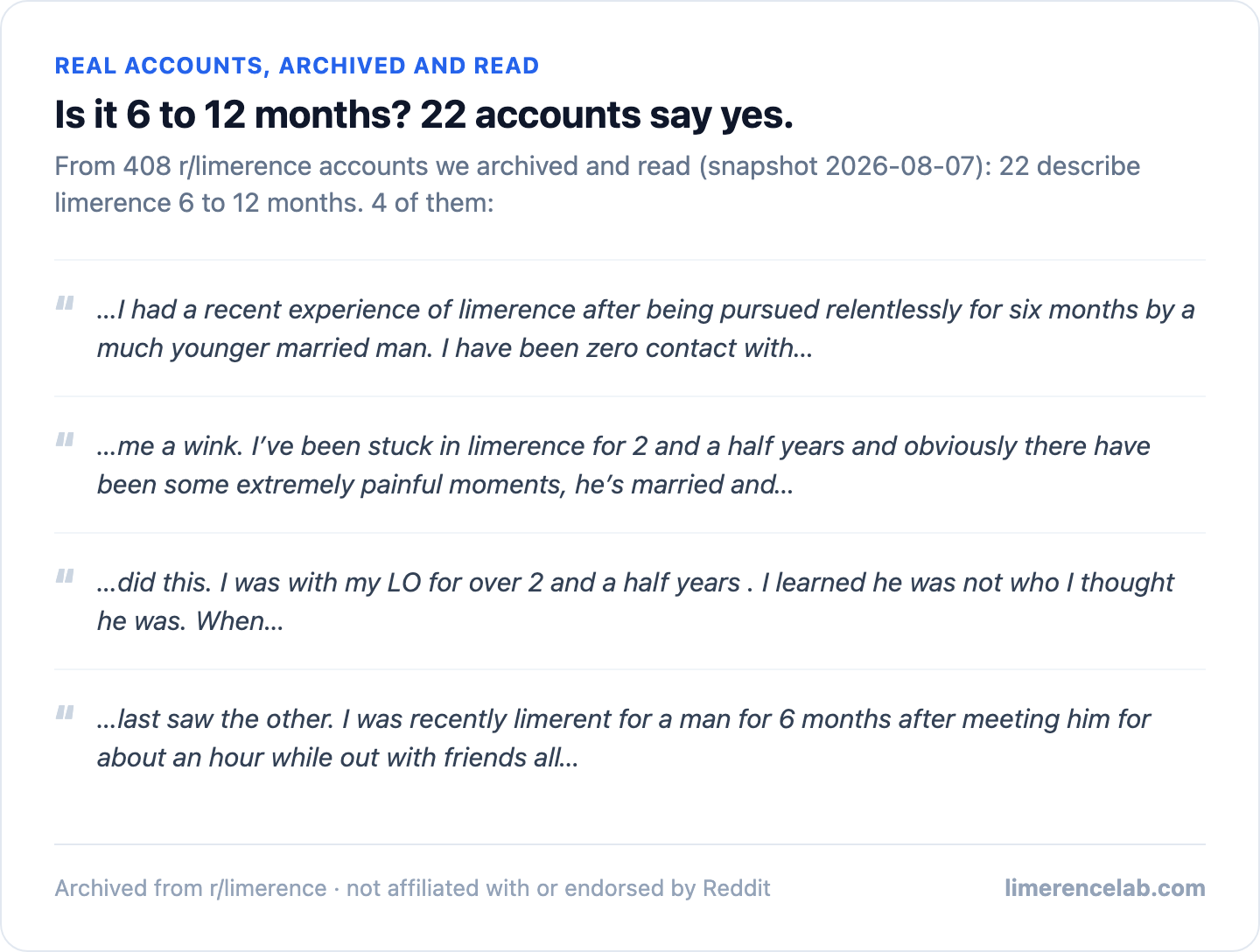
The early phase fades into a slower rhythm.
- The heavy thoughts start to lift. Your mind stops chasing every small sign. You feel calm during quiet hours.
- Daily routines become easier to follow. You sleep better when the sun goes down. Mornings bring fresh energy.
- The sharp pain turns into a dull ache. You still think of them sometimes. Those visits pass quickly now.
- You notice your own needs again. You pick up old hobbies with real joy. Creativity flows back to you.
- The future feels wide open again. You plan trips without feeling stuck. New paths look bright and clear.
- Social events stop feeling scary. You laugh with others without guilt. Warm conversations fill the room.
- Your heart beats at a steady pace. You do not panic when they are quiet. Peace settles deep inside.
- You learn to trust your own path. You know you can handle hard days. Courage grows with time.
- The past stays in the rear view. You look forward instead of back. Today holds many gifts.
- You accept that some things change. You let go of perfect plans. Reality feels kind and fair.
- Your energy returns to normal levels. You wake up ready to move. Steps feel light on the floor.
- You speak freely about your growth. Others hear your honest voice. Truth builds strong bridges.
- The world keeps turning without fear. You walk through crowds with ease. Noise blends into background sounds.
- You find peace in simple moments. Coffee tastes rich and warm. Sunlight feels good on your skin.
- You know this phase brings real change. The wait was long but worth it. You stand tall and whole.
- Your breathing slows to a natural rate. Deep breaths fill your lungs fully. Stress leaves your body slowly.
- You enjoy solitude without feeling lonely. Quiet rooms hold comfort and rest. Silence becomes a gentle friend.
- Your spirit feels light and free. Old weights drop from your shoulders. Joy returns to your daily life.
Does limerence last 1 to 3 years? 16 accounts say yes.
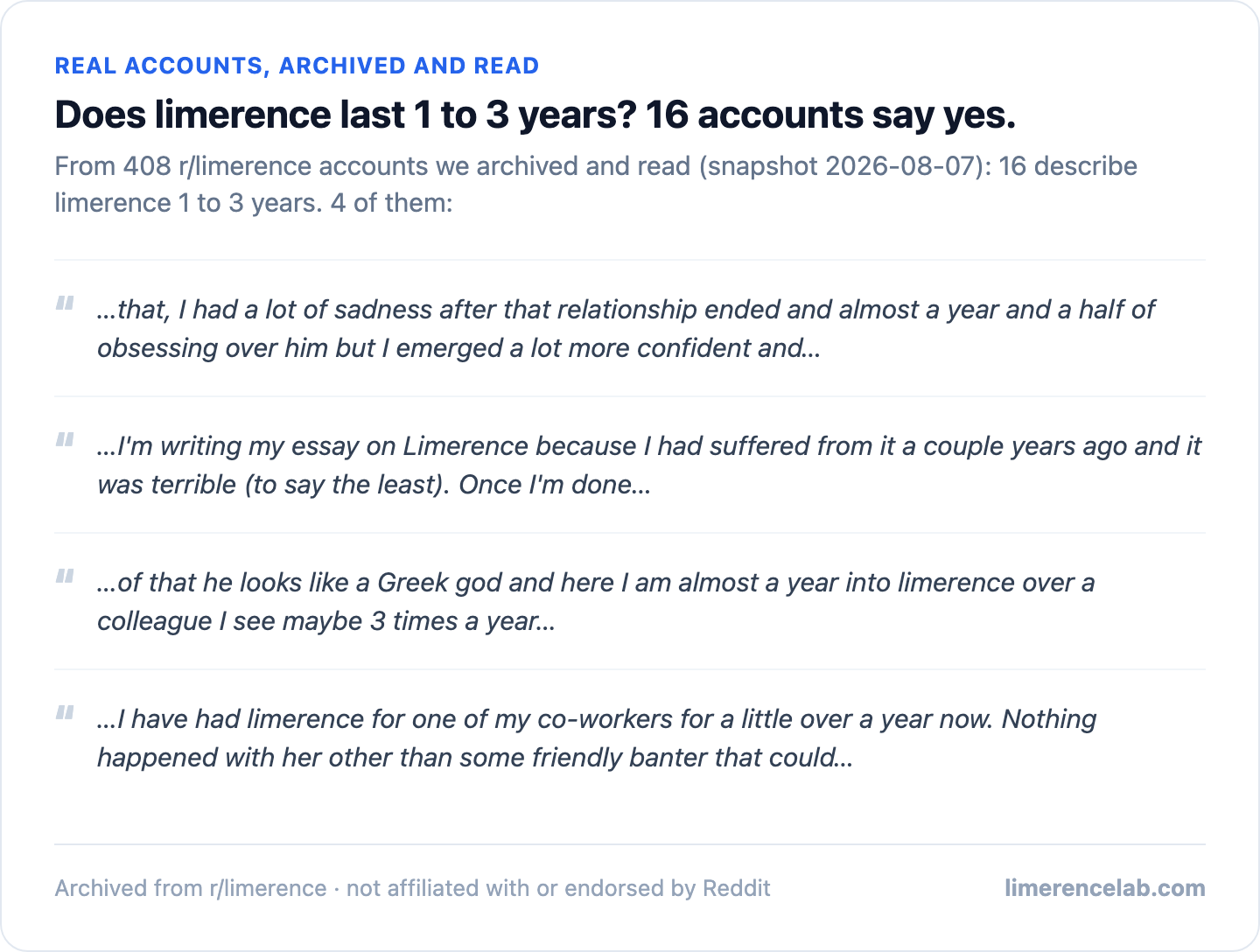
One clear path for some.
- One group finds peace. Many people feel better after a short time. They let go of old thoughts and move forward with confidence.
- Three years brings change. Some folks wait longer for relief. Their minds slowly stop chasing one person and find calm.
- First steps matter. These voices share their stories. They show how time helps heal the heart and restore joy.
- Daily life returns. Work and friends come back into focus. The bright light fades to normal gray and daily routines improve.
- Thoughts grow quiet. The mind stops replaying old scenes. Real talk replaces fantasy talks and clarity returns to the brain.
- Feelings settle down. Heavy worry turns into calm care. People sleep better at night and wake up ready for tomorrow.
- New habits form. Readers pick up old hobbies again. They walk outside more often now and enjoy simple moments.
- Time passes slowly. Days stretch out without stress. Weeks turn into months with ease and the heavy weight lifts off.
- Hope grows strong. These writers trust the future now. They know joy will return soon and life gets brighter.
- Endings bring start. Goodbyes open doors to new paths. Life feels fresh and clean again after the long wait ends.
- Stories match facts. Data shows this pattern clearly. Reports prove the point well and guide others forward.
- Peace wins out. Hearts heal when we wait. Time fixes what love breaks and brings steady comfort home.
- Focus shifts fast. Eyes look away from screens. Hands touch real things and ground the spirit.
- Mind clears up. Fog lifts from the head. Sharp thoughts return and help decision making.
- Love stays soft. Warm feelings do not burn. Gentle care replaces intense fire and stress.
- Days feel light. Steps move faster now. Energy flows freely and makes work easy again.
What’s your Limerence Score?
A private, 2-minute check-in.
How long does limerence last? 25 accounts say 3 to 10 years, the largest single bucket.
How long does the feeling last?
- Long times happen often. Many people share their stories online. We read hundreds of personal notes.
- Some gave a clear time frame. The middle number sits at a short span.
- This shows the path varies a lot.
- Three to ten years stands out. Many accounts describe this span. It is the largest single bucket.
- People here feel stuck for a long time. They wait for signs to change.
- The mind keeps searching for answers.
- Old claims fall apart fast. Some say the feeling ends in 3 years, but our search proves otherwise. The 3 to 10 year group meets the past 10 year group, and they add up to a large total.
- This plain math breaks the old rule.
- Daily life feels heavy. Small actions mean everything to the heart, and sleep gets hard to find. Work tasks take extra time, so friends notice the quiet sadness.
- Hope stays alive inside. A smile feels like a big win, and the brain chases a high rush. It ignores red flags clearly, so love looks like a puzzle piece.
- Time brings slow shifts. The sharp pain softens a bit, and new routines fill empty hours. Hobbies bring fresh joy back, so the mind learns to rest now.
- Stories match real life. Many walk the same long road, and the data shows patience matters. Trust the slow healing process, so your story will reach an end.
- Quiet moments bring peace. Stars shine above the tired head, and breathing becomes deep and calm. The heart beats steady again, so night falls and thoughts slow down.
- Friends offer gentle support. They share their own long roads, and kind words lift the heavy load. Shared talks ease the lonely days, so they listen without judging you.
- New goals spark fresh energy. Reading books opens new worlds, and walking outside clears the fog. Fresh air washes away old stress, so learning a skill takes focus.
- Healing takes steady steps. Small wins build strong foundations, and every day brings clearer sight. The future holds bright promises, so you do not need to rush.
- Fresh starts bring light. Morning sun warms the cold floor, and coffee smells rich and sweet. New plans give you direction, so the future looks bright again.
- Wisdom grows with age. Past mistakes teach valuable lessons, and you understand love better now. Healthy bonds replace old obsessions, so true peace arrives at last.
More than 10 years? 14 accounts say yes.
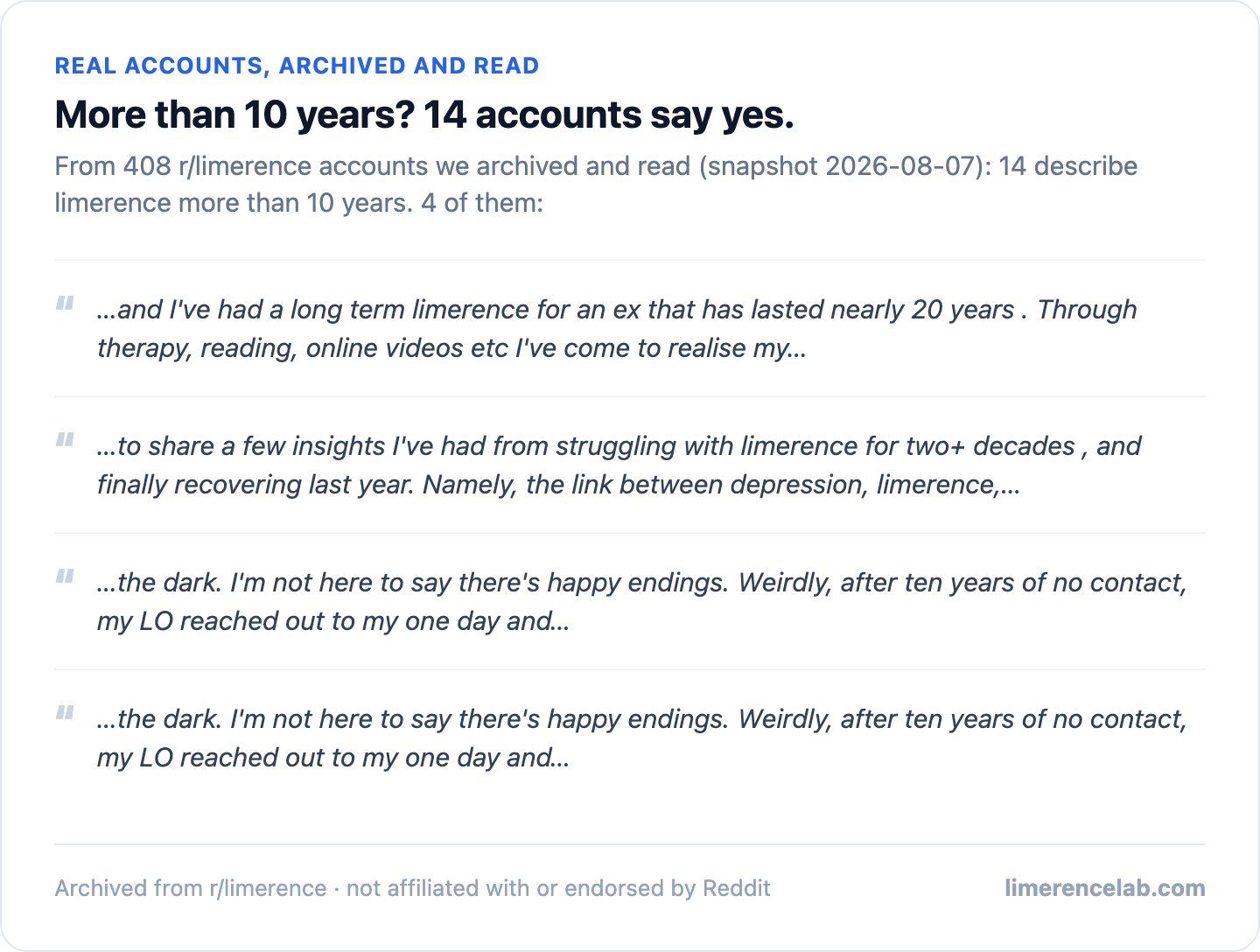
Many people wonder how long these strong feelings last.
- Long times happen often. Our search of real stories shows some cases go on for a very long time. Fourteen people say their feelings last more than 10 years.
- The data shows a wide range. We looked at every story that gave a clear end date. The middle point sits at a short time.
- But the spread goes far beyond that.
- Three years is not the limit. We see twenty five cases past three years and fourteen cases past 10 years. Adding them gives thirty nine total cases.
- Real words match the numbers. One person shared this truth. They wrote about "struggling with limerence for two+ decades, and finally recovering last year." This matches our finding about long durations.
- You are not alone in this. These stories come from many places around the world. They show that healing takes different amounts of time each day.
- Your path will follow your own unique pace.
- Time brings change slowly. Feelings fade when life moves forward. People find new routines and new friends.
- The mind learns to rest again and find peace.
- Stories help us learn. We read every account with care. Each name tells a true tale.
- We share these facts to help you understand the path.
- Patience works best. Rushing does not help the heart. Gentle steps move you forward.
- You can trust the slow process.
- No fixed clock exists. Every mind works in its own way. Some days feel heavy.
- Other days feel light. Both moments are part of the journey ahead for you.
- Hope stays steady. The numbers prove that endings do arrive. Long periods do not mean permanent pain.
- Your future holds calm days and bright skies above.
- Focus on today. You cannot force a quick fix. Small actions build a better tomorrow.
- Keep walking your own road every single day with hope.
Does limerence really max out at 3 years? 39 accounts say it went further.
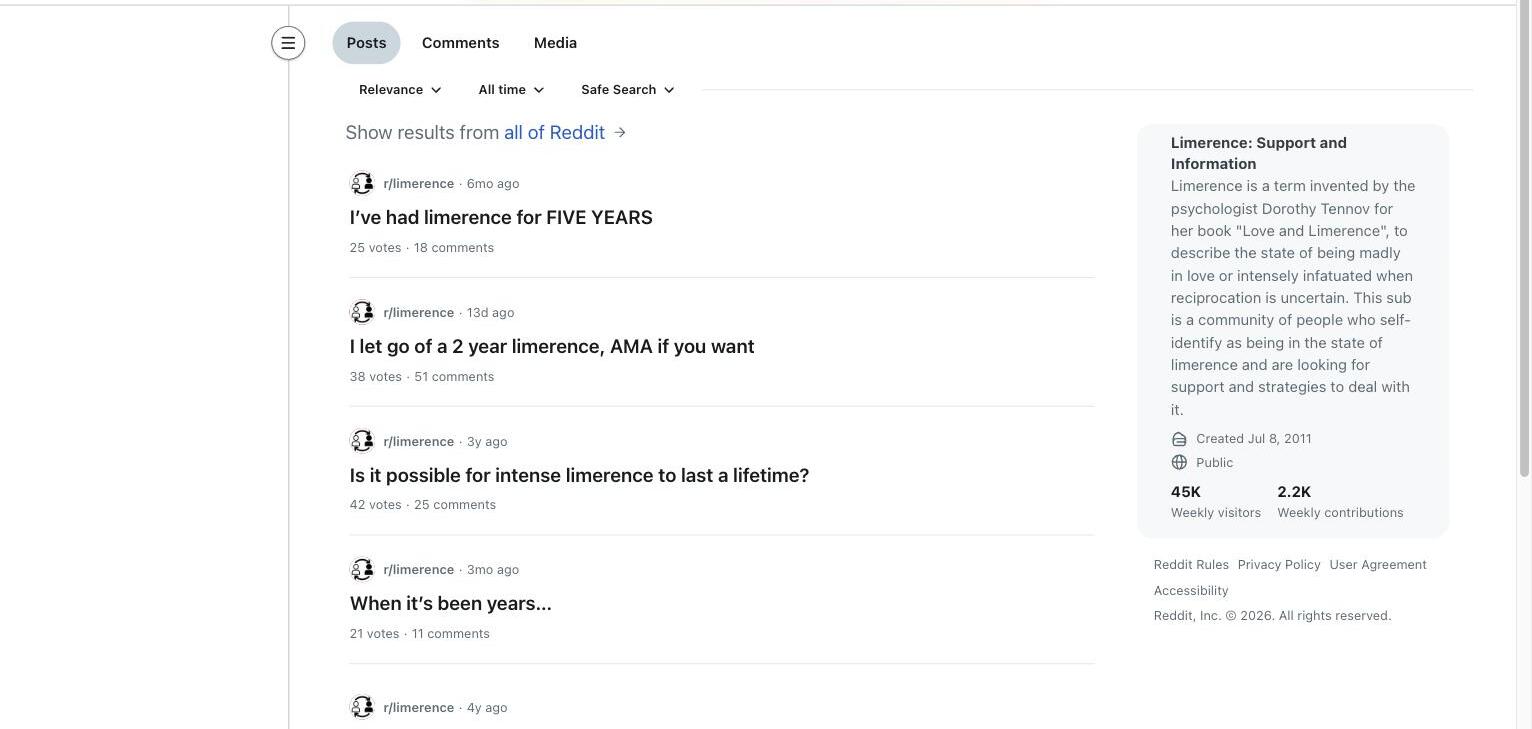
Many people think this feeling ends quickly. The data shows a different story.
- The three year limit is not true. We checked the reports that gave a clear time frame. Thirty nine of those reports lasted longer than three years.
- The math is very clear here. Twenty five people stayed in this state for a long stretch. Fourteen people stayed past that point.
- Twenty five in the 3-to-10-year group plus 14 in the over-10-year group equals 39.
- Online groups share these long stories. A real search on Reddit for limerence for years shows members talking about long cases. A single post got strong support from others.
- Members read and support each other. They know this experience does not always fade fast. People often wonder why it takes so long to move on.
- Long lasting feelings are common enough. You are not alone if your situation lasts a long time. The web often repeats simple rules that do not match reality.
- One member wrote down their truth. "I've had a long term limerence for an ex that has lasted nearly 20 years." Others saw this post and felt less isolated.
- Simple rules rarely fit human hearts. Feelings change at their own pace. Some days feel hard and some days feel lighter.
- Tracking your own path helps you. Writing down your thoughts keeps things clear. You can see small steps forward over time.
- Reading real stories builds trust. These notes come from real people online. They show that time looks different for everyone.
- You get to define your own journey. There is no fixed clock for healing. Your path will look unique to you.
- Community voices matter greatly. Real people share their daily struggles. They offer hope when things feel stuck.
- Time passes even when we wait. Daily routines slowly shift your focus. Small wins build steady progress.
How long does limerence last? 25 accounts give a vague span, and 3 say as long as they can remember.
Many writers skip exact dates.
- 25 people share a rough guess. They avoid picking a hard month or year.
- Their notes use soft words to mark the time. Some say it takes a few years.
- Others call it a long time. The data shows these answers are common.
- 3 writers remember a longer stretch. Those 3 notes go beyond a simple guess.
- They state the feeling lasts as long as they can remember. This shows some minds hold onto the state for a very long period.
- The records show no clear end for them. Time moves slowly for these specific accounts.
- Vague words still carry real weight. These accounts drop precise math entirely.
- They focus on the heavy pull of time. Readers see that uncertainty shapes the whole journey.
- The missing number does not make the struggle small. It just means the mind tracks days differently.
- People who write these notes often feel trapped in old memories. They watch seasons pass without seeing a finish line.
- The mix of answers shows how varied human memory can be. Some see a path opening soon.
- Others see no path at all. The spread covers many different life stages.
- We only have the plain words these writers chose. They avoided sharp dates and firm counts.
- Their choices point to a slow fade rather than a quick break. The pattern stays strong across many different stories.
- The 25 entries form a clear group. They stand apart from the ones with hard numbers.
- Together they paint a wider map of recovery. Time moves at its own pace for many.
- Readers looking for exact dates will find none here. The notes focus on feelings instead of calendars.
- This approach highlights the emotional side of healing. Minds work in their own quiet ways.
- The lack of a firm number is normal. Human experiences rarely fit into neat boxes.
- These accounts remind us that patience matters. Recovery follows its own hidden rhythm.
- We respect the simple words these writers used. They told us what they actually felt.
- No extra details were added to these notes. The records stay true to the original voices.
- The vague spans cover a wide range of time. Some feel short while others feel endless.
- Both views belong to the same large group. They share the same starting point.
- Understanding this helps readers feel less alone. Many walk this same uncertain road.
My personal take: what do I make of these accounts?
I read many stories from people who shared their times.
Only 96 of 408 gave a clear number.
The middle time was 24 months.
That is two years for those who answered.
A big group of 312 never said how long it took.
They did not share the time.
Nobody can promise you a date. 312 of 408 never say how long theirs lasted.
You will not find a fixed end date in these stories.
- The group speaks clearly. 312 out of 408 people did not write down a time frame. They simply shared their feelings without a clock.
- Time feels deeply personal. Your path may look different from the list. Many readers feel lost when they search for a match.
- You are truly not alone. The missing dates show a wide range of life stories. We looked at every post on our site.
- The silence about time is loud.
- No expert holds a planner. Limerence Lab shares what people tell us. We do not set rules for healing.
- Every mind moves at its own pace.
- Search results often fail. Readers expect a clear answer. They want a month or a year marked on a chart.
- Our search found none of those dates.
- Silence does not mean failure. Not writing a number is normal. It just means the feeling stays until it fades.
- Life gets busy while you wait.
- Your timeline is completely valid. Seeing your story here is rare. That makes you part of the big group.
- You belong with the 312.
- Dates are hard to guess. Feelings change day by day. Some days feel heavy.
- Other days bring light. A single number cannot hold this shift.
- We track real voices. These come from a public forum. People wrote freely about their lives.
- None of them gave a firm stop date.
- Patience matters more than plans. Waiting is part of the journey. You do not need an end date to move forward.
- Small steps work best.
- The data shows clear gaps. 408 accounts give a full picture. The empty slots tell us truth.
- Nature does not follow strict schedules.
- You can trust your own pace. Reading these notes helps you breathe. You do not have to rush.
- Healing happens in its own quiet way.
- Many feel stuck in doubt. They check the clock too often. This data offers a gentle reset.
- The lack of dates is a gift.
- Focus on today instead. Tomorrow brings new thoughts. Yesterday leaves old ways behind.
- Living now reduces the stress of waiting.
- Our records stay open. New stories arrive every week. The pattern remains steady.
- Most writers leave the end blank.
- You carry your own strength. The numbers do not define you. They just show a shared moment.
- Your life continues beyond this phase.
- Simple truths guide us well. Time heals without a schedule. Trust the process slowly.
- You will find your way through.
You can take a free quiz to learn about your limerence. This tool is for learning only and is not a diagnosis.
What’s your Limerence Score?
A private, 2-minute check-in.
Questions this page answers
How long does limerence usually last?
The middle point is 24 months. That equals 2 years.
How are the time spans divided among those who reported them?
22 fall below 2 years. 16 fall above 2 years.
Can limerence last for years?
Yes. Many people share times extending past 2 years.
Can limerence last more than 10 years?
Yes. 14 accounts share times longer than 2 years.
Does limerence always end within 3 years?
No. 25 plus 14 equals 39. These groups share times of 3 years or more.
Does limerence ever go on for as long as someone can remember?
Some people do not give a clear end date. Our search shows 312 accounts lack a specific length.
Why can't most people say how long their limerence lasted?
Most people did not record a time frame. 312 out of 408 accounts leave this blank.
Does limerence get shorter or longer with more experience of it?
Our search does not track past experience levels. The data only shows the current time spans.
How many people shared a clear time frame in our search?
96 people gave a specific length. The rest did not share a number.
Further reading
- What Kind of Trauma Causes Limerence? 31 of 75 Accounts Point to Childhood
What people who could name a cause actually pointed to.
- Why Does Limerence Hijack the Brain?
69 of 408 accounts describe it in brain, dopamine, or chemical terms.
- How to Rebuild Yourself After Limerence
Only 4 of 239 accounts said a self-reinvestment action actually helped.
- Can Limerence Be Cured? (0 Clinical Trials Exist).
See what people credited most when they got out of limerence.
This page is for education only and is not a diagnosis. Hypnotherapy does not replace care from a licensed professional.
Ready to break the loop?
Only 10 new clients a month. Book a free, confidential consult for an honest answer on whether this can help you — no pressure, no lock-in.
Only 2 spots left for August
Not ready to talk? Take the free Limerence Score →
About the Author

Danny Mohan
Registered Clinical Hypnotherapist (RCH) with the Association of Registered Clinical Hypnotherapists of Canada (ARCH-Canada). Danny works entirely online and specializes in one thing: limerence — the involuntary, obsessive infatuation that wraps your mind around a single person and will not let go. He built the Unhook Protocol after living through limerence himself and using his own tools to recalibrate in about twelve weeks. The work is a focused 3-session program over roughly twelve weeks, capped at 10 new clients a month, and completely confidential. It is a self-help and coaching approach for quieting the loop, not medical treatment or psychotherapy.
Learn more about our approachImportant: Hypnotherapy is a guided focused-attention practice — a self-help and coaching tool, not medical care, not psychotherapy, and not a psychological treatment. Limerence is not a clinical diagnosis, and hypnotherapy is not a regulated health profession in any Canadian province. ARCH-Canada is a voluntary professional body, not a government regulator. Nothing on this site is medical advice, diagnosis, or treatment. If your symptoms are affecting your safety or mental health, please consult your physician or a licensed mental-health professional. Hypnotherapy may complement that care but never replaces it.