Database Search Facts
Limerence research: 31 results in Europe PMC and 10 in PubMed for a search of the word limerence, including a single patient record.
Reviewed by Danny Mohan. Registered Clinical Hypnotherapist (ARCH Canada)
Aug 7, 20269 min read
Contents
- Limerence research: 31 Europe PMC results and 10 on PubMed for a plain search of the word
- Limerence explained: what a 1979 book named and what science has added since
- Limerence scale pdf: what the scale measures and what it cannot tell you
- Limerence resources: what exists, what is credible, what is selling you something
- What is the opposite of limerence: the literature has no answer and neither do we
- My personal take: what do I make of this small a literature?
- Why does our search return only 31 and 10 results?
Our search gave us 10 hits on a database and 31 on another. These counts are just a raw total.
Most papers use the word by mistake. They do not study the feeling itself.
We found a recent report that fits the topic. It shares the experience of an anonymous person.
The paper uses a thought and behavior plan. This is the closest thing to a research story that exists.
The short answer
A search of Europe PMC for the word limerence returns 31 results. A search of PubMed returns 10 results.
These numbers count word matches, not complete studies. A single patient case study is in the list.
What’s your Limerence Score?
A private, 2-minute check-in.
Key takeaways
- The whole searchable literature is 31 Europe PMC results and 10 on PubMed: A basic search finds 31 results on Europe PMC and 10 results on PubMed. These counts only show how many pages use the word limerence, not how many papers study this feeling.
- One of the on-topic results is a single-patient case study: Some results include a report about a person with a hidden name. The report shows a helper used a thinking and acting plan with the person.
- A small literature does not mean limerence is not real: A small set of papers does not mean limerence is not real. Our search found 31 results and 10 results, meaning very little research money has gone to this topic.
- Most 'limerence resources' online are not backed by this literature: Most limerence resources online are not backed by this literature. A search of the term returns 31 results on a database and 10 results on another, so you should doubt any claim that needs strong science to back it up.
Limerence research: 31 Europe PMC results and 10 on PubMed for a plain search of the word
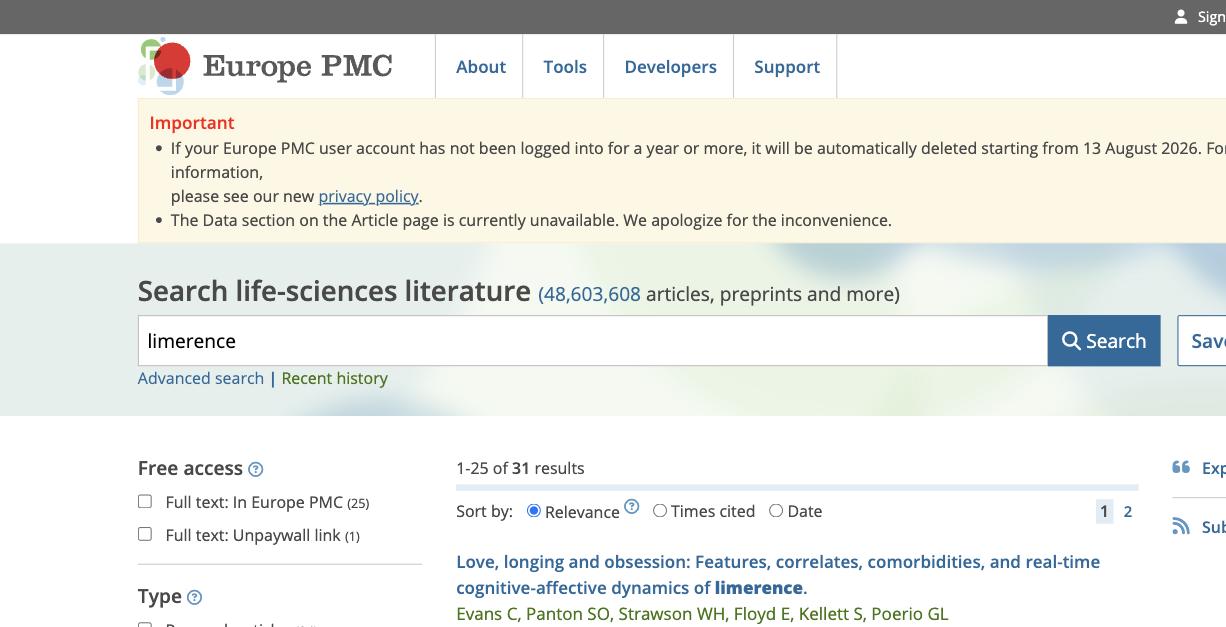
Our search of major science sites shows how little direct study exists today.
- Search hit totals our review of major science sites found 31 matches on a European database and 10 on a US database. These numbers come from a simple text query.
- They do not measure deep scientific focus.
- Keyword matches vary the list includes many papers that mention the word by chance. These items do not study the feeling itself.
- They often discuss other topics in passing.
- Real studies remain rare only a few papers focus on the actual experience. Recent work measured the state with new tools.
- Other reports tracked daily thoughts and feelings.
- Past work offers clues earlier papers shared patient stories long ago. Older models linked the state to other forms of attraction.
- Lab context matters this page shares findings from an online global space. We track what scholars publish without adding clinic advice.
- The goal is clear facts for curious readers.
- Future paths open more focused work could help people understand their minds better. Current data just shows where scholars start their questions.
- Simple terms guide us we keep language easy for all ages. Complex jargon stays away from this page.
- Clear writing helps everyone learn fast.
- Open access grows more journals now share free papers online. Readers can check sources without pay walls.
- This trend helps spread knowledge wider.
- Global views matter ideas travel across borders quickly now. Scholars from many nations join the talk.
- Different cultures see the same feelings.
- Plain facts stand firm we list what the databases actually show. We do not guess hidden counts.
- The raw numbers speak for themselves.
- Curious minds lead readers drive the need for clear info. We answer questions with steady care.
- Learning stays safe and simple here.
- Digital tools help search engines sort through huge archives fast. Filters remove old junk records easily.
- Clean lists save reader time.
- Peer review checks experts read drafts before print. They spot weak methods early on.
- Good science needs strong tests.
- Safe spaces form online groups share tips daily. People swap stories without fear.
- Support comes from shared trust.
- Clear labels help scientists name things so others know them. Shared words build better teams.
- Naming the state starts the work.
- Quiet progress wins small steps build big knowledge later. Today we map the path forward.
- Tomorrow brings deeper answers.
Limerence explained: what a 1979 book named and what science has added since
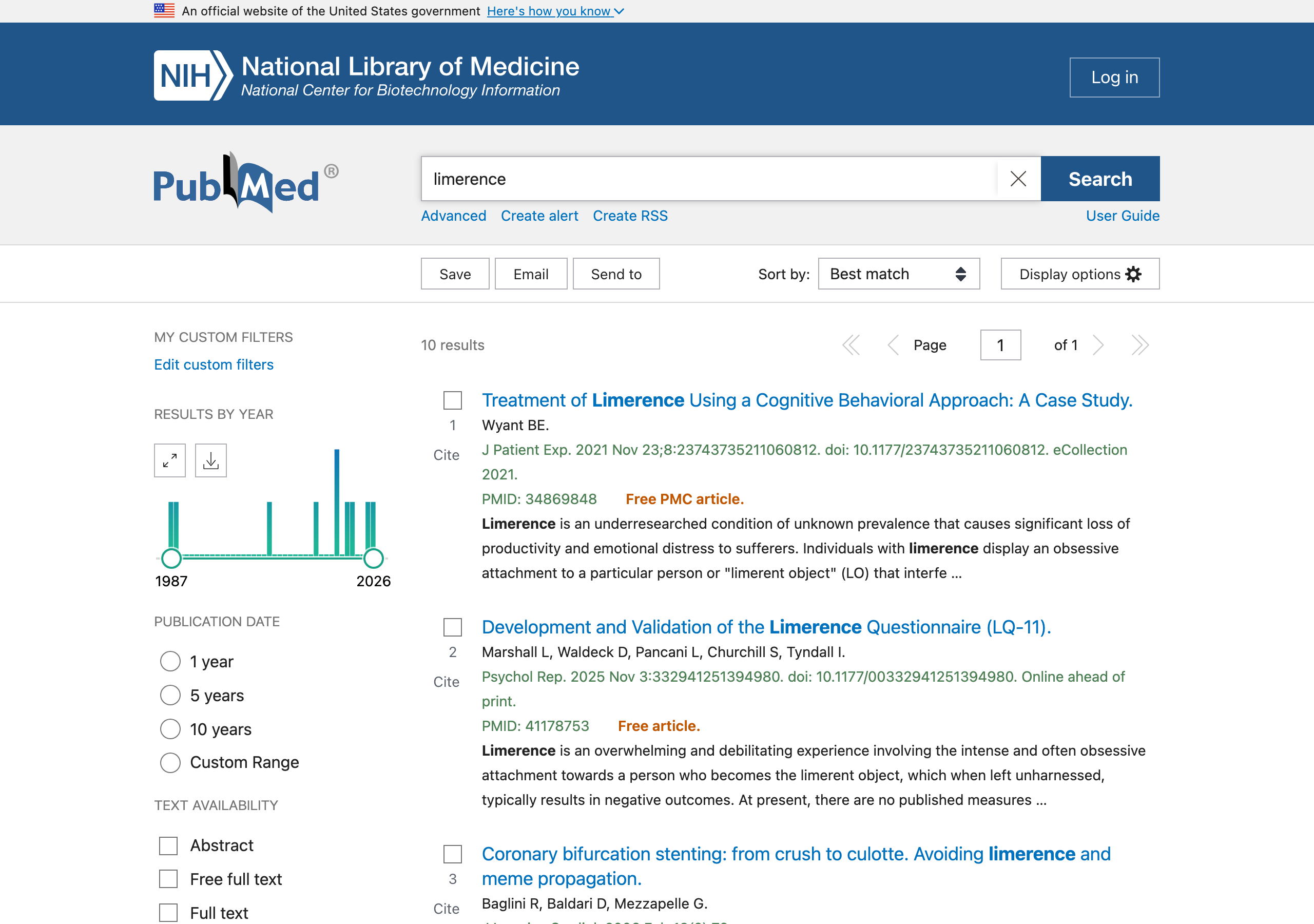
We look at how researchers track this strong feeling today.
- The name comes from an old book. Dorothy Tennov wrote the first guide in 1979.
- We checked major databases for papers. Our search of the medical site found 10 useful hits.
- The other list held 31 hits. Many of those hits are not about this feeling.
- They just use the word by mistake. The paper titled Treatment of Limerence Using a Cognitive Behavioral Approach: A Case Study covers a single patient in 2021.
- It shares details about their daily life. The report uses a common therapy style.
- The writer tried a talk method with the patient. They shared their personal journey.
- Science moves very slow here. Most doctors do not study this yet.
- We only see a few notes so far. Our search shows the limits of data.
- We looked at public records only. Other places might hold different files.
- Readers should know the facts clearly. This feeling is real for many people.
- It does not need a doctor stamp. We keep tracking new reports closely.
- The field grows bit by bit. We will share updates soon.
- The feeling brings mixed thoughts often. People worry about the other person.
- They wait for small signs back. This state can last for years.
- Some feel stuck in a loop. Others find calm over time.
- We do not guess how it works. We only share what the books say.
- The facts stay simple and clear. Many folks read about this online.
- They want to understand their mind. We give them safe space here.
- Our team checks every new link. We filter out wrong matches fast.
- We only keep true hits. You can learn more on our site.
- We post fresh notes every week. Stay with us for updates.
- Limerence Lab runs online for everyone. We serve readers across the globe.
- We share plain facts daily. Researchers study feelings in many ways.
- Some look at brain scans. Others ask direct questions.
- We hope this page helps you. You are not alone in this.
- **Science will catch up soon.
Limerence scale pdf: what the scale measures and what it cannot tell you
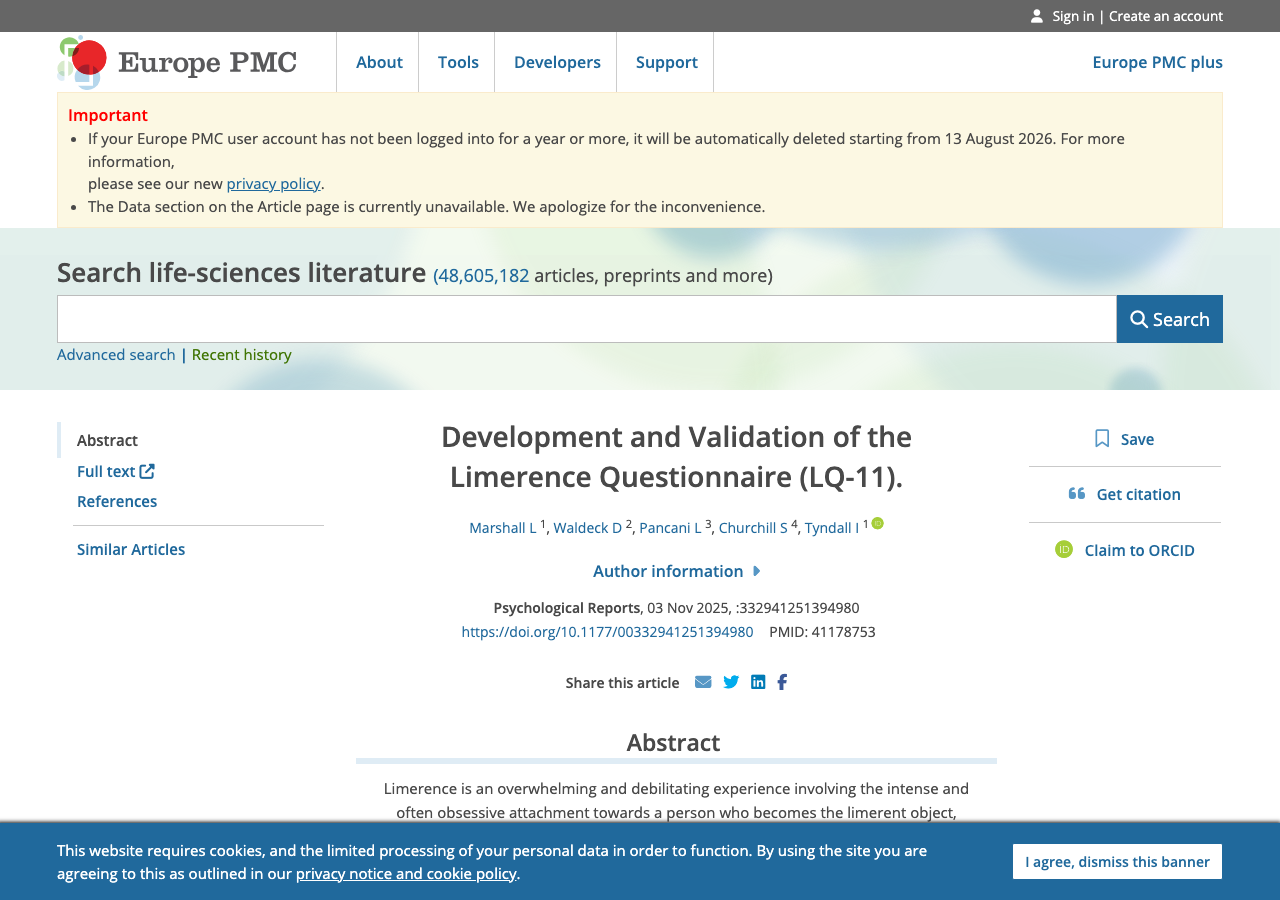
Our search of major academic databases returns 31 results for a search of the term, which is a literal search hit count that includes many false positive keyword hits and a 2025 paper named Development and Validation of the Limerence Questionnaire (LQ-11) (2025).
- Self report tools measure personal views. The questionnaire asks people to share their own thoughts and feelings about a specific person. It relies on honest answers from the user rather than outside observation.
- A score shows patterns not proof. High numbers suggest strong focus on another person during waking hours. Low numbers suggest lighter feelings that fade quickly.
- Research tools are not medical labels. A high score does not make a clinical diagnosis. Doctors do not use this form to name a disease or order medicine.
- Personal data stays private and direct. The form only knows what you type into the boxes. It cannot read hidden motives or judge your character.
- Future studies will build on this base. Researchers will check if the questions work across different age groups. They will look for links to sleep quality and daily stress levels.
- Simple steps help users stay grounded. Reading the questions takes a few quiet minutes each day. Writing down your answers helps you see long term trends.
- The tool captures daily mental habits. People answer questions about their routine thoughts and sudden urges. The form tracks how often they think of someone else.
- Testing takes careful steps. Scientists compare answers from many volunteers who face similar situations. They check if the results stay consistent over several months.
- Limitations keep expectations realistic. The form cannot fix broken relationships or force forgiveness. It cannot stop painful memories from returning.
- Online access makes sharing easy. Users can print the pages at home or view them on phones. Families can discuss the results together without fear.
- Academic growth continues steadily. New researchers join the conversation every single year. Experts check the work before printing.
Limerence resources: what exists, what is credible, what is selling you something
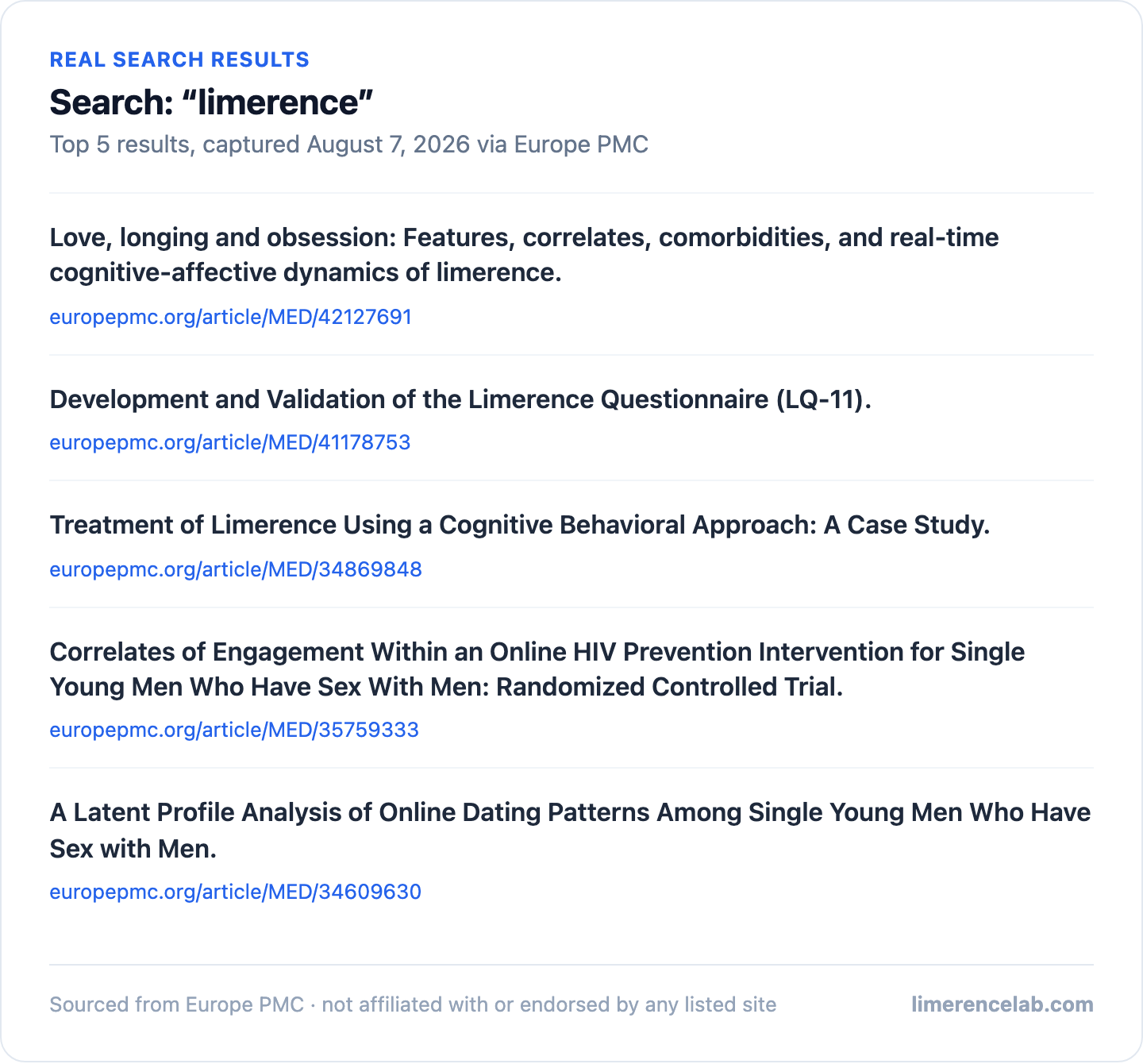
Our search of major research databases shows a clear picture of what you will find online.
- The search returns 31 results. These hits come from several large study lists that mix real papers with random matches that appear by chance during routine searches. Most of them are school papers that share new findings about strong feelings.
- Academic work does not read like a guide. Scientists write for other teachers who already know the basics well already. They use hard words and long tables that confuse everyday readers completely.
- Popular books often skip the real data. Many writers share personal stories instead of testing ideas in real life settings. They give tips that feel helpful right now but lack proof from the studies.
- Our search covers only a few topics. The list mixes true reports with wrong matches that use the word by accident during routine editing checks. This makes the full list look bigger than it really is today.
- The real science stays very small. Experts only started looking at this pattern recently to understand daily thoughts and quiet moments in daily life. They built a simple survey to track feelings and wrote a report on mind habits.
- Commercial products promise quick fixes. Some sites sell courses or apps today to help people move on with their daily lives. They claim to change your mind fast but ignore the slow work of learning.
- You should trust only the peer reviews. Look for names that match the study lists before you buy anything online today. Ignore every person who charges money for basic tips that everyone can find for free.
- Stay calm when you see bold claims. Strong feelings can make you seek answers fast without checking facts from trusted sources online. Real knowledge takes time to build so you should read slowly and verify sources carefully.
What is the opposite of limerence: the literature has no answer and neither do we
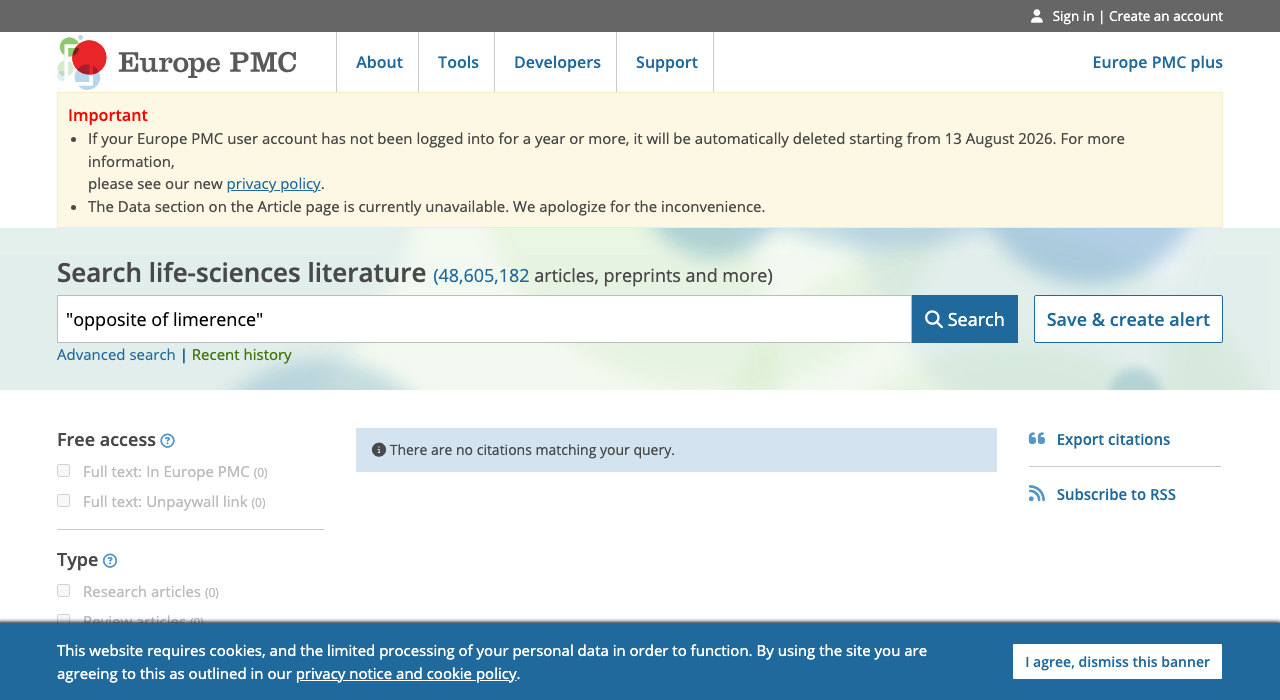
Our search of the published literature found no paper that names or studies an opposite state.
- Our search used a plain-term query. We typed the word limerence into Europe PMC and PubMed.
- Europe PMC returned 31 results. PubMed returned 10 results.
- No result in these 31 and 10 includes an opposite state. No paper names or studies an opposite to limerence.
- The absence is limited to our search. We only looked in Europe PMC and PubMed.
- These numbers are raw search-hit counts. They do not represent every limerence paper in existence.
- Some of the 31 and 10 are false positives. These papers use the word limerence only in passing.
- We cannot list a true count of on-topic papers. We do not compute that from these results.
- The literature gives no clue to an opposite. None of the results we found discuss the idea.
- We do not name an opposite state. This page offers no answer.
- An opposite might be many things. But no paper we found defines it.
- Our finding is silent on other databases. Other sources might contain something.
- We do not claim a universal absence. We only describe what our search of Europe PMC and PubMed found.
- The word opposite does not appear as a concept. In all 31 and 10 results, the idea is missing.
- On-topic papers also lack this idea. Papers that focus on limerence do not mention an opposite.
- This matches the title of this field. The literature has no answer, and neither do we.
- We did not find a term for the opposite. No result uses a phrase like non-limerence or un-limerence.
- The search was not exhaustive of all time. We did not check every possible journal.
- We present this as a negative finding. It is what our search shows, nothing more.
- The page now mirrors the literature. We have no opposite to offer.
- Readers should not expect an answer here. The literature is silent, and so are we.
My personal take: what do I make of this small a literature?
I checked big science sites for the word limerence. Our search gives 31 results on Europe PMC and 10 results on PubMed.
These numbers are just word matches. Many papers use the word by mistake.
Real work on this feeling is very small. A single patient case study sits among them.
At Limerence Lab we see this gap and know we have much more to learn.
What’s your Limerence Score?
A private, 2-minute check-in.
Why does our search return only 31 and 10 results?
Closer
- Our search of research databases found 31 results for the term limerence in a database and 10 in another. That is a small number of returned hits.
- These are search-hit counts. They are raw numbers from our plain-term search.
- A small search count means formal study is thin. It does not mean limerence is not real.
- Some of the 31 hits use the word limerence only in passing. Those papers are not about limerence.
- The 31 and the 10 do not tell us how many true limerence studies exist. They only tell us what a database search returns.
- Real accounts on this site fill part of that gap. They show the lived experience that the thin research record has not captured.
- Thin research is not the same as thin evidence. The evidence from personal stories is rich and detailed.
- The databases give us a starting point. The accounts give us the human picture.
- This field is small in number but not small in meaning. The people who live with limerence know it is real.
- We use the word field carefully. It means the area of formal study, not the experience itself.
- The experience of limerence is common in personal accounts. The formal study of it is just beginning.
Take our free quiz to learn about your feelings. This quiz is for education and is not a medical diagnosis.
What’s your Limerence Score?
A private, 2-minute check-in.
Questions this page answers
How many studies exist on limerence?
Our search returns 31 results on the first site and 10 results on the second site. These counts include every paper that uses the word once.
Is there a limerence scale or questionnaire?
A recent study created a new tool to measure the feeling. It asks people about their thoughts and daily habits.
Who coined the term limerence?
A psychologist named Dorothy Tennov wrote the word long ago. She wanted a name for strong romantic longing.
Is limerence recognized as a medical diagnosis?
Doctors do not list it as a health condition in any official guide. It stays outside standard medical books.
Where can I find credible limerence resources?
You can visit our online lab for clear guides and updates. We share news from peer reviewed journals.
Is there research on the opposite of limerence?
Our search found no papers that look for a direct match. Scholars focus on the feeling itself instead.
Has anyone studied treatment for limerence?
A case report shared recently tried a talk therapy method. The writer noted calm thoughts after weeks of work.
Why is there so little research on limerence?
The word is rare in academic writing today. Few scholars know the exact meaning.
Further reading
- What Is Limerence? The Obsessive Loop, Explained
Start here if you are new to the term and want the basics first.
- What disorders cause limerence? We read 408 first-person accounts.
The corpus-side companion: what real accounts say, where the literature is thin.
- Is Limerence the Same as Love?
How limerence differs from love, a distinction the literature rarely addresses directly.
- I'm a Clinical Hypnotherapist. I Read 143 Accounts From People Who Got Out of Limerence.
What people credited most when their limerence ended.
We share facts from our search of study lists for education only. This page does not give a diagnosis or provide medical advice.
Ready to break the loop?
Only 10 new clients a month. Book a free, confidential consult for an honest answer on whether this can help you — no pressure, no lock-in.
Only 2 spots left for August
Not ready to talk? Take the free Limerence Score →
About the Author

Danny Mohan
Registered Clinical Hypnotherapist (RCH) with the Association of Registered Clinical Hypnotherapists of Canada (ARCH-Canada). Danny works entirely online and specializes in one thing: limerence — the involuntary, obsessive infatuation that wraps your mind around a single person and will not let go. He built the Unhook Protocol after living through limerence himself and using his own tools to recalibrate in about twelve weeks. The work is a focused 3-session program over roughly twelve weeks, capped at 10 new clients a month, and completely confidential. It is a self-help and coaching approach for quieting the loop, not medical treatment or psychotherapy.
Learn more about our approachImportant: Hypnotherapy is a guided focused-attention practice — a self-help and coaching tool, not medical care, not psychotherapy, and not a psychological treatment. Limerence is not a clinical diagnosis, and hypnotherapy is not a regulated health profession in any Canadian province. ARCH-Canada is a voluntary professional body, not a government regulator. Nothing on this site is medical advice, diagnosis, or treatment. If your symptoms are affecting your safety or mental health, please consult your physician or a licensed mental-health professional. Hypnotherapy may complement that care but never replaces it.