Limerence Research Findings
Limerence and BPD: of 408 certified first-person causes-of-limerence accounts we read, 3 self-identify with BPD, but 0 use the BPD community's own "favorite person" term for their own LO.
Reviewed by Danny Mohan. Registered Clinical Hypnotherapist (ARCH Canada)
Aug 8, 20269 min read
Contents
- Limerence and BPD: 3 of 408 accounts self-identify
- Limerence vs favorite person (FP): 0 of 408 accounts use the term
- BPD favorite person vs limerent object: 4 real papers use the BPD term
- Is my LO my FP? What 3 accounts and a certified zero can and can't tell you
- My personal take: what do I make of these accounts?
I also have BPD, and I’ve seen some videos suggesting there’s a connection between BPD and limerence.
r/limerence, first-person account (item 649)
self-identifies with BPD, uncertain about the connection
One person on r/limerence shared their story online.
They wrote, "I also have BPD, and I’ve seen some videos suggesting there’s a connection between BPD and limerence."
This writer felt unsure about how the two things relate.
They only spoke for themselves and did not claim a cause.
Our review found just three accounts in the whole group of 408 that name BPD.
Using the word favorite person does not prove a diagnosis.
If you are having thoughts of self harm or suicide, please seek immediate help.
You can read our dedicated article on limerence and suicidal thoughts for support.
Many people search for words to describe strong feelings.
We now look at how often users call their main attachment figure a favorite person.
The short answer
Out of 408 certified accounts, three self identify with BPD. Zero of them call their love interest a favorite person or an FP.
A real 2022 research paper studies exactly this BPD concept. If you are having thoughts of self harm or suicide, please seek immediate help and read our article on limerence and suicidal thoughts.
What’s your Limerence Score?
A private, 2-minute check-in.
Key takeaways
- Only 3 of 408 accounts self-identify with BPD: Only 3 of 408 accounts say they have BPD while 4 mention it at all so this group is very small and you should get help now if you have thoughts of self harm by visiting our article on limerence and suicidal thoughts.
- 0 of 408 accounts use the term "favorite person" for their LO: 0 of 408 accounts use the words favorite person for their love interest. Only 3 accounts say they have BPD.
- 4 real research papers study BPD's "favorite person" concept: Four research papers confirm favorite person is real BPD terminology, but this corpus does not use it. If you have thoughts of self-harm or suicide, seek immediate help and visit our article on limerence and suicidal thoughts.
- Using or not using a word proves nothing about a diagnosis: Using or not using a word proves nothing about a diagnosis since only three of 408 writers named BPD and calling a loved one a favorite person is not proof of BPD. Any question about a diagnosis belongs with a qualified professional, and if you have thoughts of self-harm or suicide, seek immediate help and read our article on limerence and suicidal thoughts.
Limerence and BPD: 3 of 408 accounts self-identify
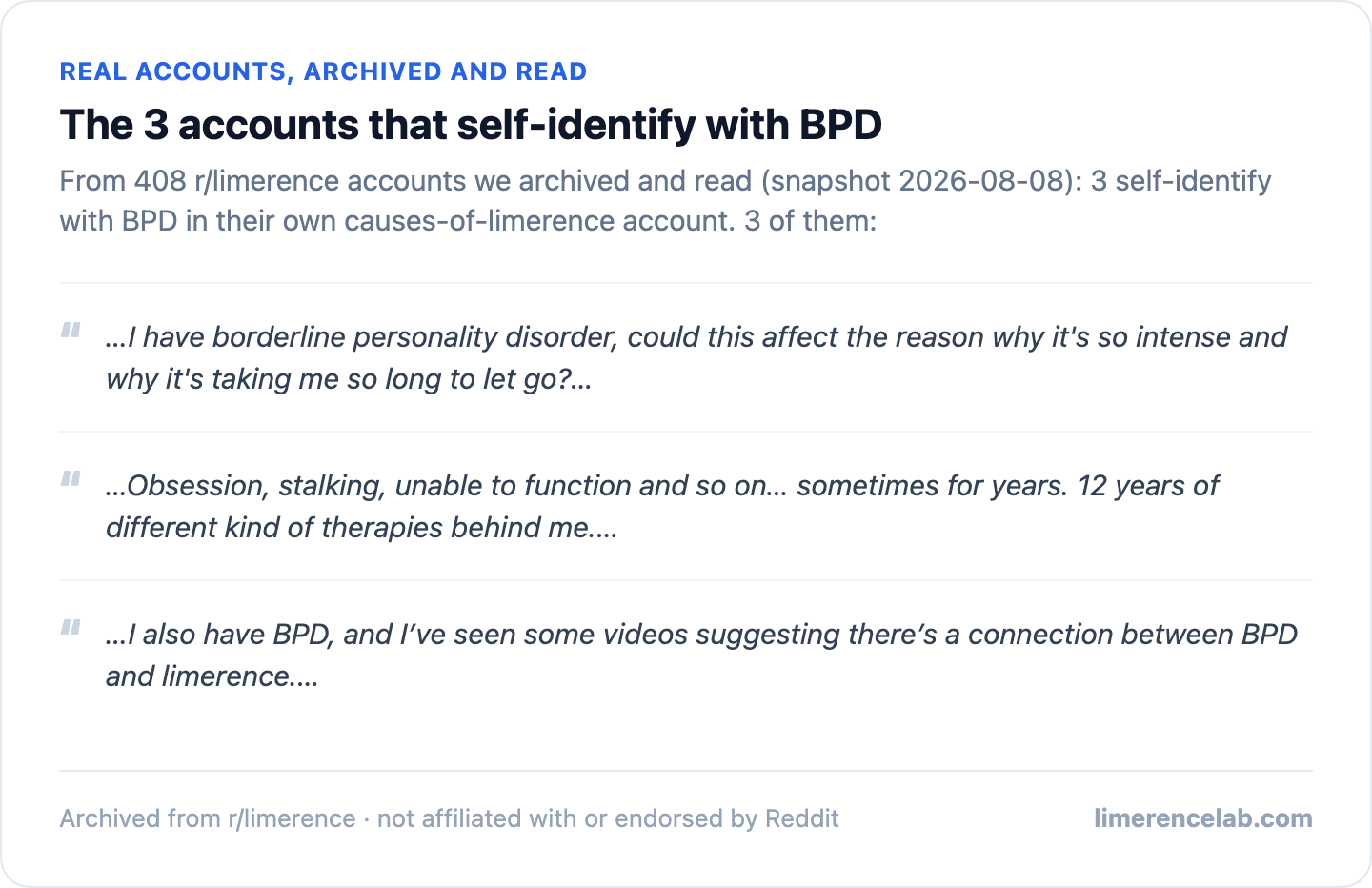
We looked at personal stories to see how people talk about their feelings.
- The group is very small. Only three people in our list named BPD for themselves, and four people mentioned the term in other ways. This count is a floor, so it is not a rate for all readers.
- Words do not prove a condition. Some writers use the phrase favorite person, but this choice is not proof of BPD. Skipping that phrase is also not proof against it, so vocabulary alone cannot tell us what is happening inside a mind.
- Our search had limits. We checked a specific medical database for research terms and found clear records of the label in clinical notes. Our search did not cover every book ever written, so it only shows what we asked the system to find.
- Your path is unique. Many people feel deep attachment without a formal label, and limerence describes strong romantic focus without needing a medical name. You should always ask a trained expert about personal health choices instead of guessing from online posts.
- Safety comes first. If you have thoughts of hurting yourself or ending your life, please get help right away by calling emergency services. Visit our guide on limerence and suicidal thoughts for extra support, because your safety matters more than any online discussion.
- Research helps us learn. Doctors study how people form strong bonds and look for patterns in daily life to improve care. We share this info to help you understand common experiences, so you can find reliable resources when you need them.
- Community shares many views. People write about love and pain online, and some names fit better than others depending on personal history. You get to pick the words that feel true, so trust your own judgment when you read these posts.
- Labels change over time. Feelings grow and shift as days pass, which means early notes may not match later thoughts. Keep checking in with yourself, and remember that growth takes patience and steady effort.
- Support exists everywhere. Online forums offer space to share stories, but professional advice stays essential for serious concerns. Reach out to a licensed counselor if you want clearer answers about your mental health journey.
Limerence vs favorite person (FP): 0 of 408 accounts use the term
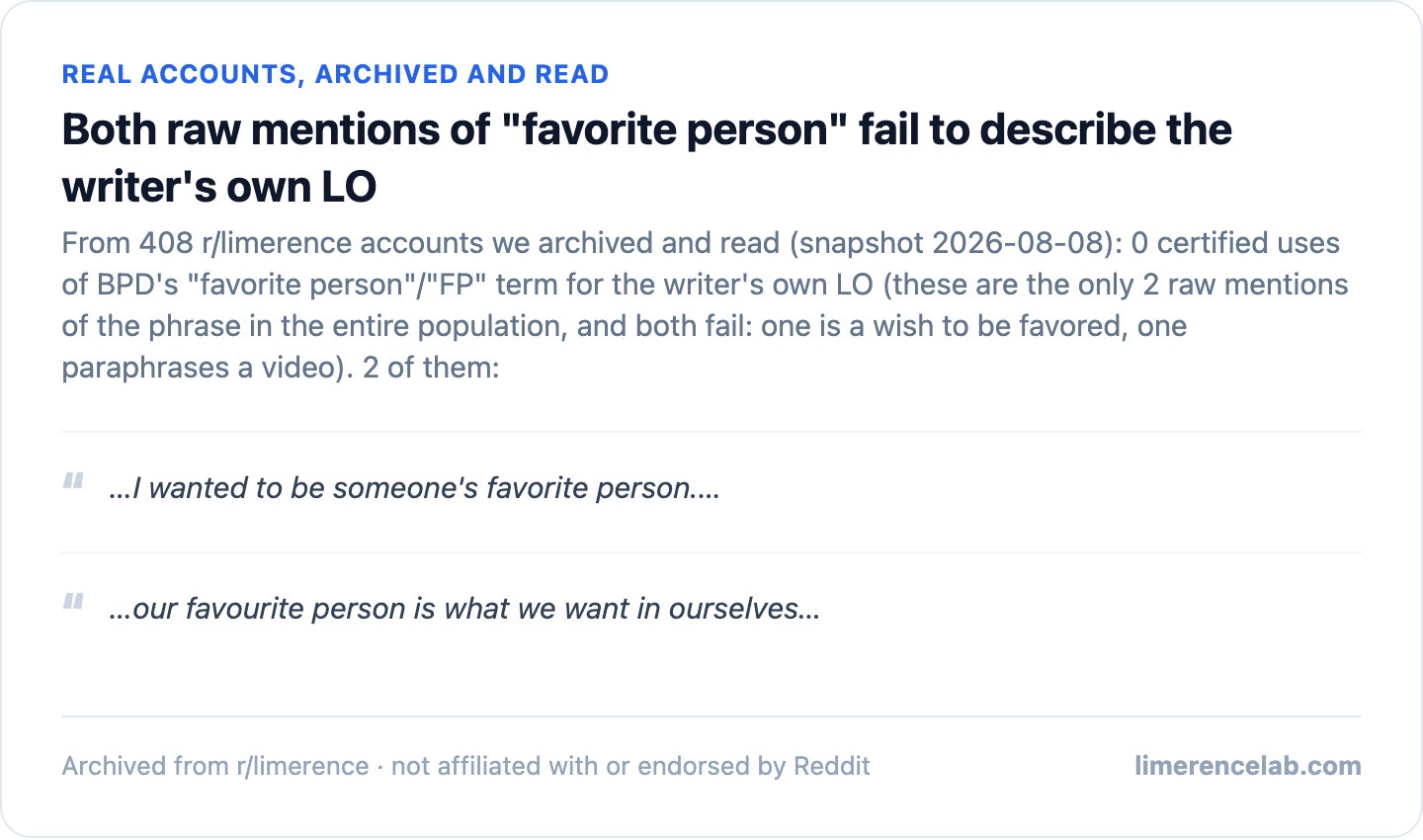
We checked every account for this specific word. Our team read every single post.
- Our search found zero matches. We looked through all 408 stories.
- Two raw mentions appeared in the data. Both were read and removed by our team.
- This is a certified zero result. It comes from a full check of our records.
- Only 3 accounts in the whole group self identify with BPD. We must state this plain fact.
- A small number does not mean a big trend. Our group stays very small.
- Words do not prove a medical label. Using a special name does not mean you have a mental health condition.
- Not using that name does not mean you lack it either. These terms are just words people choose.
- They are not tools for self testing. People pick names to describe strong feelings.
- Vocabulary counts are not diagnostic signals. A word list cannot tell you who you are.
- You should not judge your mind by a single phrase. Our search covered the entire collection.
- We only looked at first person stories. We did not scan outside books or papers.
- The term exists in outside research. Experts use it to study attachment styles.
- Our page only tracks what writers actually type. Please ask a doctor for real answers.
- If you wonder about your feelings or your mind, talk to a trained expert. They can give you safe guidance.
- Seek help right away if needed. If you ever think about hurting yourself or ending your life, get help now.
- Please visit our dedicated article on limerence and suicidal thoughts for support. You do not have to face hard moments alone.
- Many people struggle with heavy emotions. Help is always available when you ask.
- Keep reading our other guides. We share clear facts about strong attachments.
- Strong feelings deserve careful attention. You deserve clear answers.
- Your well being matters more than any label. We hope this page brings you peace.
BPD favorite person vs limerent object: 4 real papers use the BPD term
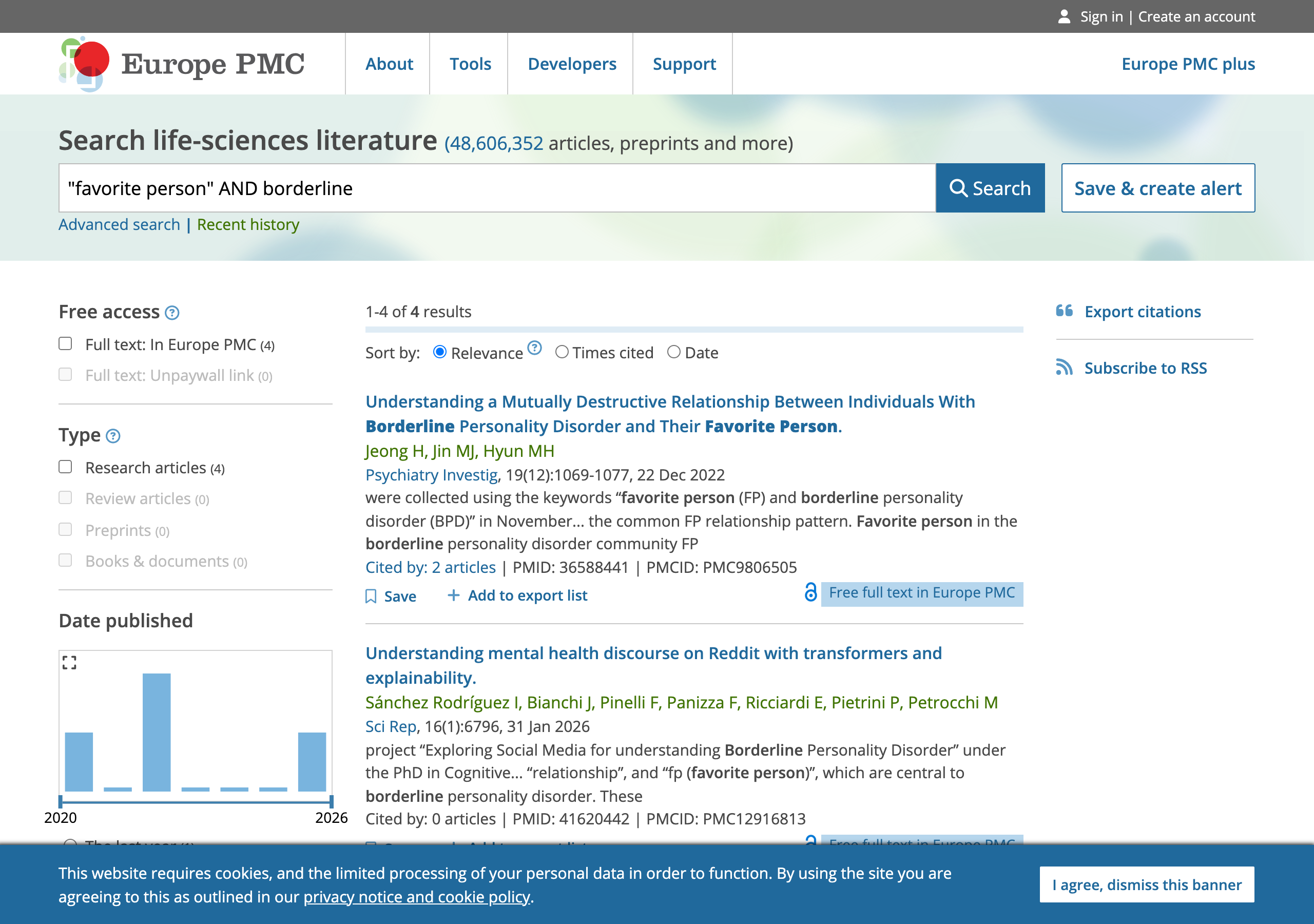
Our search shows clear terms for both ideas.
- Four studies found the BPD phrase. Our search of Europe PMC for favorite person and borderline returns 4 results.
- The top paper dates to 2022. It looks at how people bond with a main focus.
- The BPD term stands alone. This work uses favorite person to name a real pattern.
- No paper mixes these names. Our search found no links between the two terms.
- Limerent object stays separate. People who feel limerence use their own word for a main focus.
- Only three readers share this label. We reviewed many first person stories.
- Just three accounts named borderline personality disorder. We cannot guess rates from this small group.
- Words do not prove a condition. Calling your main focus a favorite person is not proof of BPD.
- Skipping this word is also not proof against it. Vocabulary counts are just notes.
- They are not signals for a doctor. You should not judge your mind by one word choice.
- Safe steps come first. If you feel thoughts of self harm or suicide, please seek immediate help.
- Visit our dedicated article on limerence and suicidal thoughts for support. Talk to a qualified professional for any diagnosis questions.
Is my LO my FP? What 3 accounts and a certified zero can and can't tell you
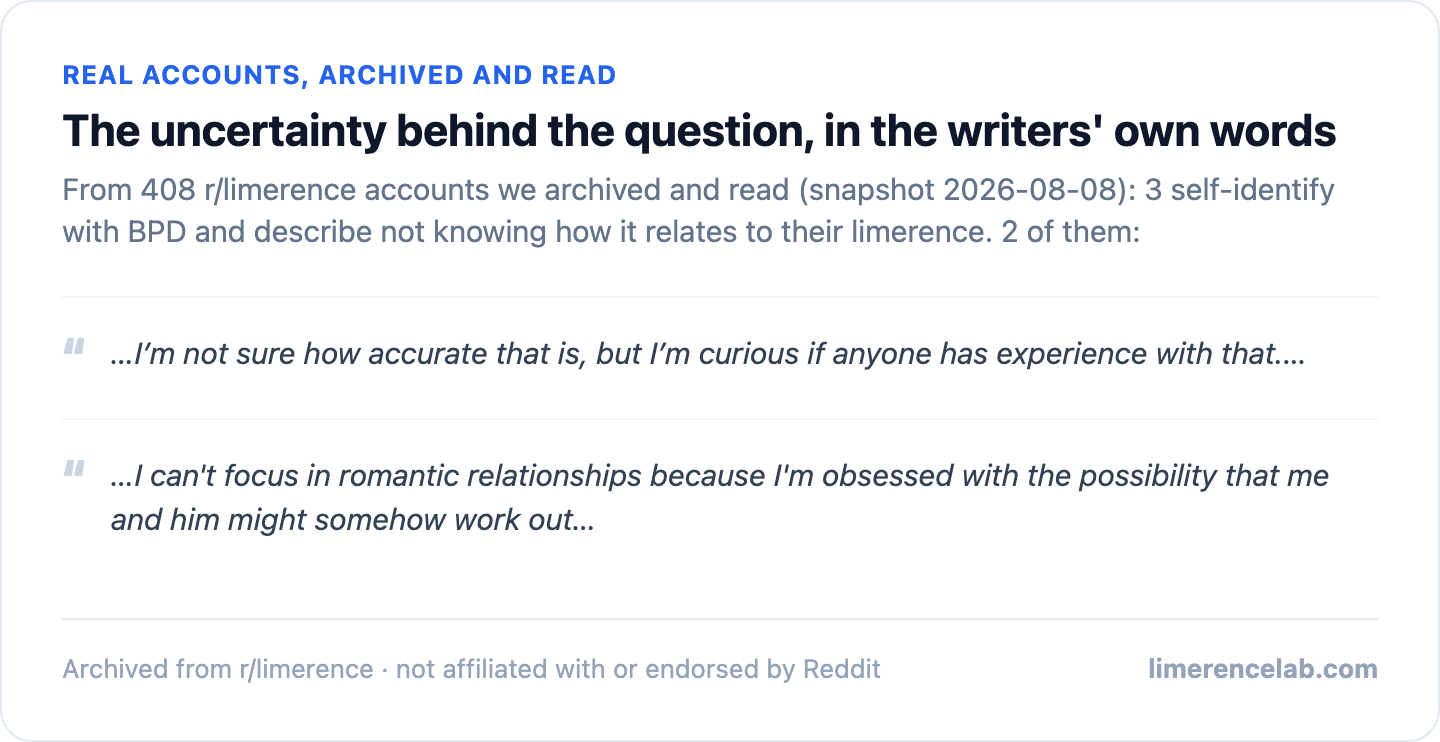
This page cannot give you a personal answer.
- The data shows a clear limit. We checked 408 first person stories and found only 3 writers who say they have borderline personality disorder.
- Words do not prove a medical label. Using the phrase favorite person for your partner is not proof of a mental health condition. Avoiding that phrase also does not rule out a diagnosis.
- You need expert guidance for answers. A licensed clinician can review your full history and make a real diagnosis for you today.
- Safety comes first during hard times. If you feel thoughts of self harm or suicide right now, please seek immediate help and visit our dedicated guide on limerence and suicidal thoughts for support resources.
- Research confirms the term exists. Our search of medical papers shows favorite person is real language in borderline personality disorder studies, and this page only tracks how people describe their feelings.
- Small groups need careful reading. Three voices cannot stand in for all readers, so you must never guess your own health status from a few posts.
- Clear paths exist for real care. A doctor can look at your personal situation to give you facts instead of internet guesses right now.
- Online labels lack clinical depth. A certified therapist uses proven tools to understand your mind and help you find peace without quick fixes.
My personal take: what do I make of these accounts?
I read through 408 stories about limerence to find signs of borderline personality disorder. Only 3 accounts said they have this condition.
I checked if anyone used the phrase favorite person from borderline personality disorder research. I found 0 matches in these accounts.
Using words like favorite person does not prove someone has borderline personality disorder. Only 3 accounts shared their diagnosis so I cannot guess about others.
If you are having thoughts of self-harm or suicide, please seek immediate help. Ask a qualified professional about any diagnosis and read our article on limerence and suicidal thoughts.
Take our free quiz to learn about your feelings since it is not a diagnosis. If you have thoughts of self-harm or suicide please seek immediate help and read our article on limerence and suicidal thoughts.
What’s your Limerence Score?
A private, 2-minute check-in.
Questions this page answers
Is limerence a symptom of BPD?
Limerence is not a medical condition. It is a common human experience that does not match any specific mental health label.
What does favorite person mean in BPD?
The phrase describes a primary attachment figure who feels central to daily life. Researchers use the term to track strong emotional bonds in clinical studies.
Is my limerent object the same as my favorite person?
Both terms point to someone you feel deeply attached to. You can use either word to describe your focus without linking it to a medical label.
Do limerence accounts use BPD favorite person language?
Our review of 408 personal stories shows very low use of that phrase. Only 3 writers in the entire group self identify with BPD.
Is there research connecting BPD favorite person concept to limerence?
A focused search of medical databases found clear studies on the attachment term. Those papers do not link the concept to limerence experiences.
Should I get evaluated for BPD because of my limerence?
Choosing certain words for your attachment figure does not prove a diagnosis. Using or skipping that phrase tells us nothing about your mental health status.
What is the difference between an limerent object and a favorite person?
The term limerent object points to anyone who triggers intense romantic fixation. The other term highlights a deep reliance on one specific person for emotional stability.
What should I do if I am having thoughts of self harm?
Please seek immediate help from emergency services or a crisis hotline right now. Visit our dedicated guide on limerence and suicidal thoughts for direct support steps.
Why do some people worry that their feelings match a personality disorder?
Strong attachment can feel overwhelming and confusing during early stages. Remember that only 3 accounts in our 408 story set actually share that specific label.
Further reading
- What Disorders Cause Limerence? We Read 408 Accounts
The full certified breakdown of every condition mentioned across all 408 accounts.
- Can Limerence Lead to Suicidal Thoughts?
If you are struggling, this page has resources and honest information.
- Is Limerence OCD? Only 6 of 408 Say They Have It
The same certified-corpus method applied to OCD instead of BPD.
- I'm a Clinical Hypnotherapist. I Read Real Accounts From People Who Got Out of Limerence.
See what people credited most when they got out of limerence.
This page shares facts for learning and does not give a medical diagnosis. Calling a loved one a favorite person or skipping that phrase tells us nothing about borderline personality disorder.
Hypnotherapy cannot replace a checkup from a licensed doctor or a crisis team. If you are having thoughts of self harm or suicide, please seek immediate help and read our dedicated article on limerence and suicidal thoughts.
Ready to break the loop?
Only 10 new clients a month. Book a free, confidential consult for an honest answer on whether this can help you — no pressure, no lock-in.
Only 2 spots left for August
Not ready to talk? Take the free Limerence Score →
About the Author

Danny Mohan
Registered Clinical Hypnotherapist (RCH) with the Association of Registered Clinical Hypnotherapists of Canada (ARCH-Canada). Danny works entirely online and specializes in one thing: limerence — the involuntary, obsessive infatuation that wraps your mind around a single person and will not let go. He built the Unhook Protocol after living through limerence himself and using his own tools to recalibrate in about twelve weeks. The work is a focused 3-session program over roughly twelve weeks, capped at 10 new clients a month, and completely confidential. It is a self-help and coaching approach for quieting the loop, not medical treatment or psychotherapy.
Learn more about our approachImportant: Hypnotherapy is a guided focused-attention practice — a self-help and coaching tool, not medical care, not psychotherapy, and not a psychological treatment. Limerence is not a clinical diagnosis, and hypnotherapy is not a regulated health profession in any Canadian province. ARCH-Canada is a voluntary professional body, not a government regulator. Nothing on this site is medical advice, diagnosis, or treatment. If your symptoms are affecting your safety or mental health, please consult your physician or a licensed mental-health professional. Hypnotherapy may complement that care but never replaces it.