Data story
Limerence and affairs: of 86 accounts that describe who the limerent object was, 30 were already committed to someone else.
Reviewed by Danny Mohan. Registered Clinical Hypnotherapist (ARCH Canada)
Aug 7, 20269 min read
Contents
- Limerence affair: what 86 accounts say about who the limerent object was
- Limerence affair: 30 of 86 accounts describe a limerent object who was unavailable
- Limerence affair fog: what accounts describe that the phrase gets wrong
- Limerence affair stages: accounts do not describe stages, they describe a loop
- Limerence affair recovery: what the accounts say about ending contact
- Limerence while married: the specific problem of no-contact when you share a house
- Limerence affair online: 6 of 86 accounts never met their limerent object in person
- My personal take: what do I make of these accounts?
- Were 30 of 408 writers committed to someone else?
I've been limerent over a coworker since December. I'm married and they are engaged.
r/limerence, first-person account
describes a limerent object already committed to someone else
A person on r/limerence described their situation. They said, "I've been limerent over a coworker since December. I'm married and they are engaged."
In their account, the person they wanted was already committed to someone else. Their account is part of our archive of 408 accounts.
We sorted these accounts by who the limerent object was.
The short answer
Out of 408 accounts, 86 describe who the limerent object was. Of those 86, 30 say the limerent object was already committed to someone else.
What’s your Limerence Score?
A private, 2-minute check-in.
Key takeaways
- 86 of 408 accounts name who the LO was: 86 of 408 accounts name who the LO was. The rest describe the feeling without saying who caused it.
- 30 of 86 say the LO was already committed: 30 of 86 say the limerent object was already committed. This is about the limerent object's relationship status, not the writer's.
- 30 of 408 writers were themselves committed: 30 of 408 writers were themselves committed. This fact is about the writer's own relationship status, not the person they wanted.
- Naming a pattern is not a moral judgment: Naming a pattern is not a moral judgment. These are counts of what accounts describe, not advice, and of 408 accounts, 86 describe the LO, with 30 saying the LO was committed and 30 saying the writer was committed.
Limerence affair: what 86 accounts say about who the limerent object was
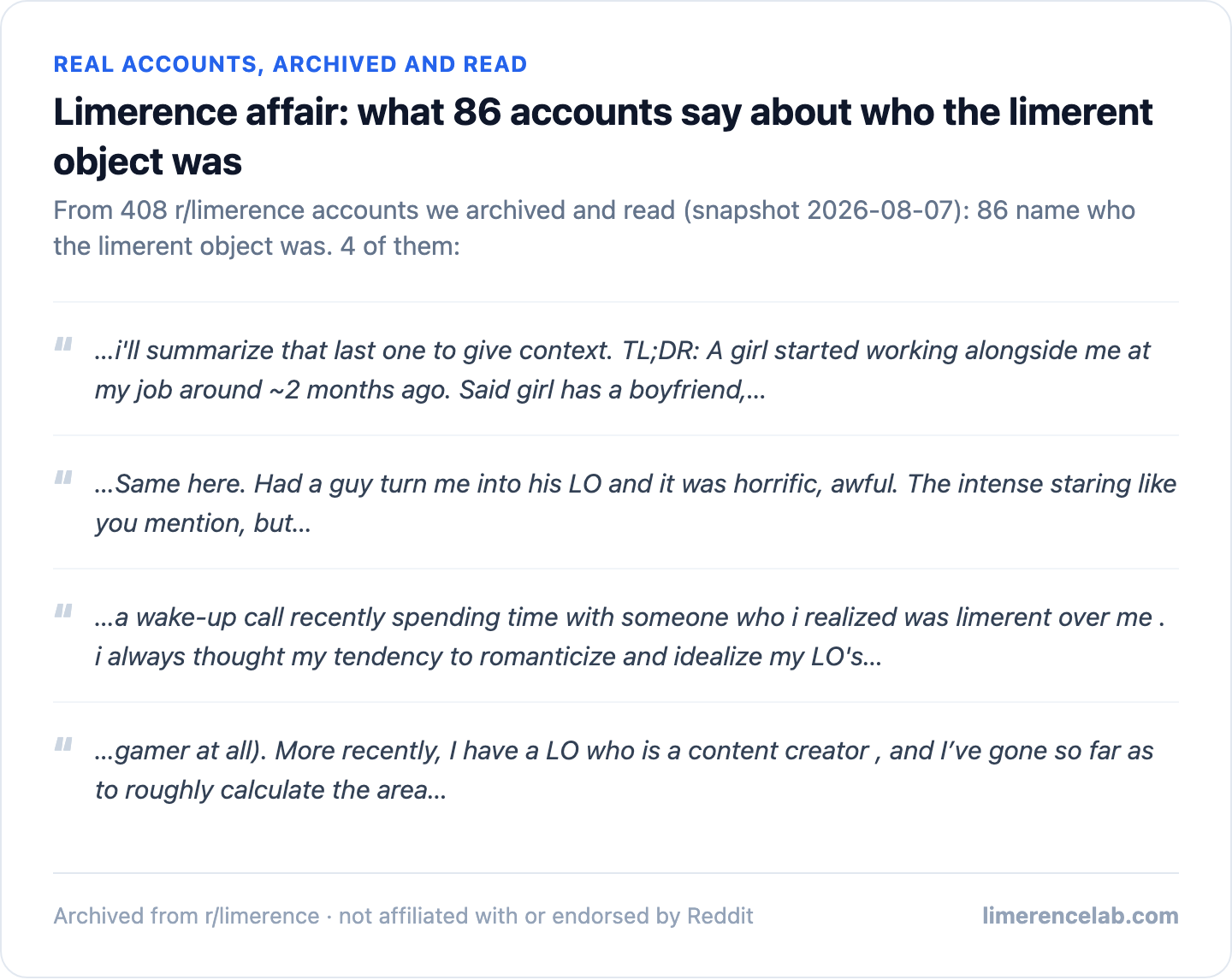
How this read was built
- The source. We collected 408 real first-person accounts from the r/limerence subreddit. These accounts were written by people who felt intense, involuntary infatuation.
- From all 408 accounts, we looked for those that said who the limerent object was. Exactly 86 accounts gave that detail.
- The limerent object. In those 86 accounts, the LO was often a friend, a coworker, a neighbor, or someone from school. Sometimes the LO was a stranger the writer barely knew.
- In some accounts, the LO was already committed to another partner. That means the LO had a spouse or a boyfriend or girlfriend at the time of the account.
- A separate fact. We also noticed that some writers were themselves committed while they felt limerence. That is a different claim.
- It tells us about the writer, not about the LO. We kept these facts separate.
- We never used the same figure for the other claim.
- What we did not do. We did not visit any clinic. We did not use any therapy program.
- We only read what people wrote in their own words. We did not test or diagnose anyone.
- Limerence is not a diagnosis in this read. It is simply the name people use for this kind of obsession.
- Sorting the accounts. We read each of the 86 accounts that named the LO. We put them into simple groups.
- Those groups are based on who the LO was to the writer. For example, friend, coworker, or former partner.
- We did not use any automated tools. A person did the reading.
- Plain reporting. This page reports what the 408 accounts say. The 86 accounts that named the LO give us a clear view.
- We state those facts plainly. We do not add guesses or advice.
- This helps readers see the pattern without confusion.
Limerence affair: 30 of 86 accounts describe a limerent object who was unavailable
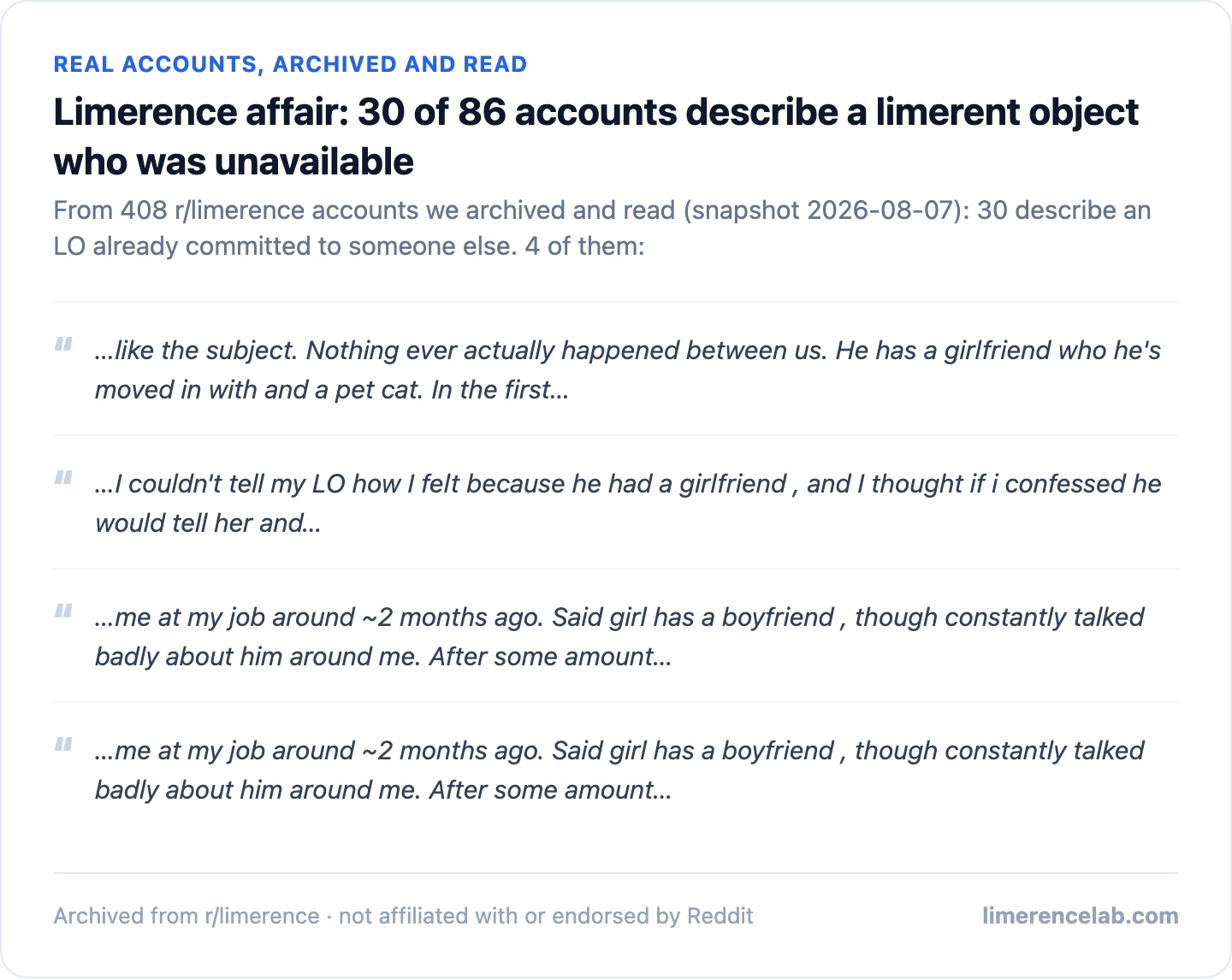
Limerence for a person already taken
- In 30 of 86 accounts, the limerent object had a partner. This means the person they obsessed over was not single, and they were committed to someone else.
- This is a clear pattern. Many people on r/limerence describe feeling drawn to someone who was already in a relationship, and it is a common situation.
- The number is about the other person only. It does not describe the writer's own status, and a writer can be single, married, or dating.
- A different number, also 30, tells about writers. That number counts accounts where the writer was married or partnered, and it is not the same 30 even though it looks identical.
- Do not mix these numbers. The 30 for the other person and the 30 for the writer measure different things.
- A real quote helps show the difference. A r/limerence account said: "I've been limerent over a coworker since December. I'm married and they are engaged."
- The quote tells about the writer and the coworker. The writer says they are married, and the coworker is engaged, so each person is committed.
- For our field, we only use the part about the coworker. The engaged coworker is the limerent object, and that makes this account a part of the 30.
- The part about being married does not count here. It belongs to the other 30, the writer_committed group, which is a separate category.
- Limerence can happen to anyone. It does not ask permission, and it can appear even when the other person is not available.
- These accounts are honest and raw. They do not hide jealousy, longing, or confusion, and they simply tell what happened.
- Our search of r/limerence found 86 detailed stories. In each story, the writer said who the limerent object was, and that gave us the number 86.
- From those 86, we found 30 with a taken object. That is a substantial share, and it shows that unavailable people are often the focus of limerence.
- Nobody should feel guilty for these feelings. Having limerence is not a choice, and it is an involuntary experience like a strong wave of emotion.
- The facts are simple to state. In 30 of 86 real accounts, the person they wanted was already committed.
I've been limerent over a coworker since December. I'm married and they are engaged.
r/limerence account
describes a limerent object already committed to someone else
Limerence affair fog: what accounts describe that the phrase gets wrong
What the phrase gets wrong
Limerence affair fog sounds like a simple crush. Real accounts from r/limerence show a deeper trap.
- The fog is not about the partner. Writers often say they still loved their own partner, but they could not stop thinking about the LO.
- The fog makes the LO feel like the only answer. Accounts describe a constant need for a sign from the LO, and a small reply felt like a huge win.
- The fog gets stronger when the LO is taken. Of 408 accounts, 86 say who the LO was, and many of those writers describe an LO who was already committed to someone else.
- The fog is not a plan. Writers say they did not want to leave anyone, and they did not set out to have an affair.
- The fog brings shame and guilt. Accounts describe feeling out of control, and they judged themselves harshly.
- The fog twists time. Writers say hours passed while they stared at a screen, and they checked for updates again and again.
- The fog is not about the other person's worth. Accounts often say the LO was not even that special, and the obsession had its own logic.
- The fog is not a diagnosis. It is a pattern that people describe, and calling it a fog makes it sound temporary and light.
- The fog does not follow a schedule. Writers say it flared up at random times, and that made daily life harder.
- The fog can hide the real problem. Some accounts say they were avoiding stress or unhappiness, and the LO became a stand-in for something else.
- The fog does not mean the writer is bad. Many accounts use words like shame and guilt, but the writers still say they could not help it.
- The fog has a name but not a fix. People in the accounts share stories, and they do not claim a cure.
Limerence affair stages: accounts do not describe stages, they describe a loop
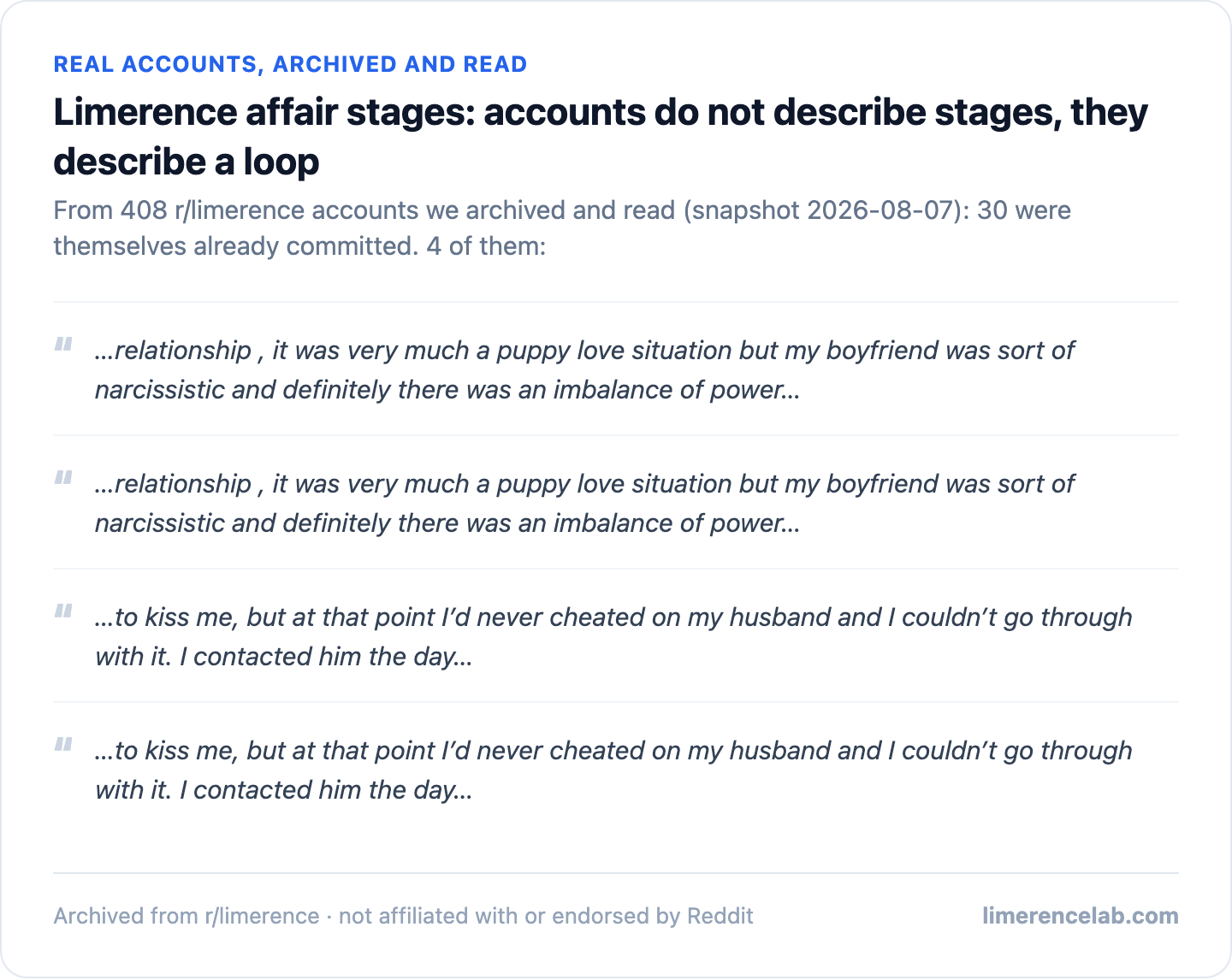
Limerence accounts do not tell a story of stages. They tell a story of who the limerent object is.
- The accounts name the person directly. In 86 accounts that say who the LO was, the person fits into a clear role, such as an authority figure or a friend, and that role never changes over the course of the account, which makes the category feel like a permanent fact.
- Authority figures appear often. In 13 of these 86 accounts, the LO is a teacher, a boss, or a therapist, and the writer often feels powerless next to that person.
- Friends are a smaller category. In 8 of these 86 accounts, the LO is a friend, and the limerence grows inside a bond that already exists.
- No account moves between categories. None of the accounts describe a friend who becomes a boss or a boss who becomes a friend.
- No account gives a step by step path. Writers do not list a starting move, a middle move, or an ending move.
- The pattern repeats like a loop. The same feeling comes back again and again around the same fixed role, and the role never changes.
- This is why affair stages fail. These accounts show a cycle, not a journey, because the LO stays in the same place from beginning to end.
- The only change is in the writer's mind. Feelings may grow stronger or weaker, but the LO remains the same kind of person.
- The category is fixed at the start. In these 86 accounts, the writer knows who the LO is from the very beginning, and no account shows a discovery that the LO is someone else.
- Without stages, there is no map. The accounts offer no path from meeting to obsession, only a fixed picture of who the LO is.
Limerence affair recovery: what the accounts say about ending contact
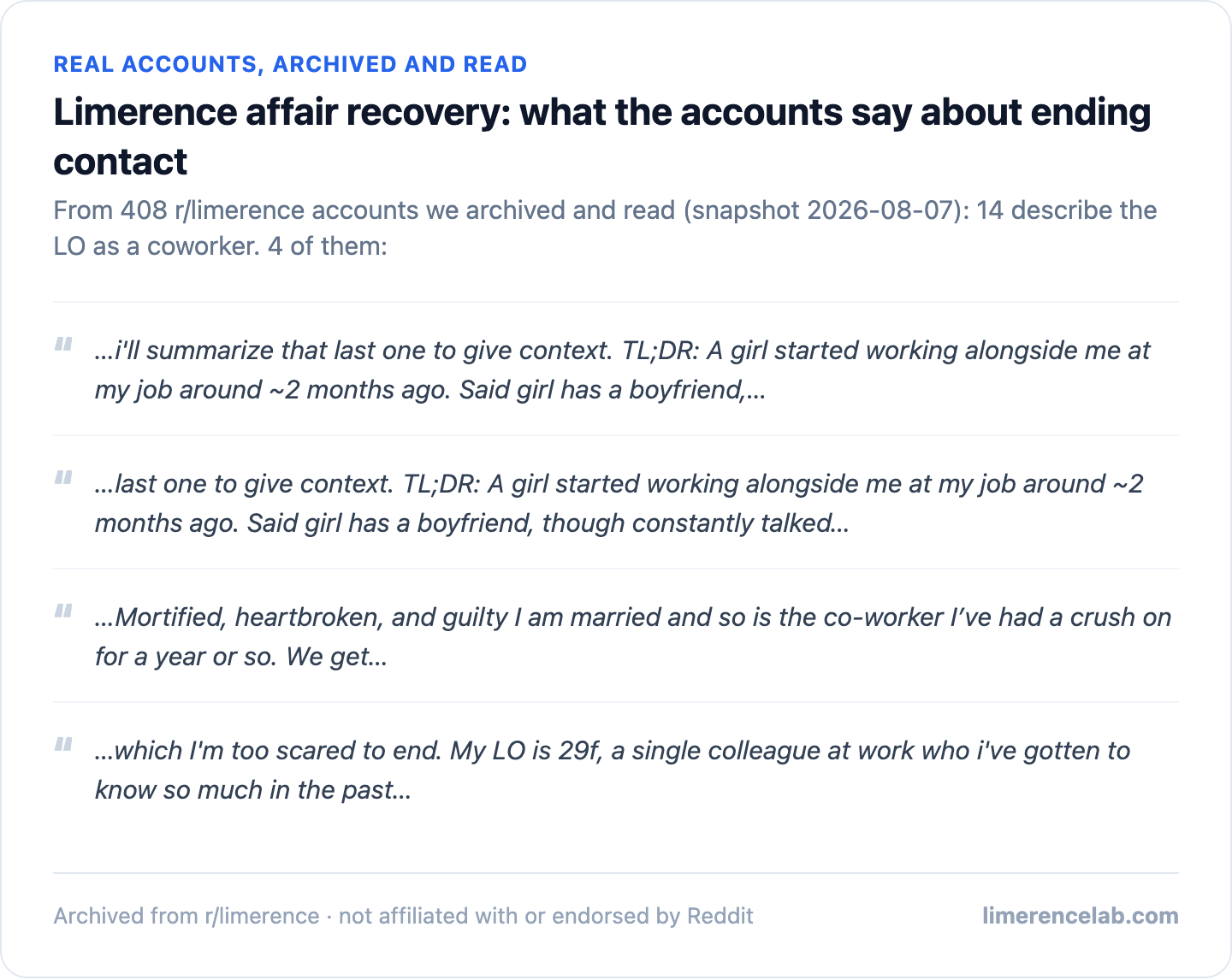
Limerence can happen while a person is already in a relationship. Thirty of the 408 writers on r/limerence said they were married or partnered while they had limerence.
- The number 30 is about the writer. It is not about whether the LO was committed.
- A separate 30 for the LO is a different claim. It is not about the writer.
- Ending contact was reported as very hard. Writers described feeling a strong pull toward the LO that was hard to ignore.
- Some writers cut off all contact. They said it helped them focus on their own partner.
- Other writers could not end contact. They felt stuck and returned to the LO again.
- No writer said recovery was easy. The process often took a long time.
- Some writers wrote about guilt. They felt guilty toward their partner because of their limerence.
- The accounts do not advise lying to a partner. Instead, writers told honest stories about their struggle.
- No writer in the accounts claimed a cure. They wrote about managing feelings, not fixing them.
- Some writers stayed with their partner. Others left their relationship.
- Some writers said ending contact was the only way. They believed they could not recover while still in touch.
- Writers described having to block the LO. They also removed reminders from their lives.
- The accounts show no single path. Each person had a different experience.
- This page reports what writers said. It does not tell you what to do.
- Limerence is a name for a feeling. The writers used it to describe painful obsession.
- Many writers said they thought about the LO all the time. This made it hard to focus on their own relationship.
- Some writers described feeling addicted to the LO. They likened it to a habit they could not break.
- A few writers said they told their partner about the limerence. Others kept it secret.
- The accounts are from real people. They are not advice from experts.
Limerence while married: the specific problem of no-contact when you share a house
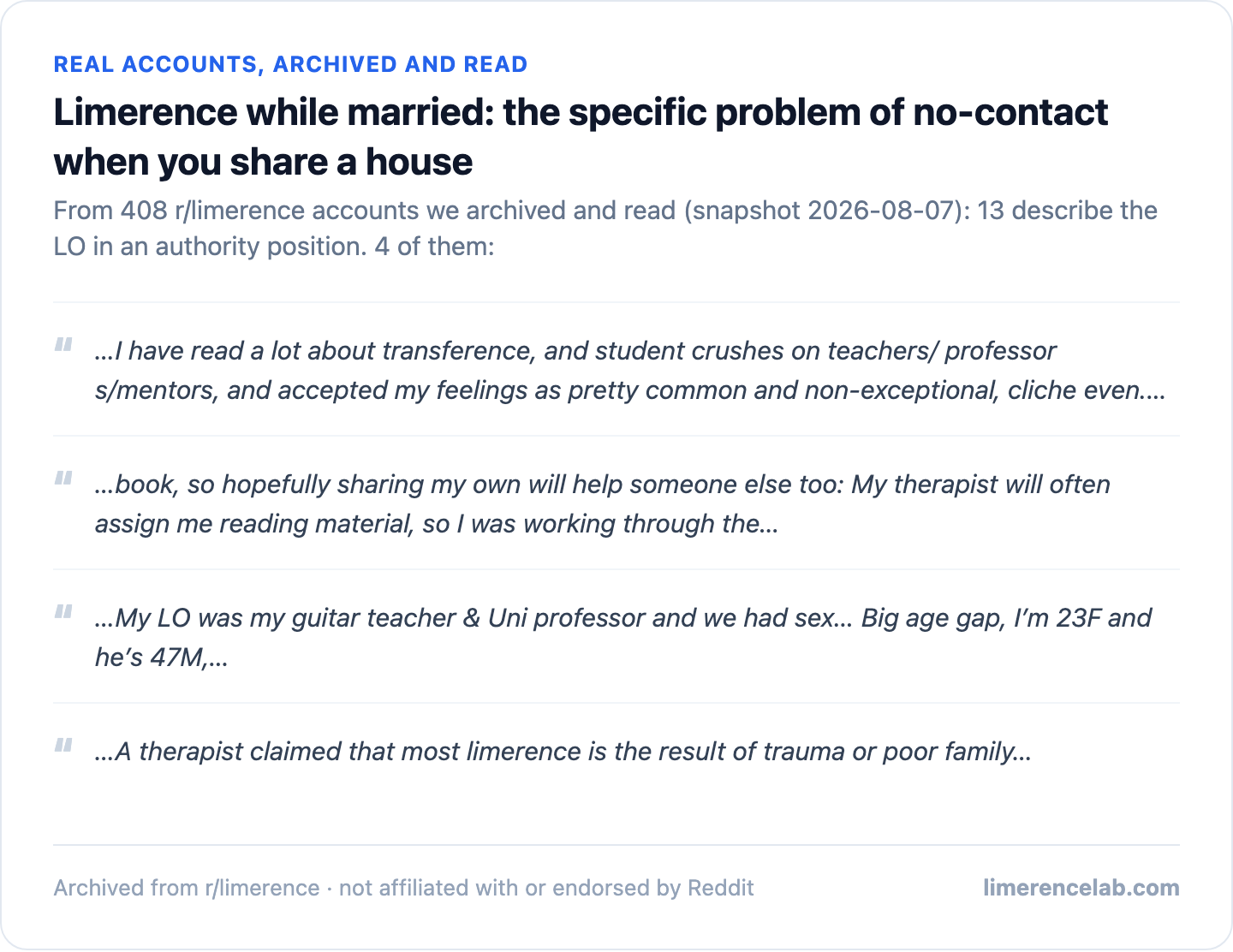
Among 408 real accounts, 30 writers said they were married or partnered while feeling limerence. For these writers, no contact is often impossible.
- Shared home: If the limerent object is a spouse or partner you live with, cutting off contact is not realistic. The person is there every day, so the feelings stay close.
- Shared workplace: If the object is a coworker, avoiding them is hard. Writers describe seeing the person at meetings and in hallways, which makes moving on slow.
- Stuck feelings: Many writers say that sharing a space keeps the limerence alive. They want to stop, but the constant presence makes it hard to heal.
- Acting normal: Some writers describe pretending everything is fine. They say hiding the obsession while sitting at the same table or in the same office adds stress.
What’s your Limerence Score?
A private, 2-minute check-in.
Limerence affair online: 6 of 86 accounts never met their limerent object in person
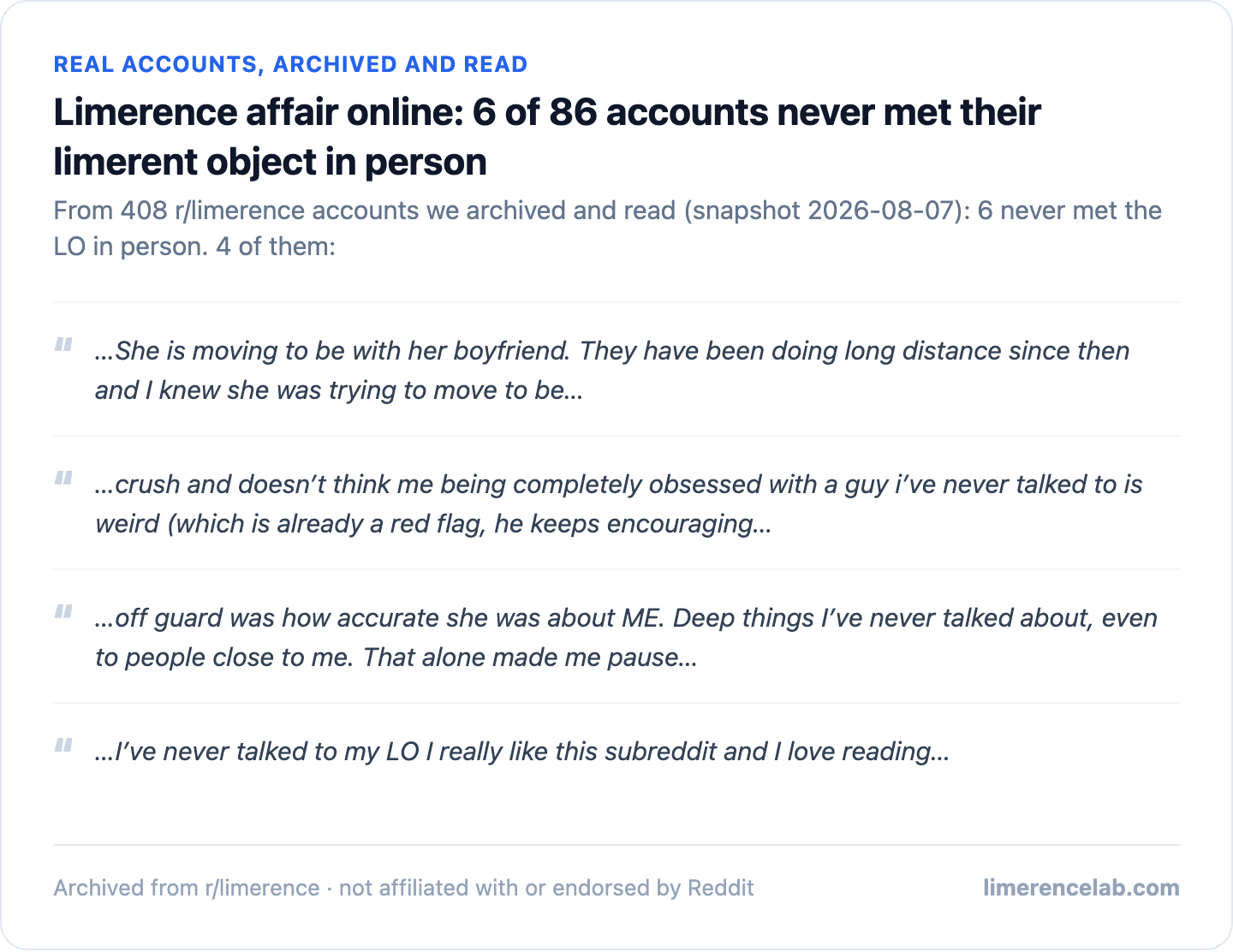
Some limerence starts online without any meeting in person.
- Six of 86 accounts describe this. These writers never met their limerent object face to face, and they knew the person only through messages, calls, or social media.
- The limerent object was already committed. In these accounts, the LO had a partner or spouse, and the writers still felt a strong pull.
- Online contact did not lessen the feeling. Writers wrote about checking the LO's posts, and they waited for replies to feel joy and pain from typed words.
- Some writers built a whole story in their minds. They imagined what the LO was like, and they never saw the LO in person, so the fantasy grew larger.
- The accounts show a real pattern. Limerence can happen without a real world meeting, and the brain fills in the missing pieces with hope.
- Writers wrote about the LO's online voice. The tone of a message could change the writer's whole day, and an emoji could feel huge.
- Some writers never saw a photo. They only had words, but that did not stop the obsession.
- Others saw pictures online but never met. The LO existed on a screen, and the writer still felt a deep bond.
- These accounts are a small part of the 86. They show an important truth, and limerence does not need a body to grow.
- The LO's commitment was a barrier. Some writers knew the LO was taken, but that knowledge did not end the feeling.
- Writers described feeling ashamed or confused. They wondered why they cared so much, and they could not stop.
- The online world made the LO close and far at once. It was close because messages came fast, and far because no real meeting ever happened.
- Some writers hoped the LO would leave the partner. That hope was common in the accounts, but they also knew it was unlikely.
- Others did not want to break up a family. They just wanted the feeling to go away, and they stayed stuck.
My personal take: what do I make of these accounts?
I read 408 accounts from people who felt limerence. In 86 of those accounts, the writer told who the LO was.
Of those 86, 30 said the LO was already committed to someone else. I was not the only person who loved someone taken.
That number gave me comfort. I saw my own story in those words.
Limerence is powerful. But I know other people share this feeling.
Were 30 of 408 writers committed to someone else?
Limerence and commitment
- In 30 of 408 accounts, the writer was married or partnered while feeling limerent. That means the writer had a commitment to someone else.
- In 30 of 408 accounts, the limerent object was already with another person.
That means the object of limerence was not free.
- Both numbers are 30, but they describe different people. One number is about the writer.
The other number is about the object.
- These patterns show that limerence often happens when someone is unavailable. It does not make anyone a bad person.
- The accounts show mixed feelings.
Some writers felt guilt. Others felt confusion.
Many just wanted to understand.
- Limerence is a strong feeling, not a choice. The accounts tell us that commitment does not stop it from happening.
- Seeing the same number twice can be confusing.
But it is only a coincidence of counting.
- The point is simple. Limerence can appear in many situations, even when people are already in a relationship.
- This page is not a judgment.
It is a look at what real people wrote.
Take our free quiz to see how you relate to these stories. It is not a diagnosis.
What’s your Limerence Score?
A private, 2-minute check-in.
Questions this page answers
Is limerence toward someone unavailable common?
In 30 of 86 accounts, the limerent object was committed to someone else. So yes, this situation appears often.
Does limerence mean I want to have an affair?
No. Limerence is a feeling, not a plan to have an affair.
Is a coworker the most common limerent object in these accounts?
We do not know. Our search of these accounts did not show that.
What does it mean if my limerent object is already committed?
It means the person you want is in a relationship. In 30 of 86 accounts, this was true.
Is it different if I am the one who is committed?
Yes. The 30 for the limerent object and the 30 for the writer are different facts about different people.
Should I tell my limerent object how I feel?
That is a personal choice. The accounts do not give one answer.
Does limerence toward an unavailable person always lead to an affair?
No. Limerence does not always lead to an affair.
Is limerence toward a coworker or boss a special category?
Our search of these accounts does not show that it is special.
Further reading
- What Is Limerence? The Obsessive Loop, Explained
Start here if you are new to the term and want the basics first.
- What disorders cause limerence? We read 408 first-person accounts.
The corpus this page draws on, with the comorbidity breakdown.
- Is Limerence the Same as Love?
How limerence differs from love, a common source of confusion in these accounts.
- I'm a Clinical Hypnotherapist. I Read 143 Accounts From People Who Got Out of Limerence.
What people credited most when their limerence ended.
This page is for education only. It does not tell you to deceive a partner.
Do not use this to plan an affair.
Ready to break the loop?
Only 10 new clients a month. Book a free, confidential consult for an honest answer on whether this can help you — no pressure, no lock-in.
Only 2 spots left for August
Not ready to talk? Take the free Limerence Score →
About the Author

Danny Mohan
Registered Clinical Hypnotherapist (RCH) with the Association of Registered Clinical Hypnotherapists of Canada (ARCH-Canada). Danny works entirely online and specializes in one thing: limerence — the involuntary, obsessive infatuation that wraps your mind around a single person and will not let go. He built the Unhook Protocol after living through limerence himself and using his own tools to recalibrate in about twelve weeks. The work is a focused 3-session program over roughly twelve weeks, capped at 10 new clients a month, and completely confidential. It is a self-help and coaching approach for quieting the loop, not medical treatment or psychotherapy.
Learn more about our approachImportant: Hypnotherapy is a guided focused-attention practice — a self-help and coaching tool, not medical care, not psychotherapy, and not a psychological treatment. Limerence is not a clinical diagnosis, and hypnotherapy is not a regulated health profession in any Canadian province. ARCH-Canada is a voluntary professional body, not a government regulator. Nothing on this site is medical advice, diagnosis, or treatment. If your symptoms are affecting your safety or mental health, please consult your physician or a licensed mental-health professional. Hypnotherapy may complement that care but never replaces it.