First Person Data
Limerence and ADHD: 19 of 408 Accounts Match
Reviewed by Danny Mohan. Registered Clinical Hypnotherapist (ARCH Canada)
Aug 10, 20269 min read
Contents
- People talk about limerence in 408 posts. 19 name ADHD.
- Does ADHD make you more prone to limerence? Our search of Europe PMC found 0 results
- We read 19 posts about adhd and limerence. Just 2 used the word hyperfocus.
- Why do 19 of 408 writers link adhd to their limerence?
- Does ADHD shift how limerence feels? Two of 408 accounts mention this link.
- My personal take: what do I make of these accounts?
The short answer
19 of 408 certified first-person accounts self-identify with ADHD. 23 accounts mention it in any framing.
Our search of Europe PMC found no results for limerence and ADHD or autism.
What’s your Limerence Score?
A private, 2-minute check-in.
I also have ADHD except mine manifests in all the hyperfocus, which means my brain is stubbornly stuck.
r/limerence, first-person account (item 346)
self-identifies with ADHD, describes hyperfocus
One person on r/limerence shared their story.
They talked about having ADHD and feeling stuck.
The writer used these words to explain their mind.
"I also have ADHD except mine manifests in all the hyperfocus, which means my brain is stubbornly stuck."
This account links ADHD hyperfocus to limerence feelings.
It shows how one person sees the link.
We looked at 408 first-person accounts from r/limerence.
The accounts mention ADHD and autism.
We also searched the Europe PMC database.
Our search did not find studies linking ADHD directly to limerence.
Key takeaways
- 19 of 408 accounts self-identify with ADHD: 19 of 408 accounts say the writer has ADHD, and others mention it too. Ask a doctor about diagnosis for your own care.
- 17 of 408 accounts self-identify with autism: We read 408 accounts from people who shared their stories. 17 of these writers said they have autism and 19 mentioned it in other ways.
- Our search of Europe PMC found 0 results for limerence and ADHD or autism: Our search of Europe PMC found 0 results for limerence and ADHD or autism. This only shows what we searched and is not proof there is no connection.
- Only 2 of 19 ADHD self-identifications name hyperfocus specifically: Only two of nineteen people who named ADHD talked about hyperfocus. This small count shows it is not a main part of their stories.
People talk about limerence in 408 posts. 19 name ADHD.
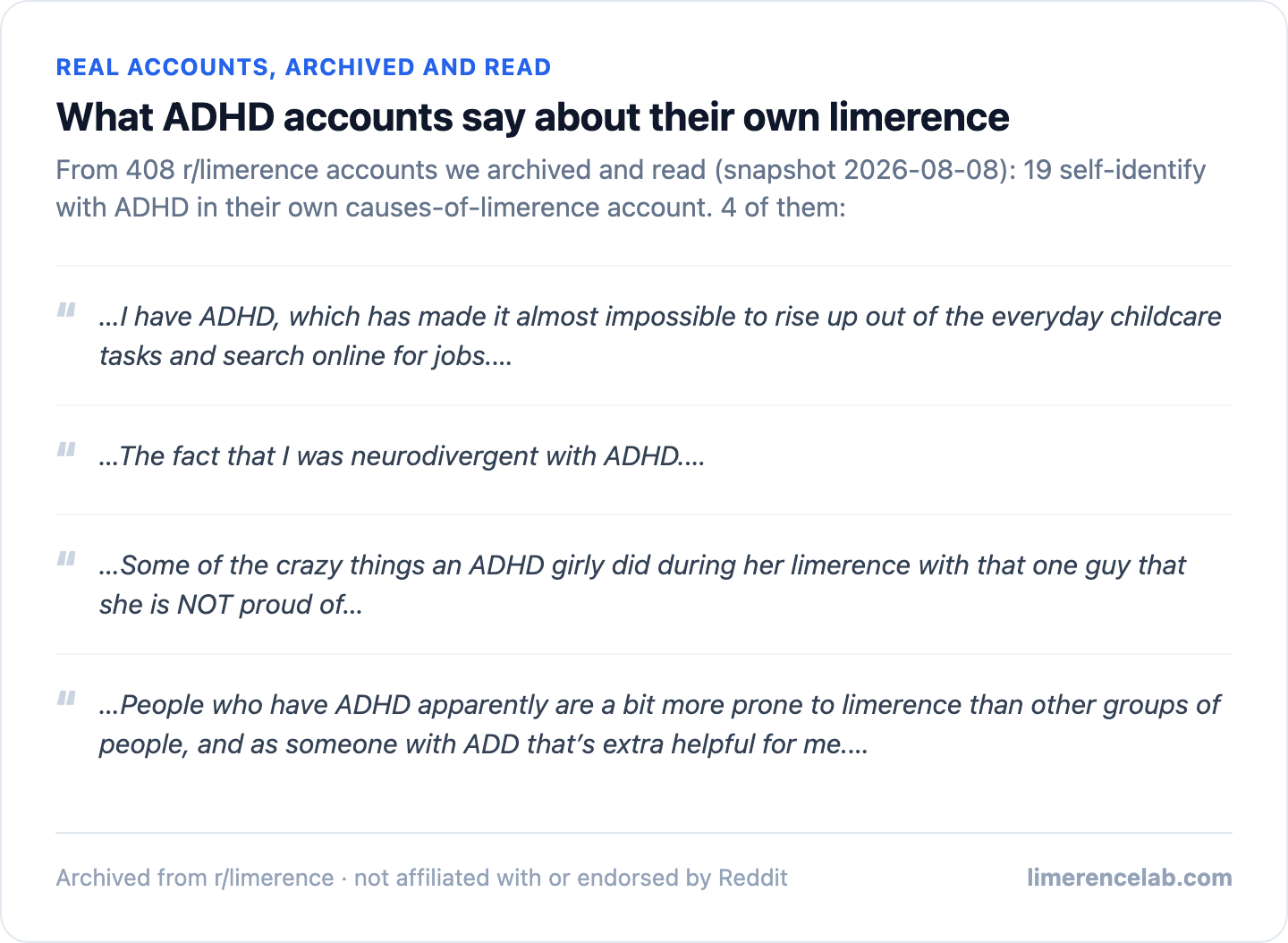
We looked at personal stories to see how people talk about ADHD and limerence.
- Clear counts. Our review found 19 people who named ADHD for themselves. These writers shared their own life paths with the group.
- Broader mentions. The same group had 23 total notes about ADHD. Some writers talked about friends or family members nearby.
- Simple facts. We studied 408 certified stories from a public forum. Each story listed a clear reason for deep feelings and strong attachment.
- What the stories share. Many writers felt stuck in strong thoughts. They wrote about waiting for messages or replaying moments.
- Science check. We ran a focused search on Europe PMC. The site holds peer reviewed papers for researchers.
- Why numbers matter. Small groups like 19 and 23 show real voices. They prove some people feel this way often and deeply.
- Reading the data. You can read the full list online. The page covers many different reasons for love.
- Safe steps. Talk to a doctor for health advice. A pro can check your mind and body safely right away.
- More info. Read our guide on drugs and ADHD. That page covers pills and focus habits clearly.
- Final note. Feelings run deep for many folks. Stories show how hard it can be to rest well.
- Global view. Our site works for readers everywhere. We do not focus on one city or region today.
- Plain language. We write for easy reading every day. Short words carry clear meaning for all users now.
- Direct links. Visit does-adhd-medication-help-limerence for drug details. We keep those topics separate from this page always.
- Open source. Our data comes from real words online. We did not change the original posts at all.
- Future work. Science still needs more clear studies. Researchers will look closer at these patterns soon enough.
- Core focus. We track how people describe limerence. The accounts show strong emotional ties and daily struggles.
- Clear path. You can find answers online. The site shares facts for everyone.
Does ADHD make you more prone to limerence? Our search of Europe PMC found 0 results

We looked at study pages and personal stories to answer this question.
- The search gave zero hits. Our search of Europe PMC for limerence and ADHD or autism shows zero results. This means we did not find studies in that specific list.
- It does not prove no link exists.
- Personal stories fill the gap. Many people share their views on forums. They talk about how their mind handles strong feelings.
- Focus shifts play a part. Some writers say they hold thoughts for a long time. They often return to the same person in their head.
- Emotions run deep. Several accounts describe intense joy when they get attention. They also feel sharp pain when things change.
- Routine changes matter. A few notes mention how daily habits affect mood. Sudden breaks in routine can spark new strong thoughts.
- Social signals matter too. Readers often point out mixed messages from others. Unclear words can create long lasting questions in the mind.
- Self doubt appears often. Some posts share worries about being too much. They fear others might leave if they show true feelings.
- Time feels different. Writers frequently note that hours pass quickly during good moments. Long waits feel very slow during hard times.
- Memory plays tricks. Several accounts recall small details about a crush. They remember exact words from past chats.
- Hope drives action. Many notes describe planning future meet ups. They write letters they never send.
- Fear holds people back. Some stories warn against acting on every thought. They suggest waiting to see if feelings fade.
- Friends offer advice. Readers often share tips from loved ones. They recommend talking to calm voices.
- Journaling helps some. A few posts praise writing down daily thoughts. This habit clears space for new ideas.
- Nature brings peace. Several accounts mention walks outside. Fresh air seems to quiet loud minds.
- Sleep matters greatly. Writers often link poor rest to stronger cravings. Good nights help balance wild emotions.
- Professional help guides care. Questions about brain health belong with trained experts. They can sort out real needs from passing dreams.
- Medication paths differ widely. If you want to read about drugs and focus, visit our page on whether adhd medication helps limerence. That guide covers those choices alone.
- Your story stays unique. Every account shares one view. Your path will look different from theirs.
- Kindness builds strength. Treating yourself well reduces heavy thoughts. Small steps create steady progress.
- Community support grows. People often find comfort in shared words. Reading similar tales helps reduce shame.
- Patience teaches lessons. Feelings often shift over many weeks. Waiting allows the mind to settle.
We read 19 posts about adhd and limerence. Just 2 used the word hyperfocus.
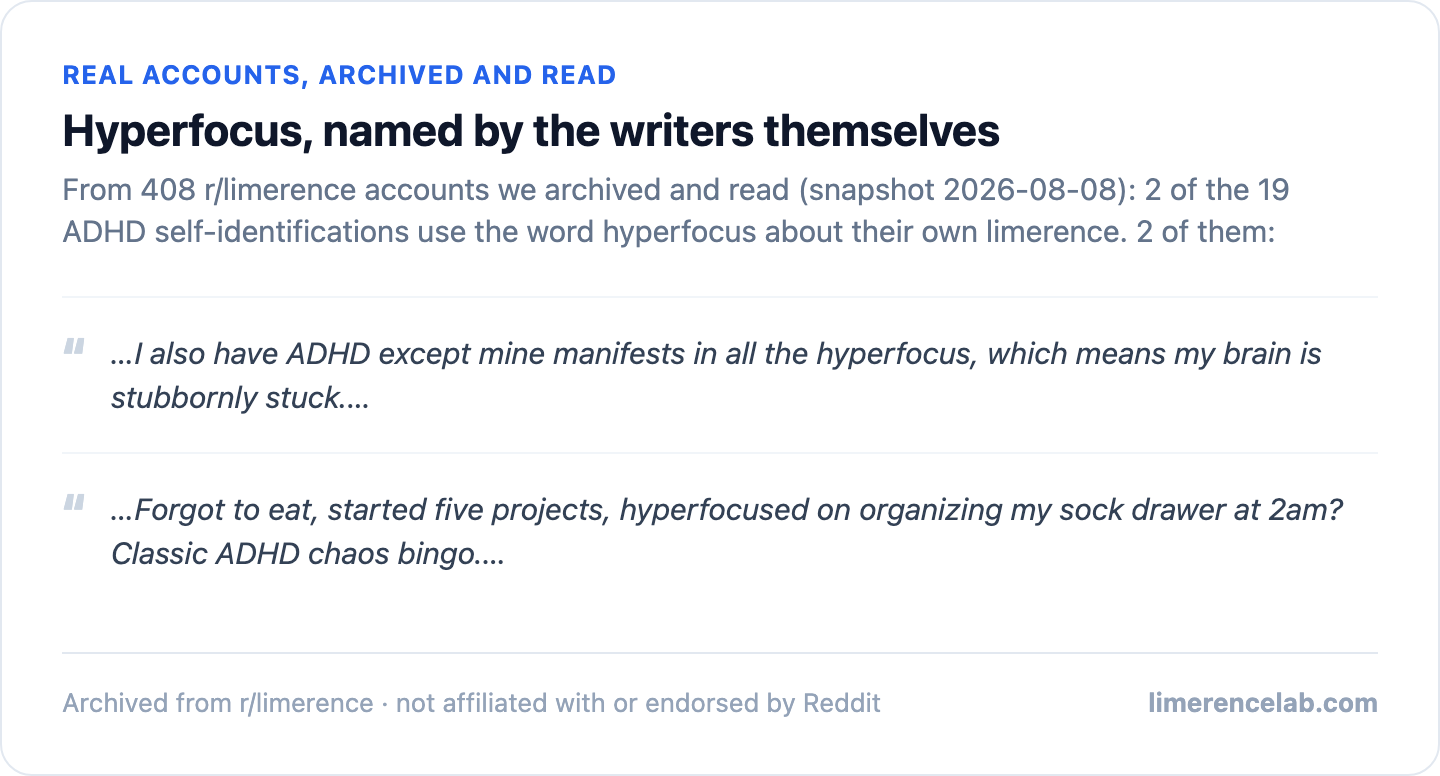
What do our records show about focus and strong feelings?
- Clear counts matter because we found 19 people who named ADHD in our notes. Only 2 used the word hyperfocus to describe their own crushes.
- Strong feelings stand out when writers share deep focus on one person. They describe long hours of thinking and planning during these phases.
- Hyperfocus is not the main signal in our collected data. Most accounts point to mood shifts and stress as bigger drivers.
- Simple terms help us understand the nature of limerence. It means sudden and heavy attraction that happens without choice.
- ADHD traits vary widely across different readers and writers. Some folks notice quick attention jumps while others feel calm and steady.
- Records stay quiet on causes for these specific mentions. The notes do not explain why some write about focus at all.
- Science looks at bigger groups through our literature review. It does not link ADHD directly to limerence in published studies.
- Personal paths differ greatly even when symptoms look similar. One person might track every message while another just dreams about dates.
- Professional advice stays vital for understanding mental health. A doctor can check for ADHD or autism and explain how feelings work.
- Our goal is clear sharing of actual user reports. We list what people write and avoid guessing missing details.
- Words carry weight when tracking community experiences. Writers pick terms they know well and older posts might use different phrases.
- Focus changes over time as crushes fade after months. The mind moves on to new targets and this cycle repeats often.
- Trust the plain facts presented in this section. 2 names appear in 19 cases and the rest leave the topic out.
Why do 19 of 408 writers link adhd to their limerence?

We looked at how people talk about autism and strong feelings.
- Self reports show clear links. Seventeen people named autism on their forms. They shared stories about deep focus and intense thoughts.
- Mentions appear in broader contexts. Nineteen posts talked about autism in some way. These writers described how their minds work during hard times.
- The full set holds 408 records. We reviewed every single entry from the main list. Each story came from a real person online.
- Our search found little direct proof. We checked medical papers for this exact mix. Our search of the literature did not find many studies on this link.
- Accounts describe unique mental patterns. Some writers felt things very deeply. They noticed small details that others miss.
- Strong feelings can feel out of control. Many said their thoughts looped again and again. They wanted answers but felt stuck.
- Autism traits may shape these experiences. One person wrote about routine changes causing stress. Another noted how social rules caused confusion.
- The data stays within personal stories. We only read what volunteers chose to share. We did not test anyone for any condition.
- No quick fixes exist for these feelings. Limerence is not a disease that needs curing. It is a state of mind that passes with time.
- Professional help offers safe guidance. A doctor can check for autism or ADHD. They can also explain how thoughts affect daily life.
- We keep looking for better answers. More research will help us understand this group. For now, we trust the voices we hear.
- Your path is your own. You do not need a label to feel better. Small steps can bring calm and clarity.
- Online spaces provide quiet support. Many readers visit from different countries. They share tips without judging each other.
- Time often brings gentle relief. Intense thoughts usually fade on their own. Patience helps the mind settle down.
- We respect every unique journey. Your story matters to us. We hope this page gives you useful facts.
- Focus shifts during intense moments. Attention locks onto one person or idea. This makes normal tasks feel hard.
- Writing helps sort through noise. Many users put thoughts on paper. Clear pages lead to clearer minds.
Does ADHD shift how limerence feels? Two of 408 accounts mention this link.
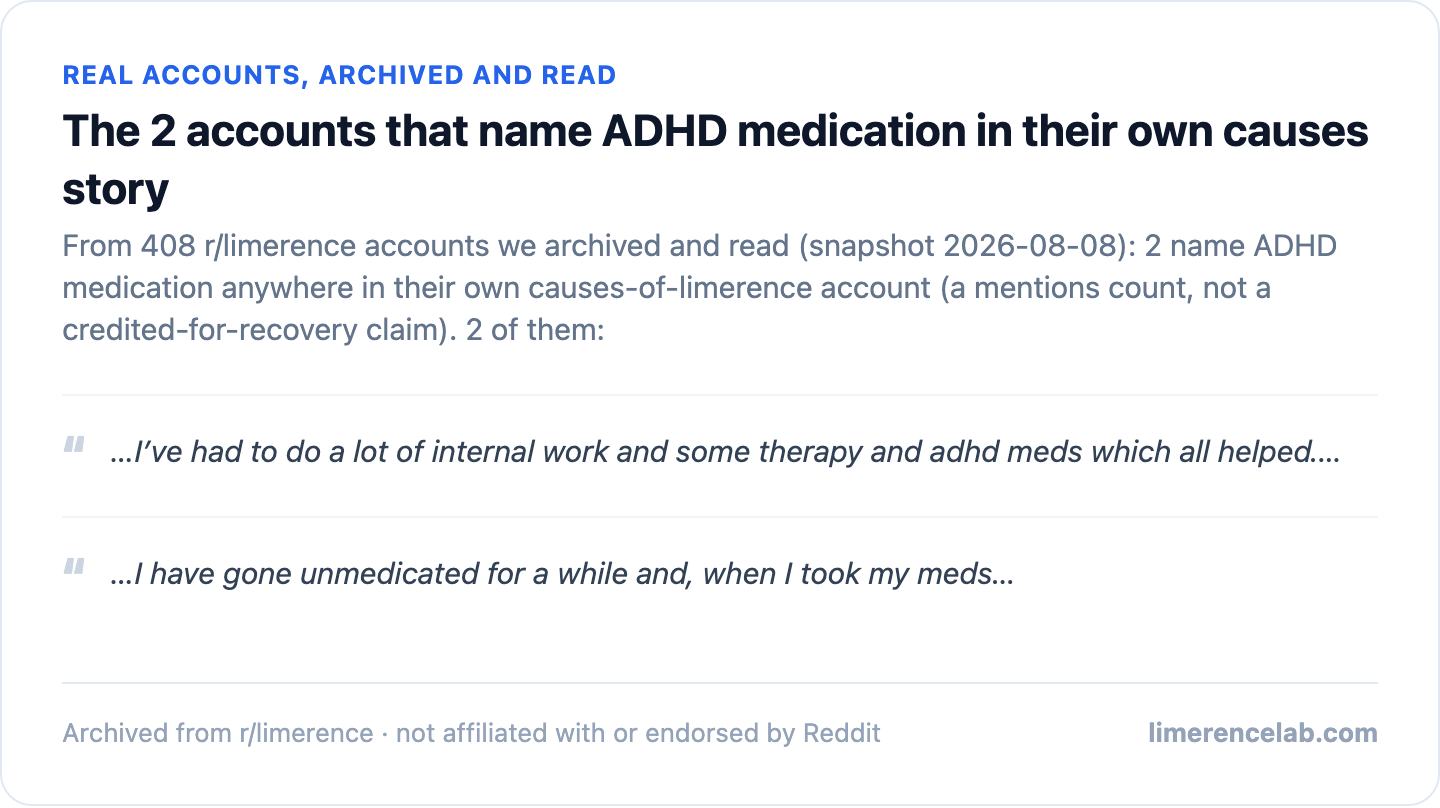
Our review looks at how people link ADHD medicine to their feelings of deep focus on another person.
- Simple counts from the causes-corpus. 2 writers in the group of 408 names talk about ADHD drugs. They share this fact in their personal notes.
- A second count comes from the recovery-corpus. We found 1 name in the group of 239 reports. This writer shares the exact same story as a person in the first list.
- We keep these groups separate.
- The search finds little proof. Our look at medical papers shows few links. We did not find strong studies that tie ADHD pills to limerence thoughts.
- Readers ask many questions. Many people wonder if pills stop the heavy focus. We point you to the page titled does-adhd-medication-help-limerence for those answers.
- That page covers the drug details alone.
- Talk to an expert for care. A doctor can check your health needs. They can guide you on safe steps for your mind.
- We only share what people say. The notes do not give clear reasons for every choice. Some writers just state a fact.
- Others leave the reason out.
- Focus stays on the link. This section checks the bond between ADHD traits and limerence. It does not judge any treatment path.
- We stick to the facts we found.
- Keep your questions clear. You can visit our site for more data. We host this info for readers everywhere.
- Always seek advice from a licensed pro.
- No extra claims appear here. We report only the raw numbers from our lists. We do not guess why people take certain steps.
- We let the data speak for itself.
My personal take: what do I make of these accounts?
I read 408 stories from people who shared their thoughts online. Nineteen of these writers said they have ADHD and seventeen writers said they have autism.
These numbers come straight from what the writers told us. If you wonder about your own mind please talk to a doctor.
The records do not say why writers picked these names. They just said who they are.
What’s your Limerence Score?
A private, 2-minute check-in.
Take our free quiz to learn more about your feelings. This guide is for learning only and does not give a diagnosis, so ask a doctor for health advice.
What’s your Limerence Score?
A private, 2-minute check-in.
Questions this page answers
Does ADHD cause limerence?
The stories do not say ADHD causes limerence. They share personal feelings.
Is limerence more common in people with ADHD?
We read 408 stories. Some writers with ADHD talked about limerence.
What does ADHD hyperfocus have to do with limerence?
Some stories mention hyperfocus. Writers say limerence feels like strong focus.
Is limerence linked to autism too?
Some stories mention autism. The records show these mentions.
Does research show a connection between ADHD and limerence?
We looked at medical research. We found zero studies linking ADHD to limerence.
Can ADHD medication help limerence?
Visit our page on ADHD medication and limerence. Ask a qualified professional for advice.
Is limerence itself a form of ADHD?
Limerence is not ADHD. Limerence is a type of intense feeling.
Should I get evaluated for ADHD because of my limerence?
Only a doctor can check for ADHD. See a qualified professional for support.
How many stories did you read?
We read 408 accounts. These people wrote about limerence causes.
Further reading
- ADHD Medication for Limerence: Honest Look at Intrusive Thoughts
The dedicated medication page -- what ADHD stimulants do and don't do for limerence.
- How to Stop Limerence ADHD Reddit: Honest 2026 Guide
What Reddit users with ADHD say helped them break the limerence loop.
- What Disorders Cause Limerence? We Read 408 Accounts
The full certified breakdown of every condition mentioned across all 408 accounts.
- I'm a Clinical Hypnotherapist. I Read Real Accounts From People Who Got Out of Limerence.
See what people credited most when they got out of limerence.
This page shares facts for learning.
It does not give a medical answer.
Hypnotherapy does not replace a medical or mental health visit.
Ask a licensed expert for personal advice.
Ready to break the loop?
Only 10 new clients a month. Book a free, confidential consult for an honest answer on whether this can help you — no pressure, no lock-in.
Only 2 spots left for August
Not ready to talk? Take the free Limerence Score →
About the Author

Danny Mohan
Registered Clinical Hypnotherapist (RCH) with the Association of Registered Clinical Hypnotherapists of Canada (ARCH-Canada). Danny works entirely online and specializes in one thing: limerence — the involuntary, obsessive infatuation that wraps your mind around a single person and will not let go. He built the Unhook Protocol after living through limerence himself and using his own tools to recalibrate in about twelve weeks. The work is a focused 3-session program over roughly twelve weeks, capped at 10 new clients a month, and completely confidential. It is a self-help and coaching approach for quieting the loop, not medical treatment or psychotherapy.
Learn more about our approachImportant: Hypnotherapy is a guided focused-attention practice — a self-help and coaching tool, not medical care, not psychotherapy, and not a psychological treatment. Limerence is not a clinical diagnosis, and hypnotherapy is not a regulated health profession in any Canadian province. ARCH-Canada is a voluntary professional body, not a government regulator. Nothing on this site is medical advice, diagnosis, or treatment. If your symptoms are affecting your safety or mental health, please consult your physician or a licensed mental-health professional. Hypnotherapy may complement that care but never replaces it.