ACCOUNTS AND RESEARCH DATA
Is limerence an addiction? 52 of 408 accounts use addiction language. Our search of ClinicalTrials.gov found 0 registered trials testing whether it withdraws like one.
Reviewed by Danny Mohan. Registered Clinical Hypnotherapist (ARCH Canada)
Aug 8, 20269 min read
Contents
- How did we get these numbers? We read 408 first-person accounts
- Is limerence an addiction? Europe PMC returns 9 results, none settles it
- Limerence love addiction: 52 of 408 accounts use addiction language
- Limerence addiction recovery: our search found 0 registered trials
- Limerence withdrawal symptoms: 5 of 408 describe one when contact stops
- Limerence detox: 0 of 408 accounts use the word
- SLAA limerence: 4 of 408 accounts name attending
- Deprogramming limerence: 0 of 408 accounts use the word
- My personal take: is limerence really an addiction?
When I got blocked by a LO who even changed their number to avoid me, I was in intense physical pain, my heart actually felt broken.
r/limerence, first-person account
describes physical pain when contact stopped
A person on r/limerence described a hard time after being cut off.
They wrote about strong feelings that hurt their body.
They shared this exact story. "When I got blocked by a LO who even changed their number to avoid me, I was in intense physical pain, my heart actually felt broken."
This shows how deep love can feel like a heavy weight. We note this is just a view from our list of 408 accounts.
Some people use words like addiction to talk about their pain, but limerence is not a sickness called addiction. There are also no tests showing limerence works in the brain like drugs do.
Our review of 408 stories shows some people use addiction words and a few mention meetings where people share steps. Others describe feeling sick when contact stops.
We checked Europe PMC and found a small set of papers that do not test limerence as an addiction. Our search of ClinicalTrials.gov found no registered trials testing this link.
The short answer
Of 408 certified first-person accounts, 52 use addiction language about their own limerence, and four name attending SLAA or a 12-step program for peer support and meetings.
Our search of ClinicalTrials.gov found 0 registered trials testing whether limerence works like an addiction.
Limerence is not a diagnosis and not a clinically recognized addiction.
This does not mean you have an addiction.
What’s your Limerence Score?
A private, 2-minute check-in.
Key takeaways
- 52 of 408 accounts use addiction language: 52 of 408 accounts use words like craving or withdrawal to talk about their limerence. Limerence is not a diagnosis and our search found 0 trials testing if it works like a drug addiction.
- 5 describe a withdrawal symptom when contact stops: Five people say they feel bad when they cannot see their person and two of them have a sign like pain or a fast heart. Our search of ClinicalTrials.gov found zero tests to see if limerence works like a drug habit.
- 4 name attending SLAA or a 12-step program: 4 readers join SLAA or a step group for peer support while using words like craving and stopping contact. Limerence is not a clinical addiction and nobody has tested if it works the same way as a drug habit, so our search of this corpus found no outcome data for these meetings.
- No registered trial has tested limerence as an addiction: Our search of ClinicalTrials.gov found 0 registered trials and Europe PMC returns 9 results that discuss the topics together without settling the question. Some people use addiction language for their limerence, but nobody has tested if limerence works the same way in the body as a substance addiction.
How did we get these numbers? We read 408 first-person accounts
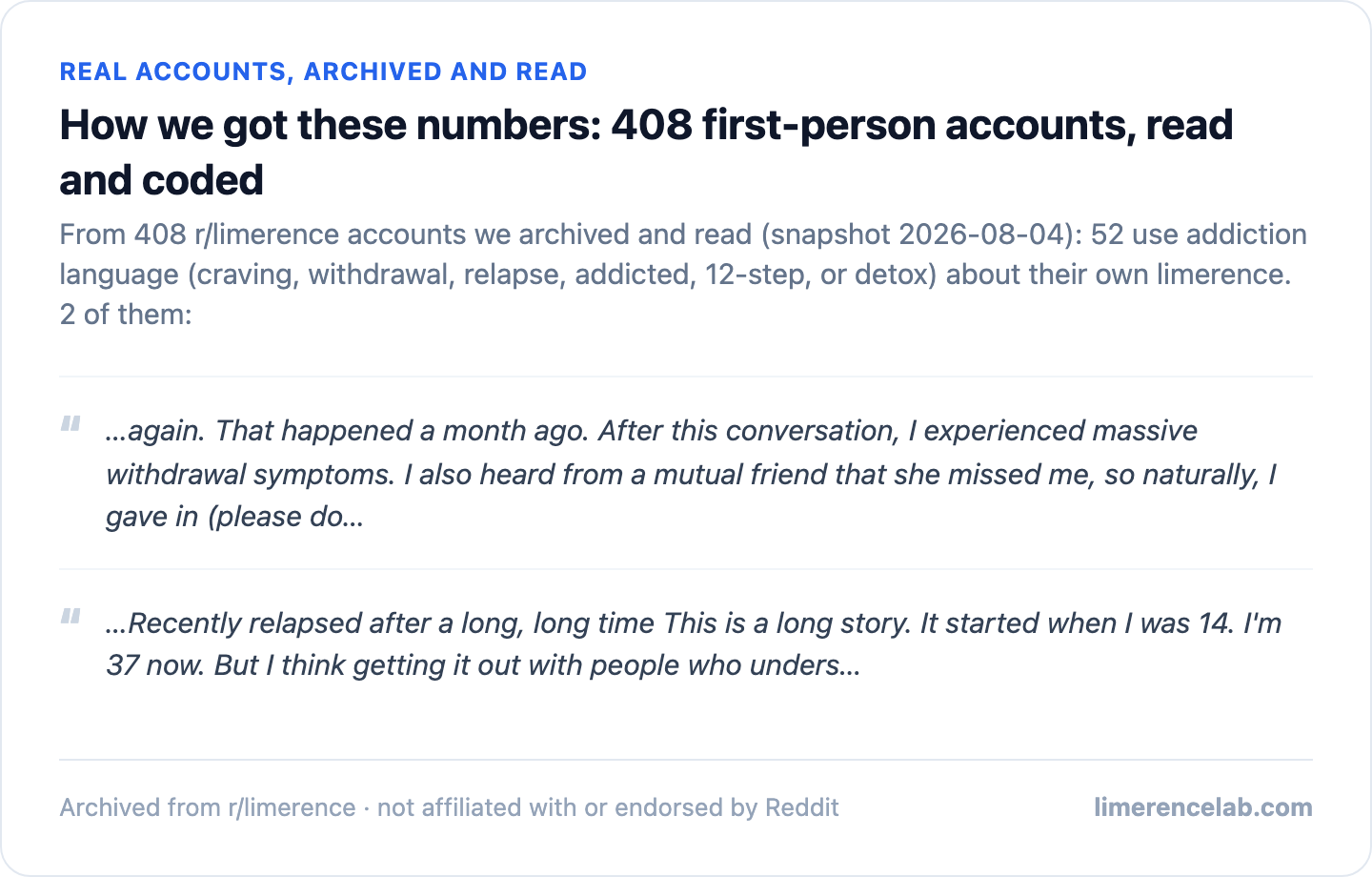
We looked at personal stories from a large online group.
- We read 408 accounts. We found 52 that used these words.
- The list shows personal pain. Limerence is not a diagnosis, and it is not a clinically recognized addiction.
- Some people join support groups. They attend meetings that follow a set of steps.
- These groups offer a peer support structure. No study proves a physical link to substance use.
- A search of major health sites shows no trials exist. Nobody has tested if this feeling works the same way physiologically.
- Words do not change the facts. Using old terms does not create a new disease.
- People simply share their honest experiences. We only used verified posts from the web.
- We removed false claims and fake voices. We kept only true personal stories.
- The count stands at 52 of 408. This number reflects open sharing and public interest.
- It shows how some describe their state. Feelings stay personal and private for everyone.
- We never name anyone who writes down their thoughts. Safety matters more than any detail.
- Research stays separate from daily life. Experts look at other topics first.
- We wait for clear science to arrive. Support helps people cope with heavy emotions.
- Talking to peers builds a steady routine. Steps give a path forward for many.
- You can trust the source. We only used certified accounts from the forum.
- False claims were left out completely. Life moves fast and loud outside.
- People seek answers in quiet moments. They want to understand their own minds.
- We hold space for all views. Some find peace in structured groups.
- Others prefer daily reflection. The truth stays simple here.
- We read the pages and counted the words. The rest is up to you.
- We report what we see. The data comes from open forums.
- We share it for public learning. Your path is your own.
- You decide what fits your life. We just share the facts.
- We value clear language. Simple words help everyone understand.
- We avoid complex medical terms. We respect every voice.
- Readers share their lives openly. We thank them for their trust.
Is limerence an addiction? Europe PMC returns 9 results, none settles it
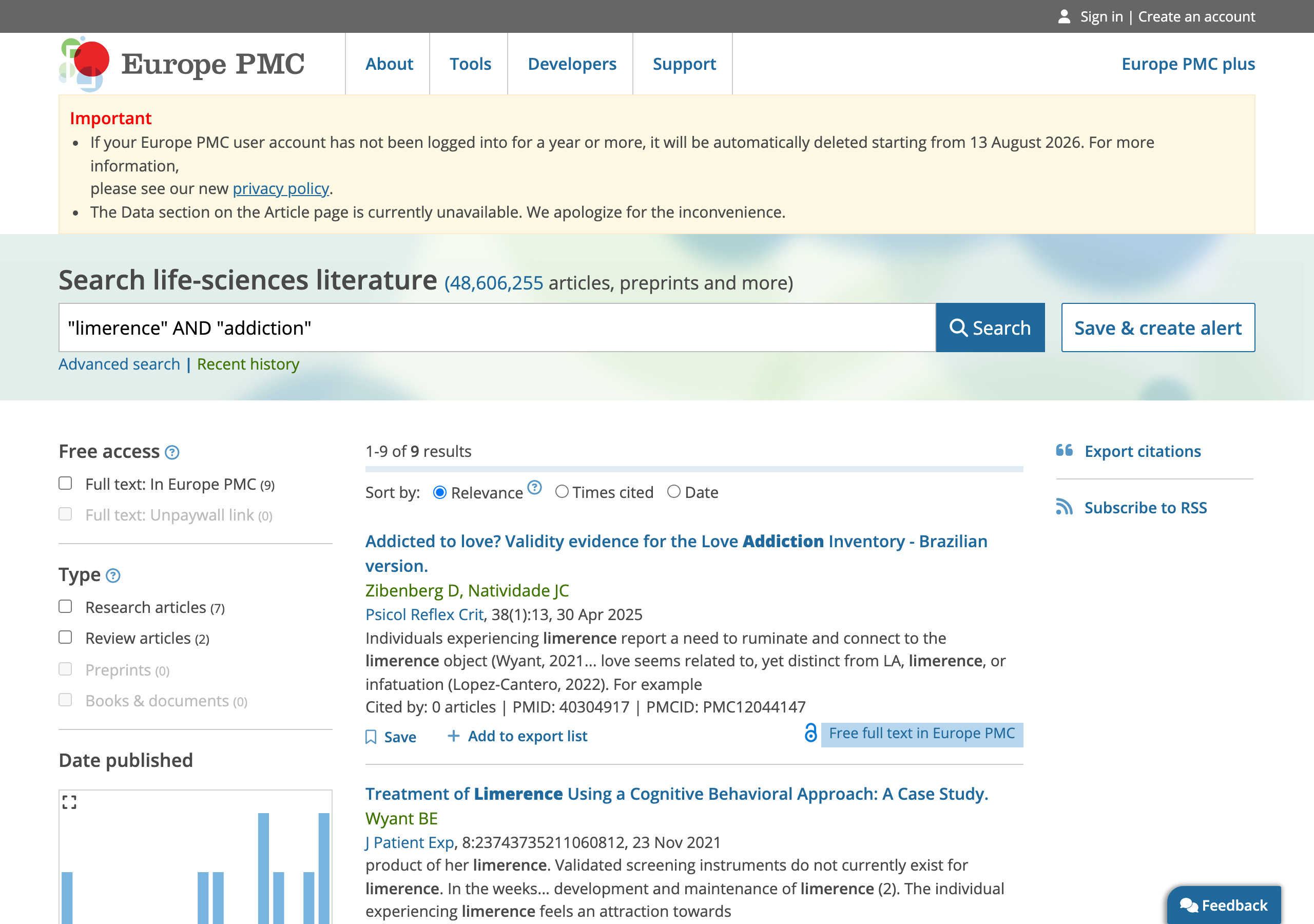
We looked at research papers to find clear answers.
- The search found nine papers. These papers talk about love and habits together. They do not prove this feeling is a true addiction.
- None check the body directly. Science has not tested how the brain reacts here. We cannot say it works like drugs or drinks.
- Some people use strong words. They speak of cravings and hard breaks. This shows deep pain and heavy focus.
- It does not mean doctors see a sickness.
- Limerence is not a medical label. Clinics do not list it as a disorder. People seek help for stress and sleep loss.
- The mind holds on to hope and fear.
- Support groups offer quiet space. Some join meetings to share stories. They follow steps and talk with peers.
- This gives comfort but lacks hard proof.
- Our search covers published work. We checked Europe PMC for studies. We found nine items that match our terms.
- They discuss ideas but stop short of facts.
- No trial lists this condition. We scanned ClinicalTrials.gov for plans. We saw no registered tests.
- The science path remains open for future work.
- You are not broken by this. Heavy thoughts do not make you ill. Many feel stuck in daily loops.
- Kind words and rest help the mind settle.
- We only read what exists. Our search of Europe PMC returns 9 results. These talks happen in journals today.
- They point to questions we still ask.
- Addiction words show real pain. People describe relapse and missing contact. This language captures their struggle well.
- It does not change the medical facts.
- The brain seeks rewards often. People want love and safety. Strong feelings can mimic old paths.
- We must watch the evidence closely.
- Studies stay far from proof. Writers talk about ideas and ties. They do not call it a sickness.
- The facts stay quiet on the body.
- Your experience matters deeply. You know the weight and the wish. Others feel the same heavy pull.
- Shared stories build a better map.
- Science moves at a slow pace. New tests may come later. We wait for careful checks now.
- Waiting keeps us safe and calm.
- We watch what writers share. We look at one small area. We check specific journal pages.
- Big claims need big proof.
- Love feels like a storm sometimes. Calm days bring relief and peace. The heart learns to rest again.
- Time helps the sharp edges fade.
Limerence love addiction: 52 of 408 accounts use addiction language
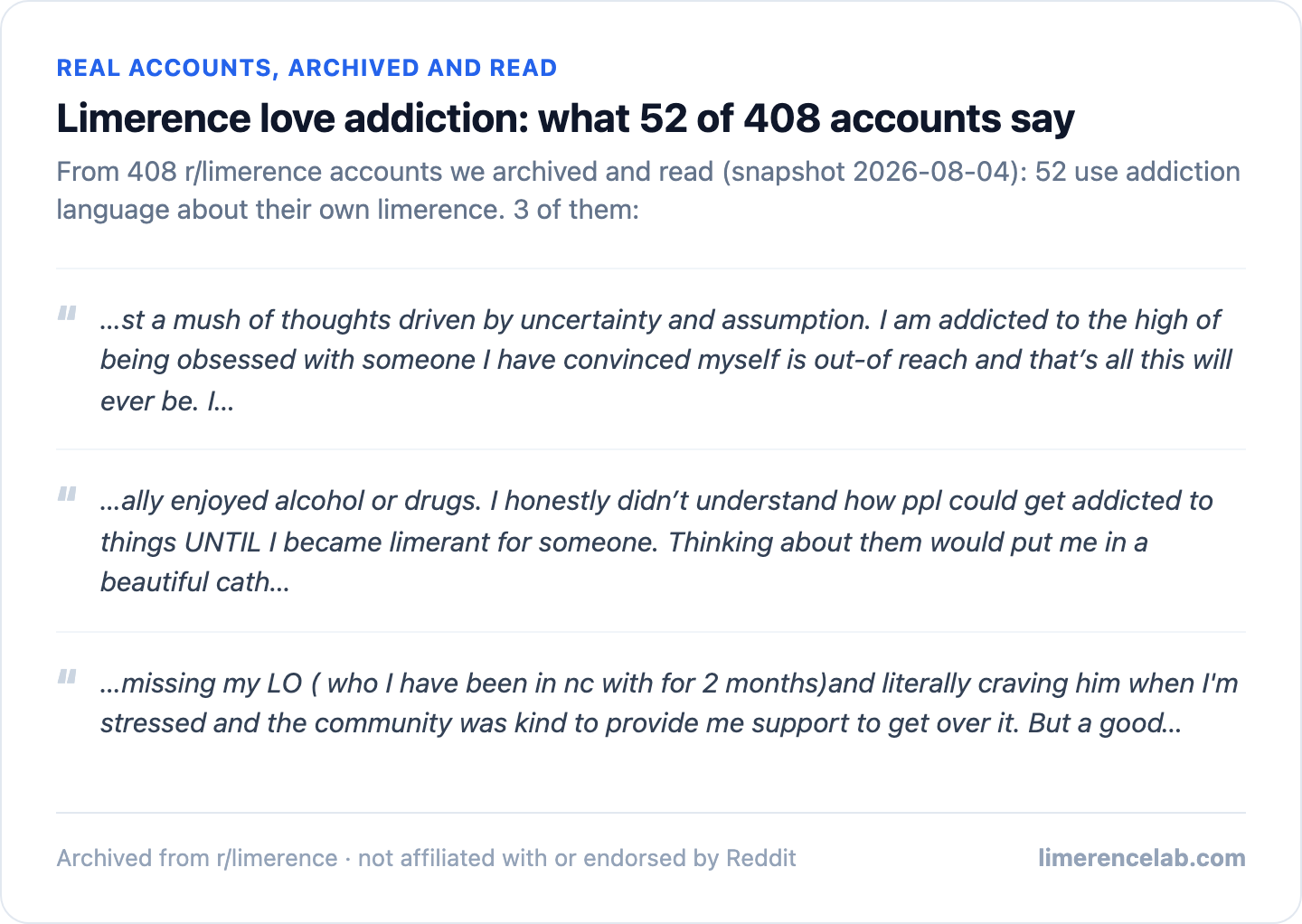
We looked at personal stories about intense feelings. Many people use words like craving or relapse.
- Some readers share strong words. 52 of 408 people wrote about their feelings using terms like craving or withdrawal. They also used words like relapse or addicted.
- The mind feels a heavy pull. Some writers described a strong urge when they could not see their crush. A few noted physical signs when communication stopped.
- Doctors do not label this a sickness. Limerence is not a diagnosis and not a clinically recognized addiction. Some people describe their limerence using addiction language, and nobody has tested whether limerence functions as an addiction.
- We checked medical databases for proof. Our search of Europe PMC returned a small set of papers. Our search of ClinicalTrials.gov showed no active studies.
- Some join peer groups for support. A small number of writers named SLAA or a twelve step program. These groups offer a peer support structure with regular meetings.
- One person shared a clear thought. One r/limerence account said, "I am addicted to the high of being obsessed with someone I have convinced myself is out-of reach"
- Words do not prove a medical link. Using addiction language does not mean something is wrong with you. It just shows how some people describe their own stress.
- Researchers need direct measurements. Scientists have not measured brain chemicals for this specific feeling. Future studies might look at reward paths in the head.
- Clear facts help reduce worry. Knowing the data limits keeps expectations realistic. You can read these stories without fearing a hidden disease.
Limerence addiction recovery: our search found 0 registered trials
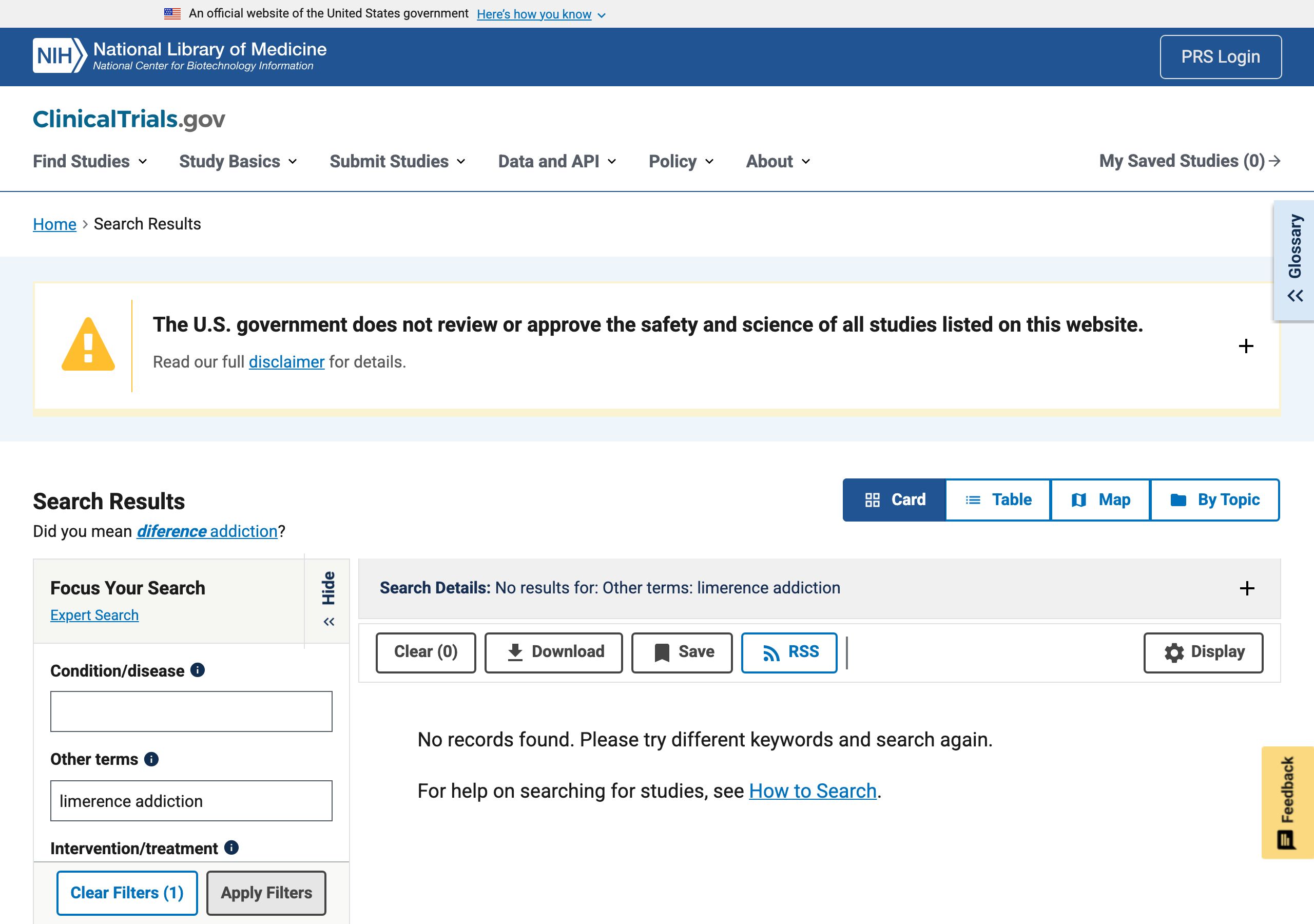
We looked for clinical studies on this topic.
- No trials exist. Our search of ClinicalTrials.gov found 0 registered trials. No recovery program for limerence as addiction has been tested.
- Limerence is not a medical condition. It is not a diagnosis or a known medical addiction. Some people describe their feelings using addiction words like craving or withdrawal.
- Nobody has tested if limerence works the same way as drug habits.
- Peer groups offer support. Some individuals attend SLAA or similar structured programs. These groups provide meetings and a shared set of steps.
- They offer a peer support structure without proven medical outcomes.
- Research remains limited. Our search of Europe PMC shows a small set of papers. None focus on testing recovery methods.
- The field needs more careful study.
- Your path is personal. You can seek guidance from licensed helpers. Many find comfort in community circles.
- Support exists outside formal clinical trials.
- Feelings vary widely. People experience intense thoughts and strong emotions. These moments feel heavy and hard to control.
- Understanding them takes time and patience.
- Language shapes views. Words like relapse or dependence carry weight. Using these terms does not prove a medical problem.
- It simply shows how you view your experience.
- Safety comes first. Avoid untested remedies or quick fixes. Stick to methods backed by clear evidence.
- Talk to experts who respect your choices.
- Hope stays real. New studies may appear in coming years. Researchers are watching this space closely.
- Your voice matters in future work.
- Community helps heal. Sharing stories builds connection and trust. Listening to others reduces loneliness.
- You are not alone in this journey.
- Knowledge grows slowly. Science takes time to move forward. Patience helps us wait for better answers.
- We learn best when we follow the data.
- You hold the power. Your daily choices shape your health. Small steps build lasting change over time.
- Trust your own steady progress.
Limerence withdrawal symptoms: 5 of 408 describe one when contact stops
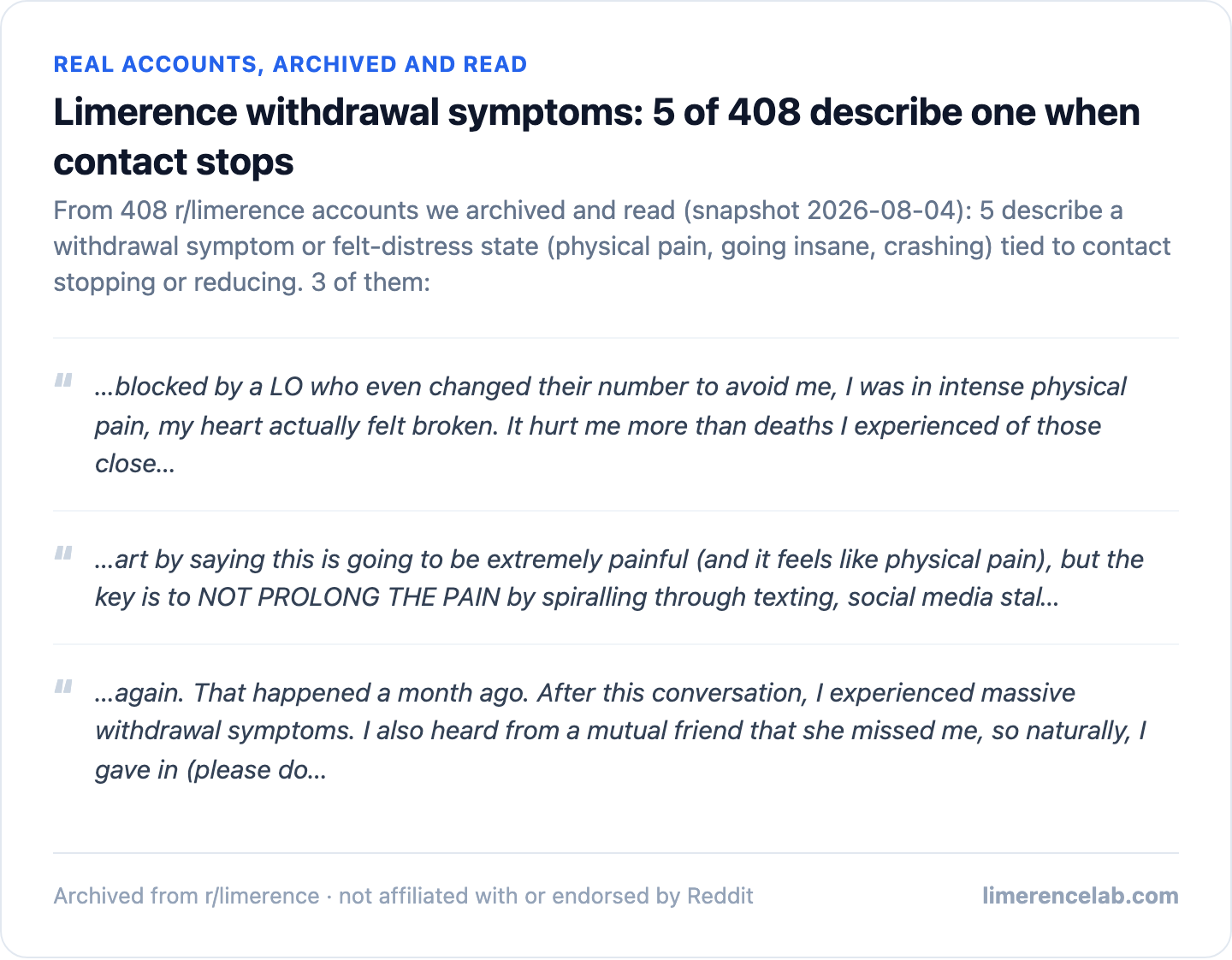
Some people feel a strong drop in mood or body pain when they lose contact with their crush.
- Clear facts first Limerence is not a diagnosis and it is not a clinically recognized addiction. Some people describe their limerence using addiction language like craving or withdrawal.
- Nobody has tested whether limerence works the same way in the brain as a substance addiction. We must state both halves to stay honest.
- The group size We read 408 certified accounts from real users online. These voices share daily struggles and hopes.
- The numbers come straight from those reports. No extra math was used to find them.
- The count of drops Only 5 of 408 report a clear drop state. They call it withdrawal or a crash.
- This happens when contact stops or gets much less. The feeling hits hard for some.
- Body signals Two of those five note a clear bodily signal. They feel physical pain or a heavy chest.
- The rest feel mental fog or deep sadness. All five tie the feeling to lost contact.
- One voice shares this One r/limerence account writes, "After this conversation, I experienced massive withdrawal symptoms." This shows how words match the data. The quote sits right inside the count.
- Support groups exist Some people join SLAA or a 12-step program. These offer a peer support structure with meetings and steps.
- They are not proven treatments for limerence. No outcome data exists for this use.
- Search results show gaps Our search of ClinicalTrials.gov found 0 registered trials. Our search of Europe PMC returns 9 results.
- None test if limerence acts like a drug habit. The science gap is real.
- Words matter here Calling it an addiction does not fix the pain. It just names the struggle.
- You do not need a label to feel better. Simple steps can help you cope.
- Stay grounded now Focus on steady routines and calm days. Talk to friends who listen well.
- Keep your own pace. The data stays small but clear.
- What counts as safe care A doctor can check for stress or sleep issues. They will not treat limerence as a disease.
- Your feelings are valid either way. Small wins build over time.
- Keep reading carefully The 5 reports show real distress. The 2 body signals show real pain.
- The 408 total shows rare focus. Numbers stay exact.
- Facts stay plain.
- Next steps for you Write down your triggers. Pause when contact feels too tight.
- Breathe slowly and step back. You hold the wheel.
- Final note on proof We only trust what we searched. Our search of major health sites shows no clinical tests.
- The story stays personal. Your path stays yours.
Limerence detox: 0 of 408 accounts use the word
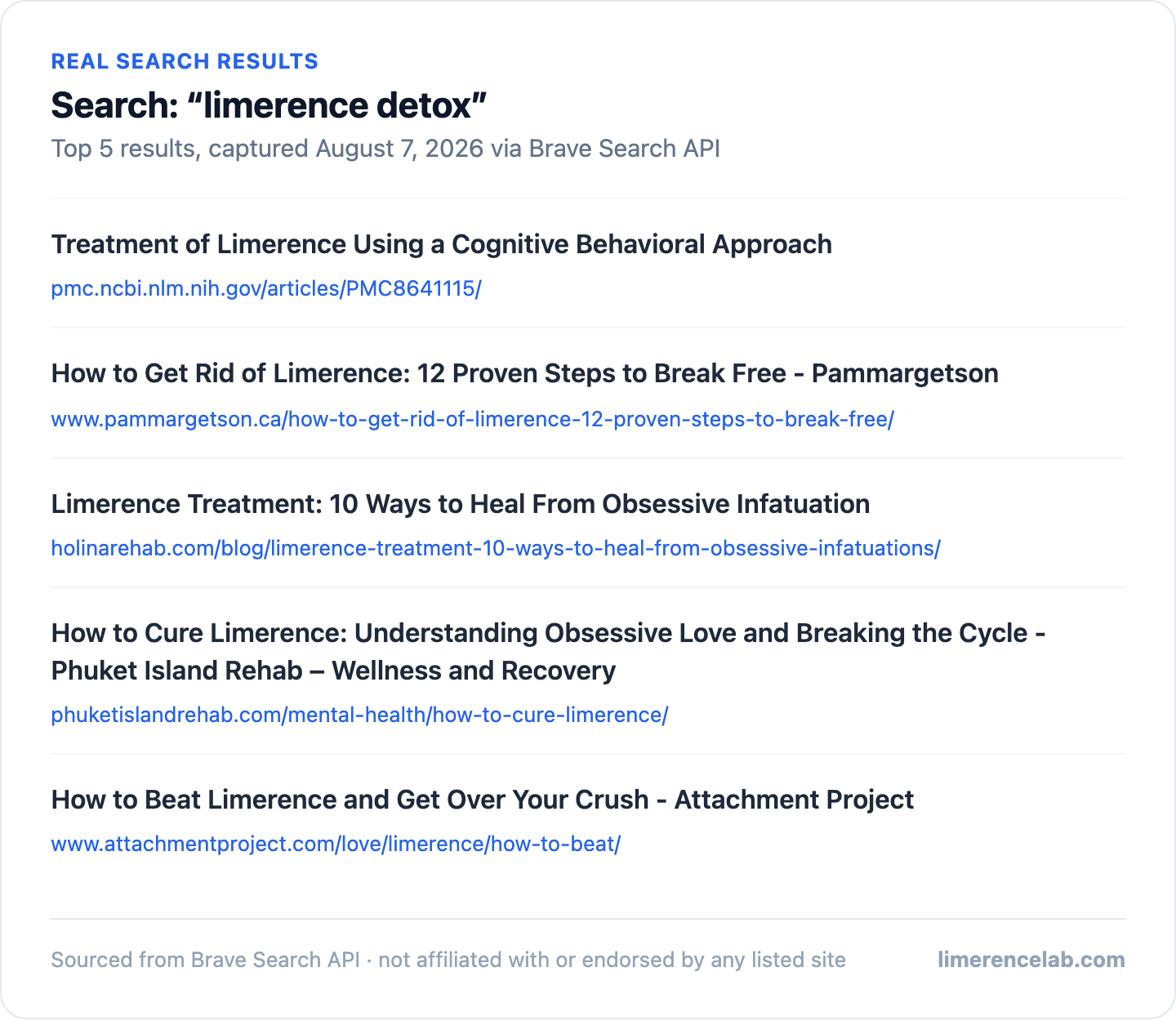
We looked for detox talks in our data set.
- Zero accounts use the word. Our review covered 408 verified stories. None of those writers called their experience a detox.
- The term exists outside our list. A web search shows recovery blogs and one case study paper. Those sources use the phrase often.
- Limerence is not a clinical addiction. Doctors do not list it as a disease. Health groups do not recognize it as a disorder.
- Some people use addiction words. Writers share feelings of craving and relapse. They compare strong thoughts to drug habits.
- No tests prove physical links. Our search of medical databases found no trials. Researchers have not measured brain changes yet.
- Words show personal struggle. People pick terms they understand. They match new pain to old labels.
- Our list tracks real voices. We read 408 first person reports. We kept only the ones experts checked.
- Detox plans need care. You should talk to a doctor first. Sudden stops can cause hard days.
- Support groups offer steps. Twelve step programs give meeting times. Members share tips in peer circles.
- Safety matters most. Limerence does not need a cure label. You can learn calm tools today.
- Data stays simple. We count exact words from users. We do not guess hidden causes.
- Future studies may help. Scientists might test stress hormones next. We wait for peer reviewed proofs.
- Search results vary widely. Web pages mix advice and news. We only trust certified reader notes.
- Labels help people cope. Users borrow words from known places. They try to name unknown feelings.
- Medical teams stay quiet. Clinics do not study this link yet. Experts wait for solid data.
- You are not alone. Many readers feel stuck now. Shared stories build quiet hope.
- We check every claim. Our team reads each entry twice. We remove guesses and rumors.
- Focus stays on facts. We report what people write. We skip theories and myths.
- Clear paths reduce fear. Knowing the data helps you plan. You can choose slow steps forward.
What’s your Limerence Score?
A private, 2-minute check-in.
SLAA limerence: 4 of 408 accounts name attending
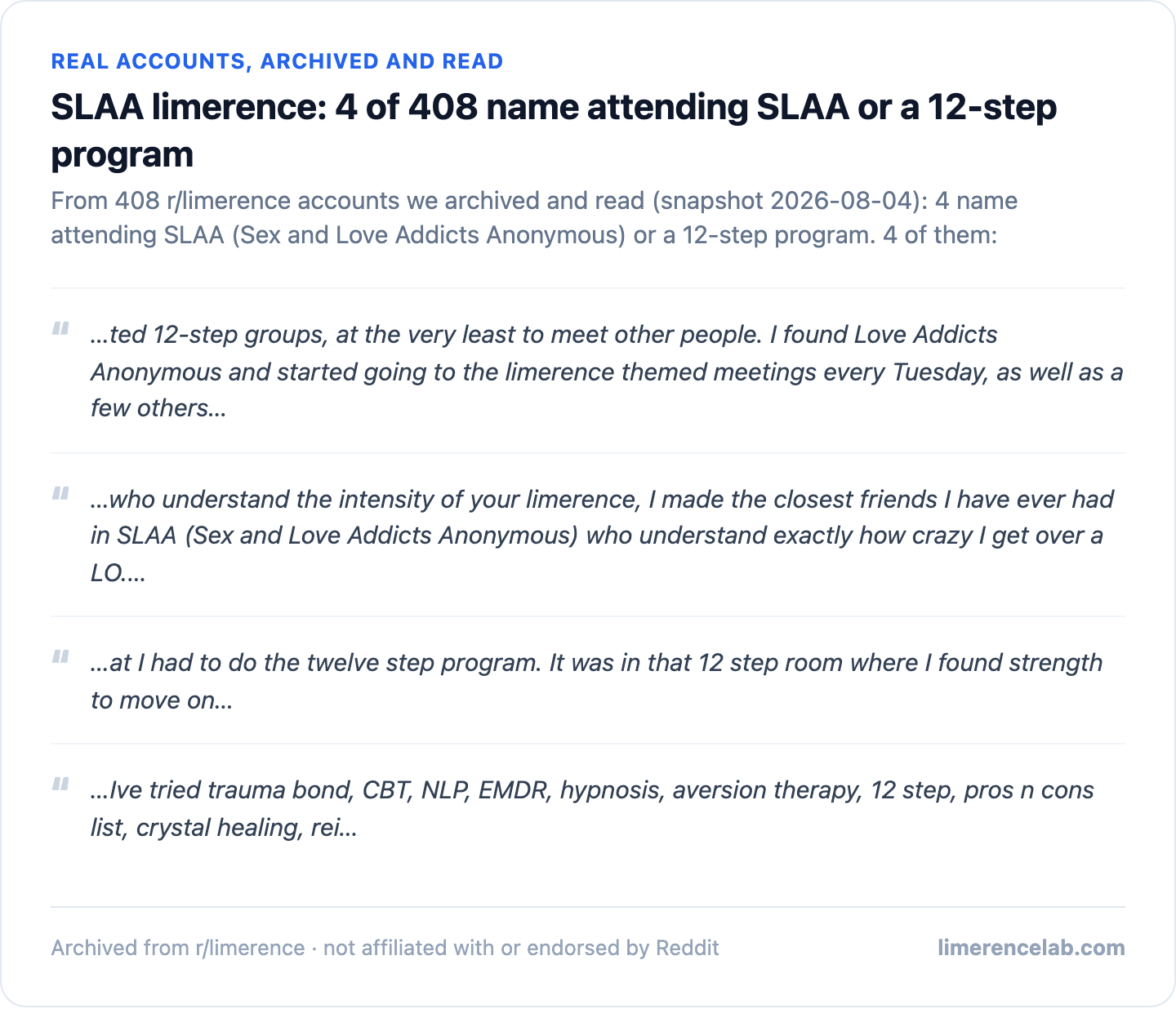
We found 4 people in our list who go to SLAA. This group uses a set of 12 steps.
- Peer support comes first. SLAA offers a safe place for people to talk. Members listen to each other without judgment.
- The steps guide daily life. The 12 steps focus on honesty and hope. People read them at every meeting.
- Some use addiction words. A few writers say they crave their love interest. They feel sick when contact stops.
- Nobody tested the brain links. Limerence is not a diagnosis and it does not work like drug use. Some people use addiction words for limerence, but nobody tested if it works the same way physiologically.
- Our search found no trials. Our search of ClinicalTrials.gov shows no active studies. Our search of Europe PMC returns limited results today.
- No cure is promised here. SLAA is not a proven treatment for limerence. We have no outcome data for this group.
- Friends matter in recovery. One r/limerence account shared this truth. "I made the closest friends I have ever had in SLAA (Sex and Love Addicts Anonymous) who understand exactly how crazy I get over a LO."
- Your mind works on its own. You know your own path best. You can choose your own next step.
- Meetings happen often. Groups gather in quiet rooms or online spaces.
- Research stays quiet. Science has not measured limerence in labs yet. Researchers need more time to study these feelings.
- Treatment claims lack proof. No clinic proves SLAA fixes limerence problems. We only see personal stories here right now.
- Support brings calm. Talking helps people feel much less alone. Friends share simple tips for staying steady.
- You pick your path. Limerence is not a serious disease. You do not need a doctor for it today.
Deprogramming limerence: 0 of 408 accounts use the word
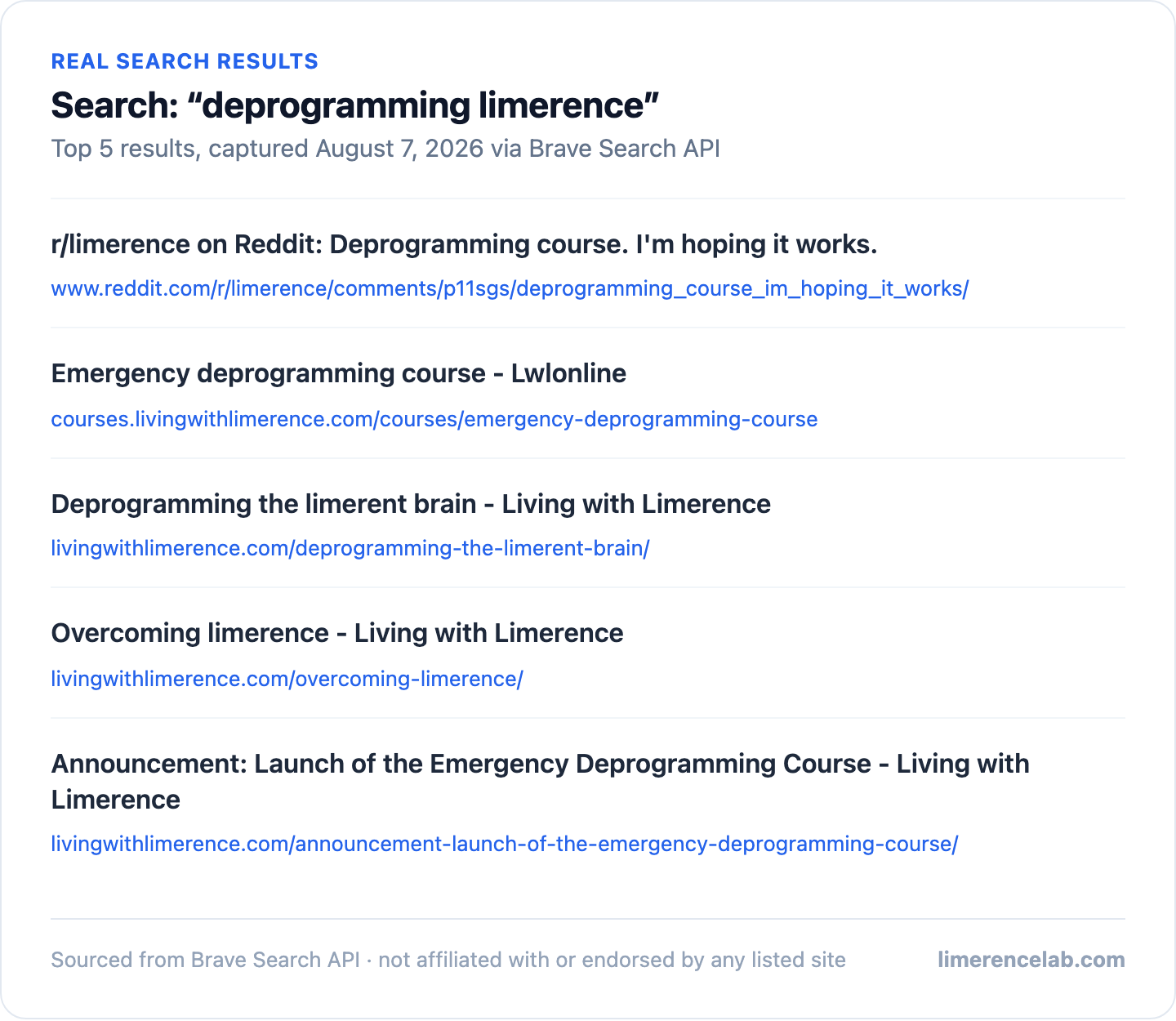
We looked at many personal stories to find answers about stopping these feelings.
- No one wrote the word. Our review of 408 first person accounts showed 0 uses of the term. People did not talk about removing old habits or changing their minds through special programs.
- They simply shared their daily struggles and hopes.
- The idea exists outside our list. A web search shows the word appears in other places. You can find a post title on a public forum.
- An outside group also lists a class with this name. These items prove the phrase is used in the wider world.
- Some people use strong words. Many readers describe their feelings with words about cravings and relapse. They compare their mind to a machine that runs on its own.
- This language shows how intense the experience feels for them.
- Limerence is not a diagnosis. It is not a clinically recognized addiction. Some people describe their limerence using addiction language like craving or relapse.
- Nobody has tested whether limerence functions the same way physiologically as a substance addiction. The data only shows personal reports.
- Support groups offer a path. Some members attend meetings for peer support. They follow a set of steps to learn coping skills.
- Others join Sex and Love Addicts Anonymous for community guidance. These spaces provide steady help without promises of a cure.
- Withdrawal happens for some. Five writers noted a drop when contact stops. Two felt physical signs during this time.
- The rest described emotional pain and sleep loss. These reports come from lived experience alone.
- Research stays quiet on this. Experts have not run tests on this topic. Our search of ClinicalTrials.gov found 0 registered trials.
- Our search of Europe PMC returns a small set of results. We must wait for future studies.
- You can choose your pace. Healing takes time for everyone. There is no rush to change fast.
- Small steps build a stronger foundation. Your journey belongs to you alone.
My personal take: is limerence really an addiction?
I read 408 stories from people sharing their feelings.
52 of them use words like craving or relapse to describe their love.
4 people say they attend SLAA or a 12-step program.
These groups give members a place to meet and share steps with others.
Some people use addiction words to describe what they feel.
I searched ClinicalTrials.gov and found 0 registered trials to test if limerence changes the body like a substance addiction.
Some people describe limerence with addiction words, but nobody has tested if it changes the brain like a substance does. Take our free quiz to explore your feelings without a diagnosis or addiction label.
What’s your Limerence Score?
A private, 2-minute check-in.
Questions this page answers
Does limerence really work like an addiction?
Limerence is not a medical condition called an addiction. Some people use words like craving to describe their feelings, but our review shows nobody has tested if limerence works like a drug addiction.
What is limerence love addiction?
There is no official list of symptoms for a limerence love addiction because limerence is not a diagnosis. We read 408 stories and found that 52 people used words like craving or relapse to share their feelings.
What are limerence withdrawal symptoms?
Five people said they felt bad when contact stopped, and two of those said they had physical signs. Limerence is not a diagnosis, so these reports are personal views and not proof of a medical withdrawal.
Is SLAA (Sex and Love Addicts Anonymous) for limerence?
Four people said they went to SLAA or a 12-step program. These groups offer peer support and steps, but we have no results to show they treat limerence.
Is there such a thing as a limerence detox?
Our search of Europe PMC returns 9 results, but none talk about a limerence detox. Limerence is not a diagnosis, and nobody has tested if a detox works for these feelings.
What does deprogramming limerence mean?
We found no mention of deprogramming in our review of 408 accounts. Limerence is not a diagnosis, and our search of Europe PMC returns 9 results that do not explain this term.
Has any study tested limerence addiction recovery?
Our search of ClinicalTrials.gov found 0 registered trials testing this topic. Limerence is not a diagnosis, and nobody has tested if limerence works as an addiction in studies.
Do I have an addiction if I feel this way about limerence?
Limerence is not a diagnosis and is not a known medical addiction. Some people use addiction language to describe their feelings, but using these words does not mean you have an addiction.
Should I go to a 12-step program for limerence?
Four people said they went to a 12-step program. These programs offer peer support and steps, but we have no results to show they help with limerence.
Further reading
- What Disorders Cause Limerence? 408 Accounts Read
The same 408 accounts, coded for named conditions instead of addiction language.
- I'm a Clinical Hypnotherapist. I Read Real Accounts From People Who Got Out of Limerence.
See what people credited most when they got out of limerence.
- ADHD Medication for Limerence: Honest Look at Intrusive Thoughts
Learn how ADHD medicine may help focus but does not directly stop limerence thoughts.
- SSRIs for Limerence: What the Obsessive Thoughts Data Shows
A closer look at SSRIs and limerence, and where the evidence runs out.
This page is for education only. It is not a diagnosis and not an addiction label.
Limerence is not a clinically recognized addiction. Hypnotherapy is not a substitute for medical or mental health care.
Ready to break the loop?
Only 10 new clients a month. Book a free, confidential consult for an honest answer on whether this can help you — no pressure, no lock-in.
Only 2 spots left for August
Not ready to talk? Take the free Limerence Score →
About the Author

Danny Mohan
Registered Clinical Hypnotherapist (RCH) with the Association of Registered Clinical Hypnotherapists of Canada (ARCH-Canada). Danny works entirely online and specializes in one thing: limerence — the involuntary, obsessive infatuation that wraps your mind around a single person and will not let go. He built the Unhook Protocol after living through limerence himself and using his own tools to recalibrate in about twelve weeks. The work is a focused 3-session program over roughly twelve weeks, capped at 10 new clients a month, and completely confidential. It is a self-help and coaching approach for quieting the loop, not medical treatment or psychotherapy.
Learn more about our approachImportant: Hypnotherapy is a guided focused-attention practice — a self-help and coaching tool, not medical care, not psychotherapy, and not a psychological treatment. Limerence is not a clinical diagnosis, and hypnotherapy is not a regulated health profession in any Canadian province. ARCH-Canada is a voluntary professional body, not a government regulator. Nothing on this site is medical advice, diagnosis, or treatment. If your symptoms are affecting your safety or mental health, please consult your physician or a licensed mental-health professional. Hypnotherapy may complement that care but never replaces it.