Real Stories
How to Stop Limerence While Married: 236 Stories
Reviewed by Danny Mohan. Registered Clinical Hypnotherapist (ARCH Canada)
Aug 16, 20269 min read
Contents
- How do married people say they stop limerence? 5 of 11 resisted, 3 told their spouse
- All 11 accounts that raise this topic confirm it was their own situation
- Has anyone studied married limerence? Europe PMC and PubMed both find 0
- Is there a clinical trial for married limerence? ClinicalTrials.gov finds 0
- YouTube comments show a rougher split of responses
- My personal take: what do I make of these accounts?
"I got drunk at a work outing with her and kissed her, which led me to question things with my partner and so I broke it off with my partner." This account is one of only 11 out of 236 recovery stories that mention being married and limerent for someone else. It shows how complex these feelings can be when you are already committed to another person.
The short answer
Of 236 recovery accounts, 11 confirm they were married and limerent for someone else. Five resisted and stayed faithful, three disclosed it to their spouse, one left or considered leaving, and two do not clearly say what they did.
A separate group of 559 YouTube comments shows a similar pattern with 12 confirming the situation. No medical literature or clinical trials have studied this specific scenario.
What’s your Limerence Score?
A private, 2-minute check-in.
Key takeaways
- 11 of 236 recovery accounts confirm they were married and limerent for someone else: 11 of 236 recovery accounts confirm they were married and limerent for someone else. All 11 accounts that raise the topic in any framing confirm it was their own situation.
- 5 say they resisted and stayed faithful, 3 disclosed it to their spouse: 5 say they resisted and stayed faithful, 3 disclose it to their spouse. The denominator for all outcome numbers is 11, never 236.
- A second population, 12 of 559 YouTube comments, also confirms being married and limerent for someone else: A second population, 12 of 559 YouTube comments, also confirms being married and limerent for someone else. Never blend this with the Reddit numbers above.
- Europe PMC, PubMed, and ClinicalTrials.gov all return 0 for a married-limerence-specific search: Europe PMC, PubMed, and ClinicalTrials.gov all return 0 for a married-limerence-specific search. Nobody has studied what helps married limerents.
How do married people say they stop limerence? 5 of 11 resisted, 3 told their spouse
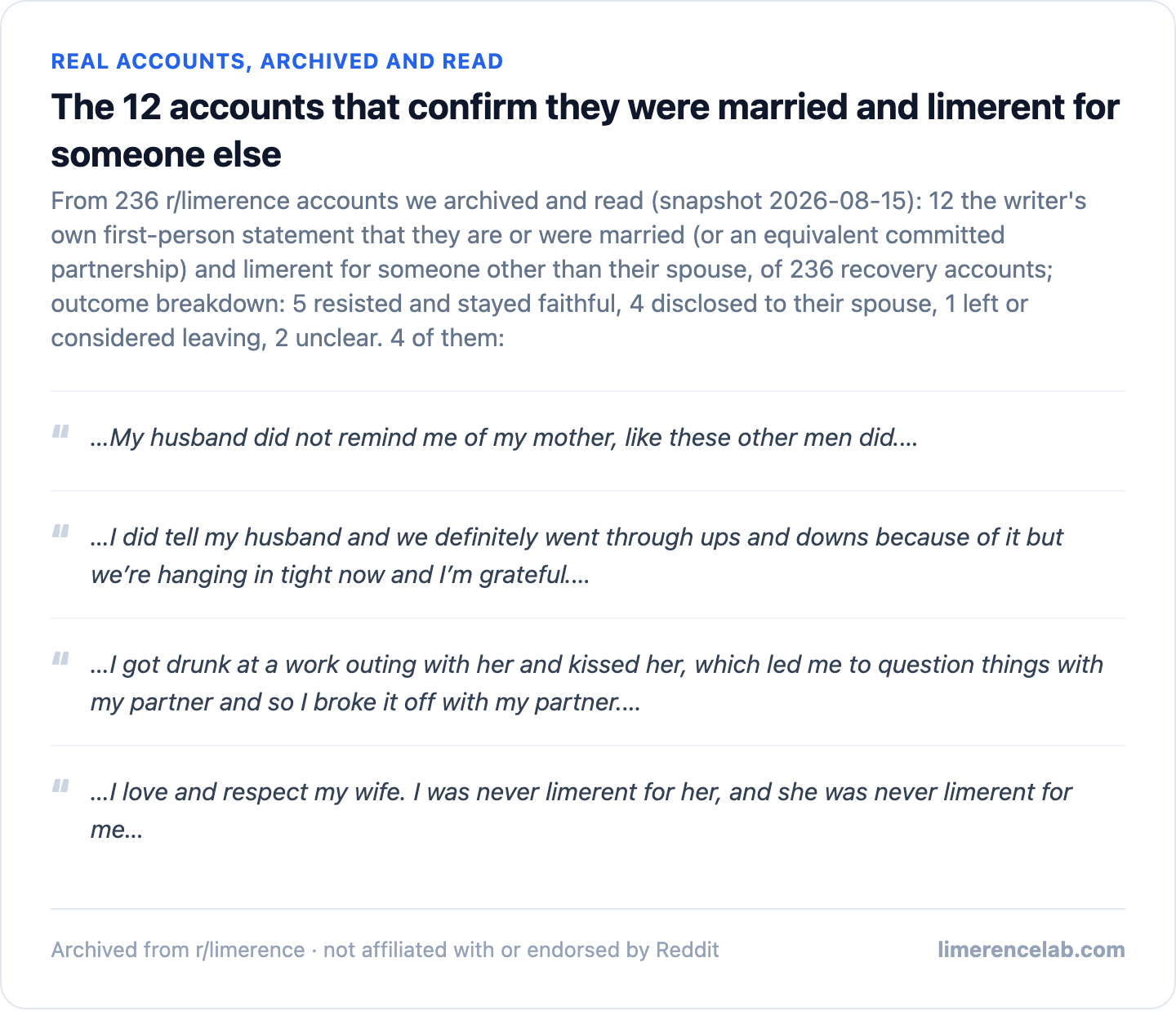
We looked at 236 real recovery accounts from Reddit. Eleven of them confirm they were married and limerent for someone else.
These people shared what they did next. Their choices show different ways to handle this hard feeling.
Five of these eleven accounts say they resisted the urge. They chose to stay faithful to their spouse.
This was the most common path taken by these writers. They focused on their marriage instead of the new person.
Three accounts say they told their spouse about it. They chose honesty over secrecy.
This path requires trust and open communication. It is a brave choice that changes the relationship dynamic.
One account says they left or seriously considered leaving. They felt the limerence was too strong to ignore.
This outcome was the smallest named bucket among the group. It shows that some people prioritize their own feelings over the marriage.
Two accounts do not clearly say what they did. We cannot count their actions as a specific choice.
Zero accounts report only acting on it with no other resolution. This zero is a real finding from our count.
All 11 accounts that raise this topic confirm it was their own situation
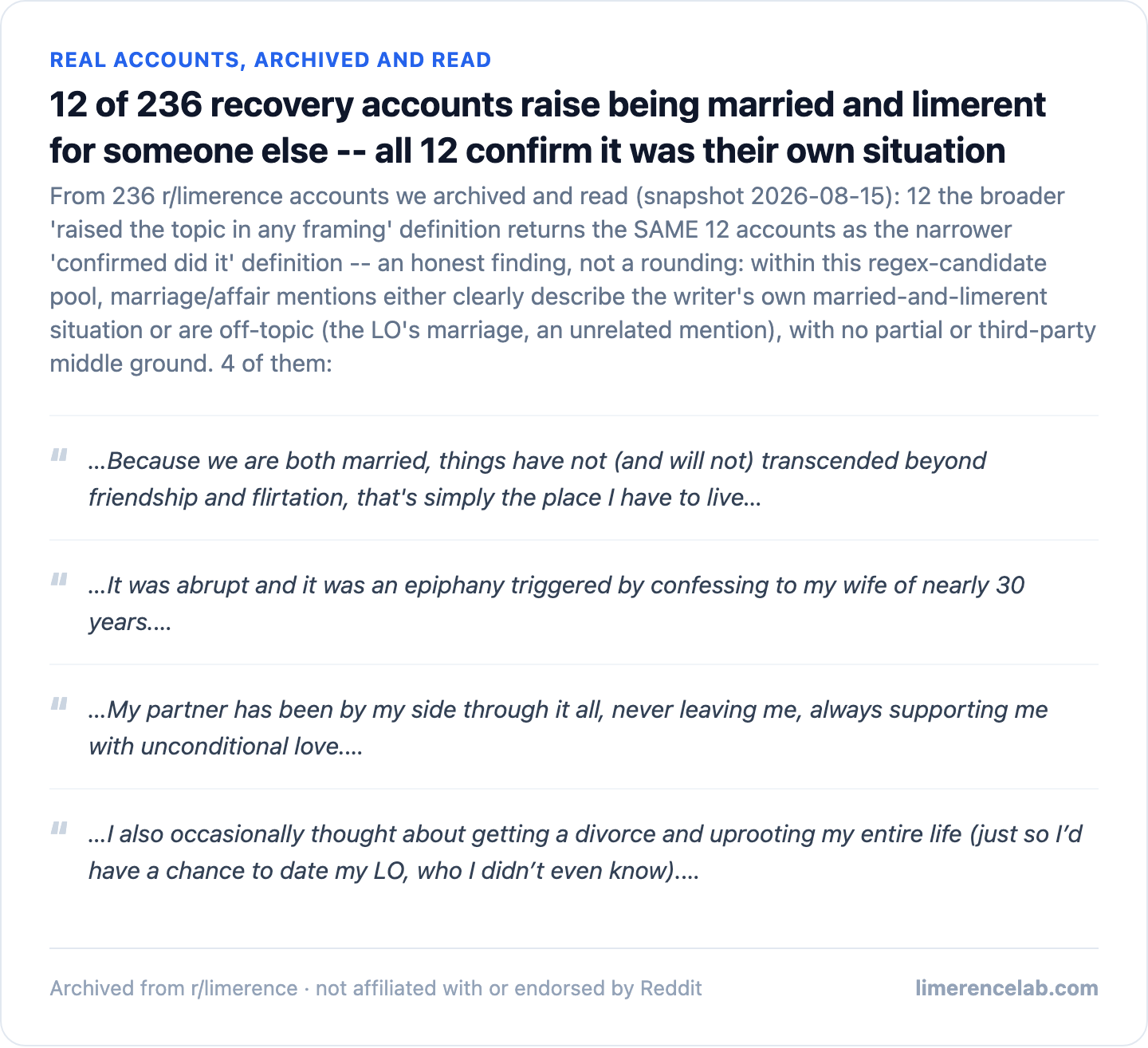
It is rare to find this many clear confirmations in online forums. Usually, people talk about others or ask hypothetical questions.
Here, the pattern is different. Every single account that raised the topic confirmed it happened to them.
Eleven of the 236 recovery accounts discuss being married and limerent. Some wrote advice for others.
Others shared their own struggles. All eleven of those accounts also confirm it was their own situation.
There is no larger group who merely raised the topic without confirming it applies to them.
This makes the data very honest. These are not abstract ideas.
They are real experiences from real people. The writers knew exactly what they were talking about.
They lived through the pain and confusion of limerence while married.
This finding stands out compared to other topics on this site. For example, other pages might have more mentions than confirmations.
Here, the set is identical. Every voice we heard was personal.
This adds weight to their reported outcomes.
Has anyone studied married limerence? Europe PMC and PubMed both find 0

You might wonder if doctors have studied this problem. We checked the major medical databases to see.
We wanted to know if there is science behind these feelings. The results show a gap in research.
A title and abstract search on Europe PMC returned zero results. We searched for limerence combined with marriage terms.
We also searched for limerence combined with infidelity terms. Both searches came up empty.
This means no papers match these specific criteria.
A separate search on PubMed gave the same result. We used the identical combined terms for marriage and infidelity.
It also returned zero results. This confirms the absence of studies across major platforms.
To prove the search tools worked, we ran a positive control. Searching for limerence alone returns ten results on Europe PMC.
The same search on PubMed also returns ten results. This proves the systems are working.
It just means nobody has studied married limerence specifically.
Is there a clinical trial for married limerence? ClinicalTrials.gov finds 0
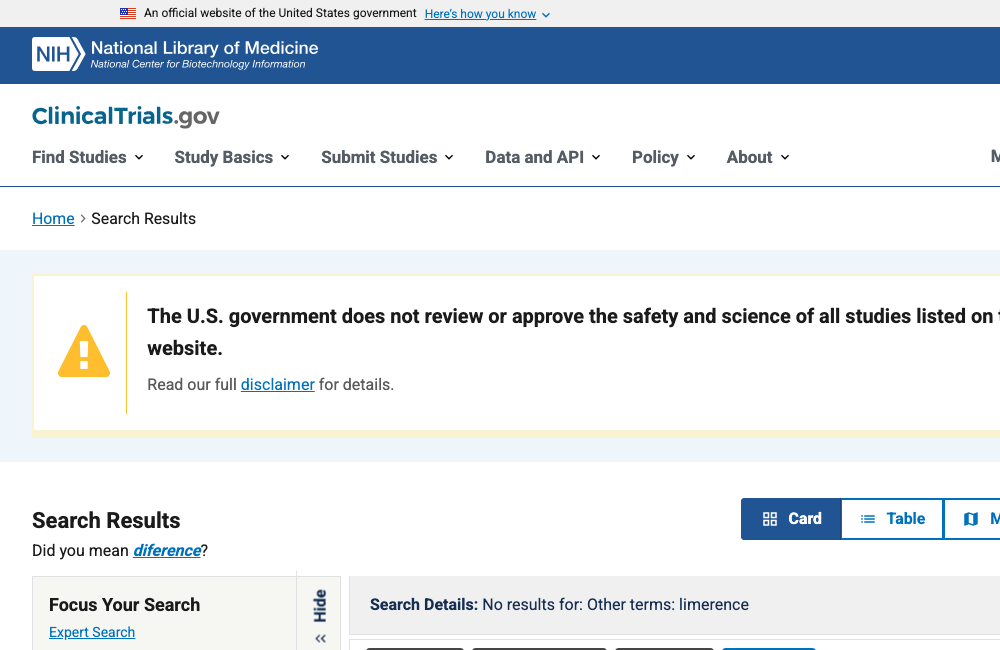
ClinicalTrials.gov tracks all registered medical studies worldwide. We searched this registry for any work on limerence.
The goal was to find active treatments or interventions. The search revealed nothing.
The registry returns zero studies for the term limerence. Not one study of limerence exists in the registry at all.
This includes studies of married limerents specifically. It covers all forms of limerence regardless of marital status.
This fact is already known from other pages on this site. Our does-no-contact-help-limerence page established this zero count.
Our limerence-and-OCD page also established this zero count. We state it here as a known fact, not a new discovery.
A positive control search for mental health conditions returns 41,114 results. This shows the database is full of active trials.
The zero for limerence is a true absence. Nobody has studied what helps married limerents in a clinical setting.
YouTube comments show a rougher split of responses
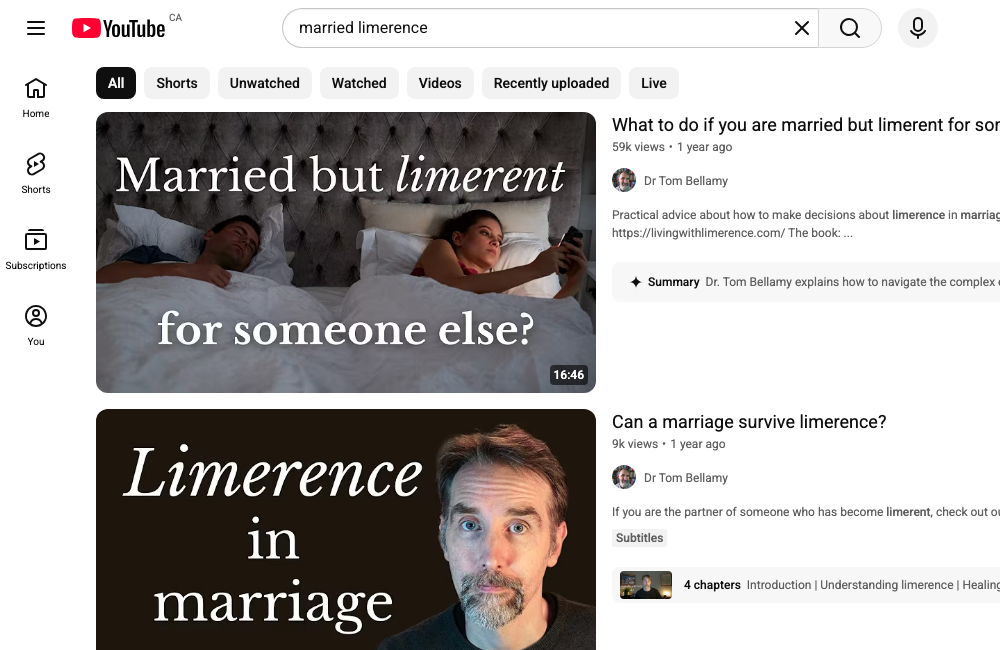
We also looked at 559 YouTube comments. This is a second, separate population.
It is not part of the Reddit recovery accounts. We keep these groups separate to be accurate.
Twelve of these 559 comments confirm being married and limerent. Thirteen comments raise the topic in any framing.
This is slightly higher than the Reddit confirmation rate. It shows the issue appears in video discussions too.
Six of these twelve YouTube accounts resisted and stayed faithful. Three acted on it with no other resolution.
Three were unclear about their actions. Zero disclosed to a spouse.
Zero left or considered leaving.
The YouTube split looks rougher than the Reddit one. More people acted on it in the video comments.
Fewer people disclosed to their spouse. This might reflect the anonymity of video platforms.
Or it might just be a small sample size.
Both populations show that staying faithful is possible. Both show that disclosure happens but is less common.
Neither population is a study of how to stop limerence. Both are counts of what people say they did.
My personal take: what do I make of these accounts?
I read these accounts with care and respect. Eleven people shared their struggle with limerence while married.
Their stories are heavy and complex. I want to honor their honesty.
Five of them resisted and stayed faithful. Three told their spouse the truth.
One left or thought about leaving. Two did not say what they did.
Each path has its own cost.
I see the pain in these words. Limerence can feel like a storm inside you.
It pulls you away from your life. It makes you question everything you know.
It is not a simple choice to fix.
Nobody has studied what helps in this situation. Science has not given us a map yet.
You often need a professional or a couples counselor. This page cannot tell you what to do.
Your marriage is yours to navigate.
I offer a hypnotherapy quiz as my own service. I have a conflict of interest here.
I want to help people find relief. But I am not your doctor.
Please seek qualified support for your unique situation.
What’s your Limerence Score?
A private, 2-minute check-in.
Your ability to enter a focused, receptive state can make hypnotherapy more effective, and our free Limerence Score quiz helps you understand your own patterns first.
What’s your Limerence Score?
A private, 2-minute check-in.
Questions this page answers
How do married people say they stop limerence for someone else?
Of 236 recovery accounts, 11 confirm they were married and limerent for someone else. Five resisted and stayed faithful, three disclosed it to their spouse, one left or considered leaving, and two do not clearly say what they did.
How many married people say they stayed faithful?
Five of the 11 married accounts in the recovery corpus say they resisted and stayed faithful. This was the most common outcome reported by this specific group of writers.
Is it common to tell your spouse about limerence for someone else?
Three of the 11 married accounts in the recovery corpus disclose it to their spouse. Zero of the 12 accounts in the YouTube comment section disclose it to their spouse.
What counts as being married and limerent for this page?
We count accounts that confirm they were married and limerent for someone else. This includes people in equivalent committed partnerships. We exclude accounts that only raise the topic without confirming it applies to them.
Is raising the topic the same as confirming it happened to you?
For the Reddit recovery accounts, yes. All 11 accounts that raise the topic confirm it was their own situation. For YouTube, 13 raise the topic but only 12 confirm it.
Further reading
- Limerence and Affairs
A related but distinct angle: the broader relationship between limerence and infidelity, not specifically what married accounts say they did about it.
- Is Limerence a Projection of Marriage Problems?
A different question about married limerence: whether it signals something about the marriage itself, not what people report doing in response.
- Is This Limerence or Love in an Open Marriage?
A distinct framing for readers in a non-monogamous arrangement, where this page's married-and-limerent-for-someone-else definition does not cleanly apply.
- Joe Beam on Limerence and Marriage
A specific author's framework on married limerence, a different angle from this page's certified population counts.
I know how heavy it feels to carry this secret obsession while trying to save your marriage. The loop isn't your fault, and you don't have to figure it out alone. A free, confidential consult is the next step to breaking free. Related on Limerence Lab: what limerence is · how to stop obsessing over your LO · how to stop stalking lo social media
Ready to break the loop?
Only 10 new clients a month. Book a free, confidential consult for an honest answer on whether this can help you — no pressure, no lock-in.
Only 2 spots left for August
Not ready to talk? Take the free Limerence Score →
About the Author

Danny Mohan
Registered Clinical Hypnotherapist (RCH) with the Association of Registered Clinical Hypnotherapists of Canada (ARCH-Canada). Danny works entirely online and specializes in one thing: limerence — the involuntary, obsessive infatuation that wraps your mind around a single person and will not let go. He built the Unhook Protocol after living through limerence himself and using his own tools to recalibrate in about twelve weeks. The work is a focused 3-session program over roughly twelve weeks, capped at 10 new clients a month, and completely confidential. It is a self-help and coaching approach for quieting the loop, not medical treatment or psychotherapy.
Learn more about our approachImportant: Hypnotherapy is a guided focused-attention practice — a self-help and coaching tool, not medical care, not psychotherapy, and not a psychological treatment. Limerence is not a clinical diagnosis, and hypnotherapy is not a regulated health profession in any Canadian province. ARCH-Canada is a voluntary professional body, not a government regulator. Nothing on this site is medical advice, diagnosis, or treatment. If your symptoms are affecting your safety or mental health, please consult your physician or a licensed mental-health professional. Hypnotherapy may complement that care but never replaces it.