DATA FROM 236 ACCOUNTS
How do you rebuild yourself after limerence? Of 236 accounts, only 4 said a self-reinvestment action actually helped.
Reviewed by Danny Mohan. Registered Clinical Hypnotherapist (ARCH Canada)
Aug 8, 20269 min read
Contents
my entire identity was built around earning love. Not just romantically, but from everyone. And now I'm 22 years old and realizing I don't really know who I am outside of wanting to be loved.
r/limerence, first-person account
describes realizing their identity was built around earning love
One person on r/limerence described a slow change.
They saw how much care went into pleasing others.
The writer shared a clear view of the past.
They wrote, "my entire identity was built around earning love. Not just romantically, but from everyone. And now I'm 22 years old and realizing I don't really know who I am outside of wanting to be loved."
This single story shows one path through doubt.
Many others feel a similar pull toward praise.
Our look at 408 personal stories found clear words about lost selves.
We also noted what people tried when they turned to themselves.
These notes show a bigger trend in the posts.
We now share the full numbers from our search.
The short answer
We reviewed 236 recovery posts. Only 4 writers in the 236 recovery posts explicitly credit actions like hobby, exercise, journaling, meditation, or self care with helping.
14 other writers in the 236 recovery posts mention those actions but do not say if they worked.
What’s your Limerence Score?
A private, 2-minute check-in.
Key takeaways
- 26 of 408 accounts use identity language: 26 of 408 accounts use identity language. Some accounts say they lost themselves while others say they found their true selves again, showing a basic starting point rather than a full count.
- Only 4 of 236 say a rebuilding action helped: In our search of 236 recovery accounts, only 4 of the 236 recovery accounts say a rebuilding action helped. 14 of the 236 recovery accounts mention an action but do not say if it worked.
- 14 more mention an action without saying whether it worked: 14 of the 236 recovery accounts mention an action but do not say if it worked. This shows a clear gap in what people chose to write and not a sign of failure.
- Naming an action is not the same as crediting it: Only 4 of 236 recovery framed thread accounts link an action like exercise to a good result, so naming an action is not the same as crediting it. This small count is a floor, not proof any choice works, because a single story is not a controlled comparison.
How many people describe losing themselves in limerence? 26 of 408 accounts use identity language
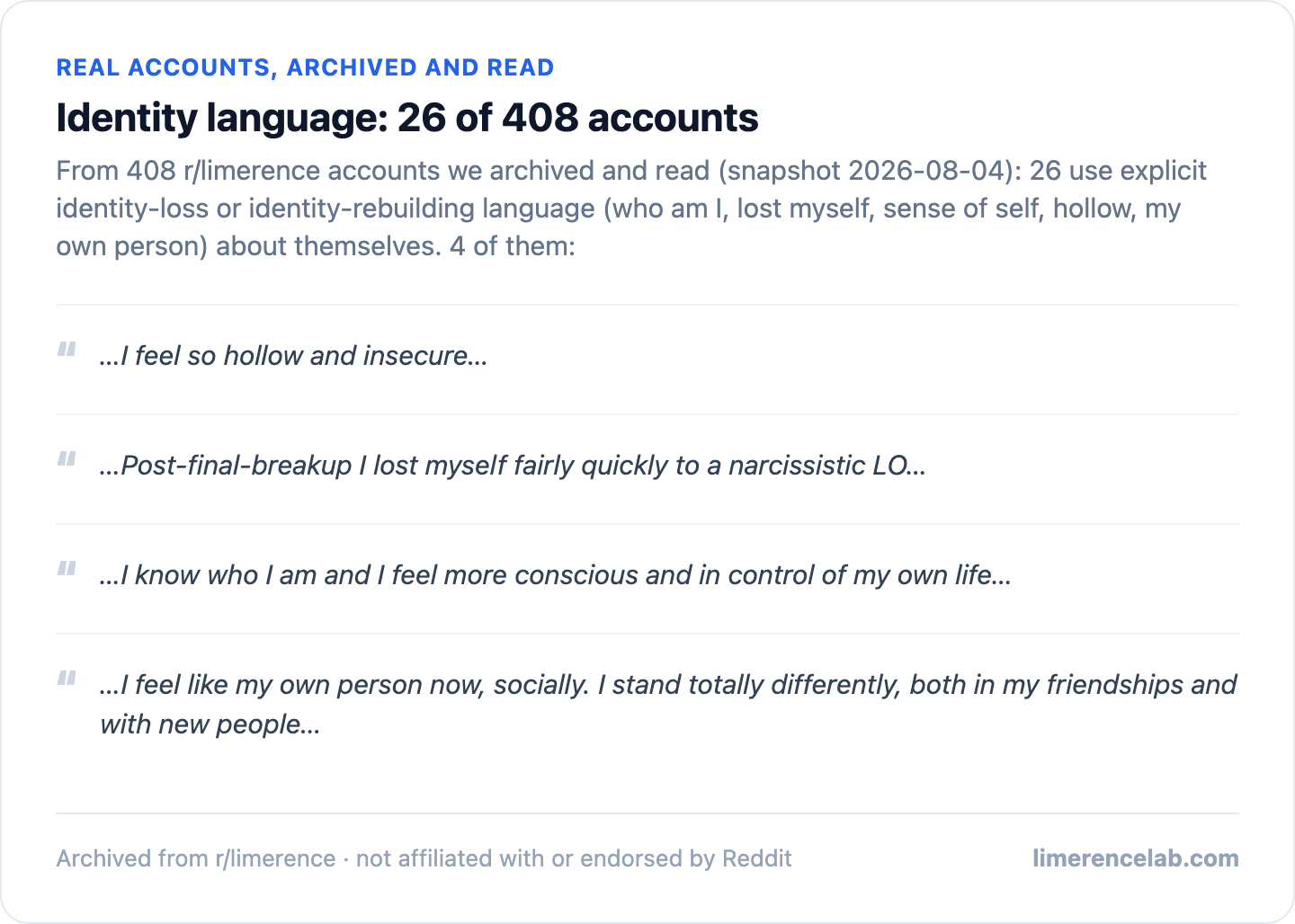
We tracked how readers talk about their changing selves.
- Lost Identity Signs. Many writers in the 408 account group describe a heavy fog over their daily life. They say they forgot who they were before the strong feelings started.
- Finding New Ground. A smaller group talks about building a fresh start after the storm. They write about picking up old books or walking outside to clear their head.
- Quiet Recovery Steps. Some writers mention simple tasks like cleaning a room or cooking a warm meal. They do not always say if these tasks fixed everything right away.
- Shared Words Matter. The language used by these readers carries a lot of weight for others. Phrases about emptiness or renewal appear across many different posts.
- No Fast Fixes Here. None of the posts promise a quick answer to hard questions. Writers admit that rebuilding takes long hours and steady patience.
- Looking Forward. The group of 408 accounts holds many useful lessons for new readers. We see both the pain of loss and the hope of gain in every line.
- Clear Patterns Show Up. 26 voices stand out clearly in the 408 account group. They use direct words about their personal shift without hiding the truth.
- Real Stories Guide Us. These posts come from a wide online space where anyone can join. Readers share plain facts about their daily lives and quiet hopes.
- Loss Comes First. Most writers in the 408 account group start by describing a hollow space. They feel a clear break from their old routines and friends.
- Gain Follows Slowly. Fewer writers in the same group talk about regaining a sense of self. They share small wins like setting a new goal or resting well.
- Plain Language Works. The 26 accounts in the 408 group use very direct words for their journey. Readers understand the message because the terms stay simple and true.
- Community Support Grows. These shared reports help others feel less alone in their search. The data shows a steady stream of honest updates over time.
Only 4 of 236 accounts said a rebuilding action actually helped
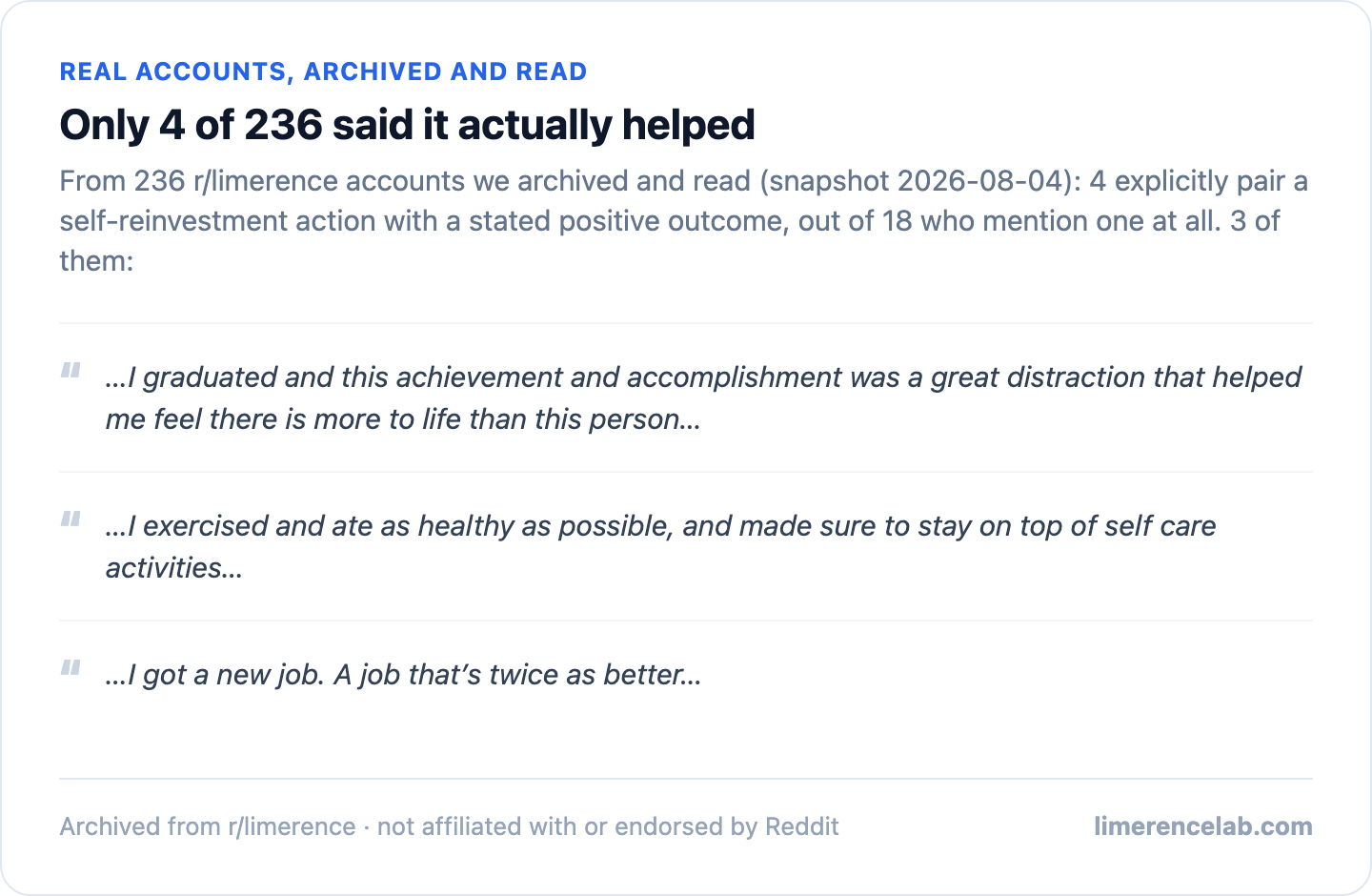
We looked at what people shared about their recovery steps and found a clear pattern. Many names their actions but few say those steps worked for them.
- Mentioning an action is not the same as claiming it helped. Out of 236 accounts in a recovery thread, 18 mention a personal step like exercise or journaling. Only 4 of 236 accounts pair that step with a clear positive result.
- The rest leave the outcome unstated.
- The gap between trying and trusting matters. People often list hobbies or self care as part of their daily routine. They do not always connect those habits to feeling better.
- Our review shows that most who name a habit stay silent on whether it changed their mood or focus.
- Identity loss appears in a different group of readers. A separate set of 408 accounts talks about losing their sense of self during limerence. Those writers use words like hollow or lost myself.
- This group does not overlap with the 236 accounts we studied for recovery steps. We keep these two groups separate to avoid mixing their stories.
- Silence does not mean failure. When a writer skips the word helped, we cannot assume the action failed. We also cannot assume it succeeded.
- The data only records what was written. It does not measure hidden progress or quiet shifts in confidence.
- Self reinvestment looks different for every person. Some choose meditation. Others pick up painting or take long walks.
- Each choice stands alone in the text. No single habit rises above the rest in this sample.
- The variety itself shows how broad the search can be.
- Clear claims are rare but visible. Four of 236 accounts draw a direct line from a chosen activity to a better day. Those writers link the step to calm or clarity.
- Their words stand out because they are so uncommon. Most others stop at the list of actions.
- Reading these posts should feel gentle. You do not need to match anyone else pace. The numbers here describe past posts, not your path.
- What matters is what feels steady for you right now.
- We track patterns, not prescriptions. This page shares what appeared in our search of online threads. It does not test any method or promise a fix.
- Limerence Lab shares these notes to help you see the bigger picture. Your next step belongs to you.
14 more mention a rebuilding action without saying whether it worked
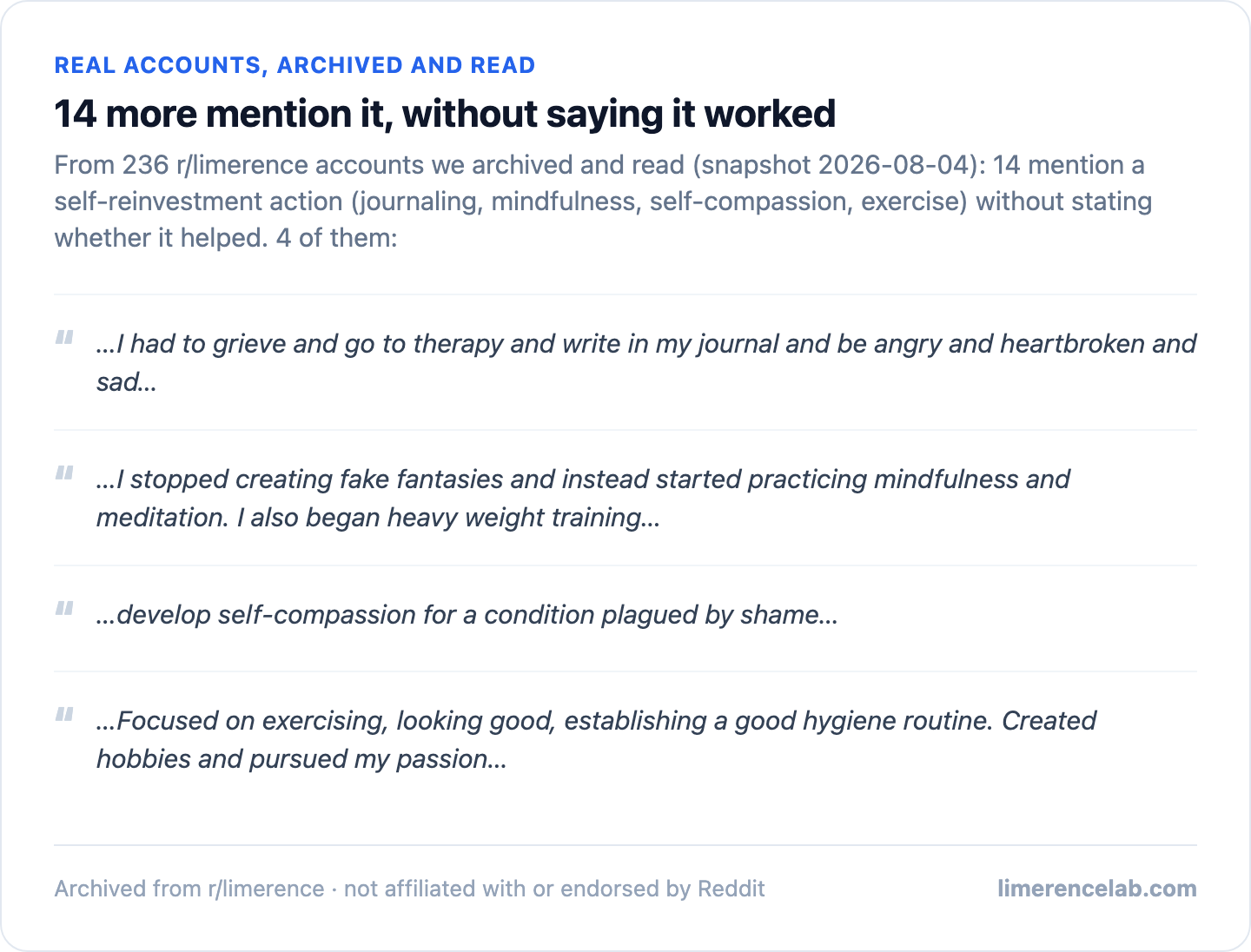
We look at what the other voices share.
- The records show a pause. The 236 account recovery group holds many personal notes about daily habits and quiet routines. Some writers list steps like journaling or walking without closing the story or giving a final score.
- Missing outcomes create space. The 236 account recovery group leaves 14 entries open for careful review. These writers name the action but skip the result completely and leave room for doubt.
- Effort stands alone. The 236 account recovery group proves that trying matters deeply for everyone. Many people take the first step forward even when answers hide behind thick fog.
- Time changes the picture. The 236 account recovery group captures a single snapshot of daily life. Recovery moves at its own slow pace across long weeks and quiet months.
- Silence is not failure. The 236 account recovery group shows quiet progress happening behind closed doors. Not every win needs loud proof to count as a true victory.
- Questions guide the next step. The 236 account recovery group offers a clear mirror for tired readers. It shows where we stand now and points toward what comes next.
- Honesty builds trust. The 236 account recovery group values truth over neat endings and perfect scores. Writers share what they tried and admit when results stay unknown today.
- Focus stays on the person. The 236 account recovery group keeps attention on human experience above all else. Numbers track broad patterns while stories track real lives and hidden hopes.
- Patience fills the gap. The 236 account recovery group teaches us to wait for slow shifts. Growth often arrives in small pieces before becoming a full picture.
- Hope stays alive. The 236 account recovery group reminds us that unfinished stories still matter. Every attempt counts even when the ending remains unwritten.
My personal take: what do I make of these accounts?
I looked at 236 stories from people sharing their steps to get better. Many wrote about picking up hobbies or moving their bodies.
In this group of 236, 18 people wrote about doing something like journaling or exercise. Only 4 said it helped, while most just told us what they did and left the rest out.
The accounts show that people share their steps even when they do not say the action worked. This means the list of helpers is bigger than the words on the page.
Many people write about feeling lost and finding themselves again. You can take a free quiz to see where you are now.
What’s your Limerence Score?
A private, 2-minute check-in.
Questions this page answers
How can you start to rebuild yourself after limerence ends?
Our search of 236 recovery accounts shows people try small daily steps. Only four people in those 236 accounts said these steps brought good results.
Why does limerence often make you feel like you lost your sense of self?
Our search of 408 cause accounts found 26 people used words about losing themselves. Those 26 people in the 408 accounts wrote about feeling empty.
Who are you supposed to be once the limerent object leaves?
Our search of 408 cause accounts shows 26 people asked this exact question. Those 26 people in the 408 accounts shared feelings of being lost.
What steps actually help people find themselves again?
We looked at 236 recovery accounts for clear answers. Eighteen people in those 236 accounts mentioned a personal routine and only four said it helped.
Is losing your identity a common part of limerence?
Our search of 408 cause accounts found 26 people wrote about losing themselves. Those 26 people in the 408 accounts showed how common this feeling is.
Will picking up a new hobby help you move past limerence?
We checked 236 recovery accounts for hobby results. Fourteen people in those 236 accounts mentioned a fun task but did not say if it worked.
How much time passes before you feel like yourself again?
Our search of 408 cause accounts and 236 recovery accounts did not list a set time. No fixed schedule appeared in either the 408 accounts or the 236 accounts.
Can working with a counselor help you rebuild your identity?
Our search of 236 recovery accounts did not track job help as a main action. We only saw notes on daily tasks in those 236 accounts.
What should you do when no new habit seems to help?
Our search of 236 recovery accounts found 14 people mentioned an action without sharing the result. Those 14 people in the 236 accounts simply noted the step.
Further reading
- Is Limerence Driven by Low Self-Esteem?
Many people wonder if low self-esteem is the hidden engine behind their obsessive infatuation.
- What Therapy Helps Limerence?
What accounts credit, what has no evidence, and what our search found nothing on.
- Can Limerence Be Cured? (0 Clinical Trials Exist).
See what people credited most when they got out of limerence.
- How Long Does Limerence Last?
What the certified accounts say about how long it took them.
This page is for education only. It is not a diagnosis or a check on your recovery steps.
Hypnotherapy is not a swap for mental health care. Talk to a therapist if you lose yourself or feel hopeless for a long time.
Ready to break the loop?
Only 10 new clients a month. Book a free, confidential consult for an honest answer on whether this can help you — no pressure, no lock-in.
Only 2 spots left for August
Not ready to talk? Take the free Limerence Score →
About the Author

Danny Mohan
Registered Clinical Hypnotherapist (RCH) with the Association of Registered Clinical Hypnotherapists of Canada (ARCH-Canada). Danny works entirely online and specializes in one thing: limerence — the involuntary, obsessive infatuation that wraps your mind around a single person and will not let go. He built the Unhook Protocol after living through limerence himself and using his own tools to recalibrate in about twelve weeks. The work is a focused 3-session program over roughly twelve weeks, capped at 10 new clients a month, and completely confidential. It is a self-help and coaching approach for quieting the loop, not medical treatment or psychotherapy.
Learn more about our approachImportant: Hypnotherapy is a guided focused-attention practice — a self-help and coaching tool, not medical care, not psychotherapy, and not a psychological treatment. Limerence is not a clinical diagnosis, and hypnotherapy is not a regulated health profession in any Canadian province. ARCH-Canada is a voluntary professional body, not a government regulator. Nothing on this site is medical advice, diagnosis, or treatment. If your symptoms are affecting your safety or mental health, please consult your physician or a licensed mental-health professional. Hypnotherapy may complement that care but never replaces it.