CENSUS OF 408 ACCOUNTS
Why does limerence jump from one person to another? We read 408 real accounts. 10 use new-LO or other switching language.
Reviewed by Danny Mohan. Registered Clinical Hypnotherapist (ARCH Canada)
Aug 8, 20269 min read
Contents
In elementary school, it was mostly the Jonas brothers, then middle school, I moved on to real people
r/limerence, first-person account
describes limerence recurring across elementary, middle, and high school
One person on r/limerence described their youth.
They said their thoughts shifted often.
They wrote, "In elementary school, it was mostly the Jonas brothers, then middle school, I moved on to real people".
This post shares a personal view.
It does not show what happens to all readers.
We looked at many posts online.
A small group uses words about shifting their focus.
Out of 408 first-person accounts we read, a few use switching language.
The short answer
Accounts from 408 people describe deep feelings for others. Ten of them use switching language to describe wanting to switch.
Seven of them look for a new person to love. Three of them share other signs of moving their attention.
What’s your Limerence Score?
A private, 2-minute check-in.
Key takeaways
- 10 of 408 accounts use new-LO or switching language: 10 of 408 accounts use switching language to describe wanting to switch. This count is a floor and not a full rate because quiet changes are not counted.
- 7 of 408 accounts describe finding a new LO: Seven of 408 accounts use switching language to describe wanting a new LO. This pattern is the dominant way people share their experience.
- 3 accounts use other switching signals, combined: 3 accounts use other switching signals, combined. These readers use switching language to describe wanting to share their feelings, move on, or name a prior love, making this pattern rare.
- Using switching language is not proof of a pattern: Using switching language is not proof of a pattern. 10 of 408 accounts use switching language, and one story is not a doctor check for how all people feel.
Why does limerence jump to a new LO? 7 of 408 accounts describe it
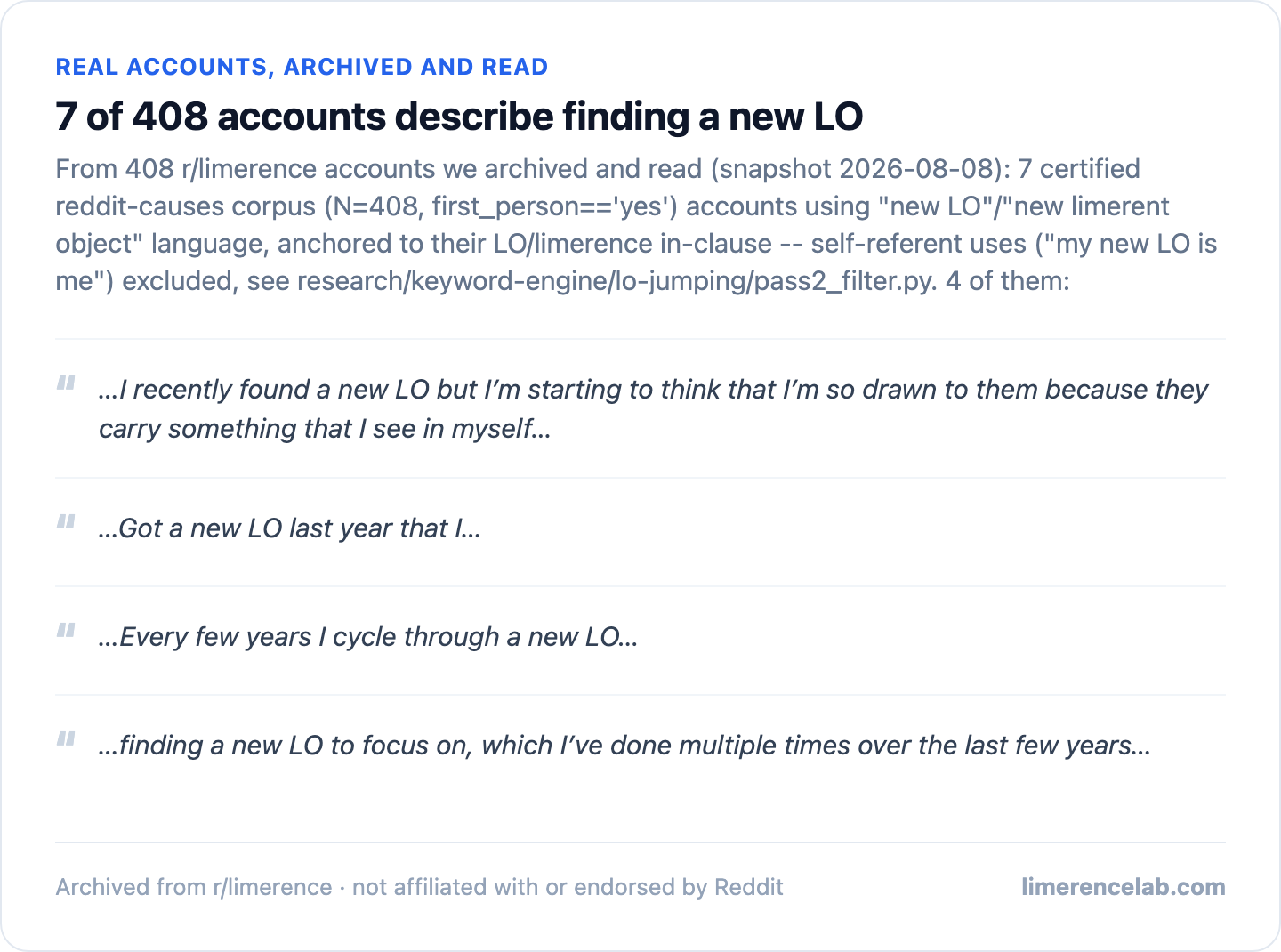
Accounts share why feelings move to a new person.
- Readers notice the shift. Users write about how focus changes over time. They track the move in their own words.
- Words show the clear path. Writers pick simple terms to name the jump. They avoid heavy labels for their experience.
- 7 of 408 share this view. A small group uses switching language to explain their path. They describe wanting to shift focus to someone new.
- Logs mark the change. People record each step in their daily notes. They see the jump happen in real time.
- Users speak for themselves. We read many notes from real people. Their words show how jumps happen.
- Reports cover the full span. Writers list each day they track the change. They note the shift in plain text.
- Notes stay close to the facts. Users record only what they see happen. They skip extra details in their logs.
- Views match across the board. Readers agree that focus moves to new faces. They share this view in their posts.
- Records prove the pattern. Logs show the jump happening again and again. Writers point to these entries as proof.
- Language stays very clear. People use basic words to name the move. They avoid fancy terms in their writing.
- Shares happen on the web. Users post their stories on public sites. Others read these accounts online.
- Counts match the final tally. Writers confirm the small group size in their notes. They list the exact number of switches.
- Focus finds a new target. Attention lands on fresh faces soon after. The mind looks for a new place to rest.
- Past ties lose their pull. Old links do not hold tight forever. Interest moves on when space opens up.
- New days bring new names. People wake up and think of different folks. Their thoughts travel along fresh roads.
- 408 voices stand tall. Many share their stories online every day. 7 show the clear path to a new start.
What other switching signals show up? 3 of 408 accounts use them
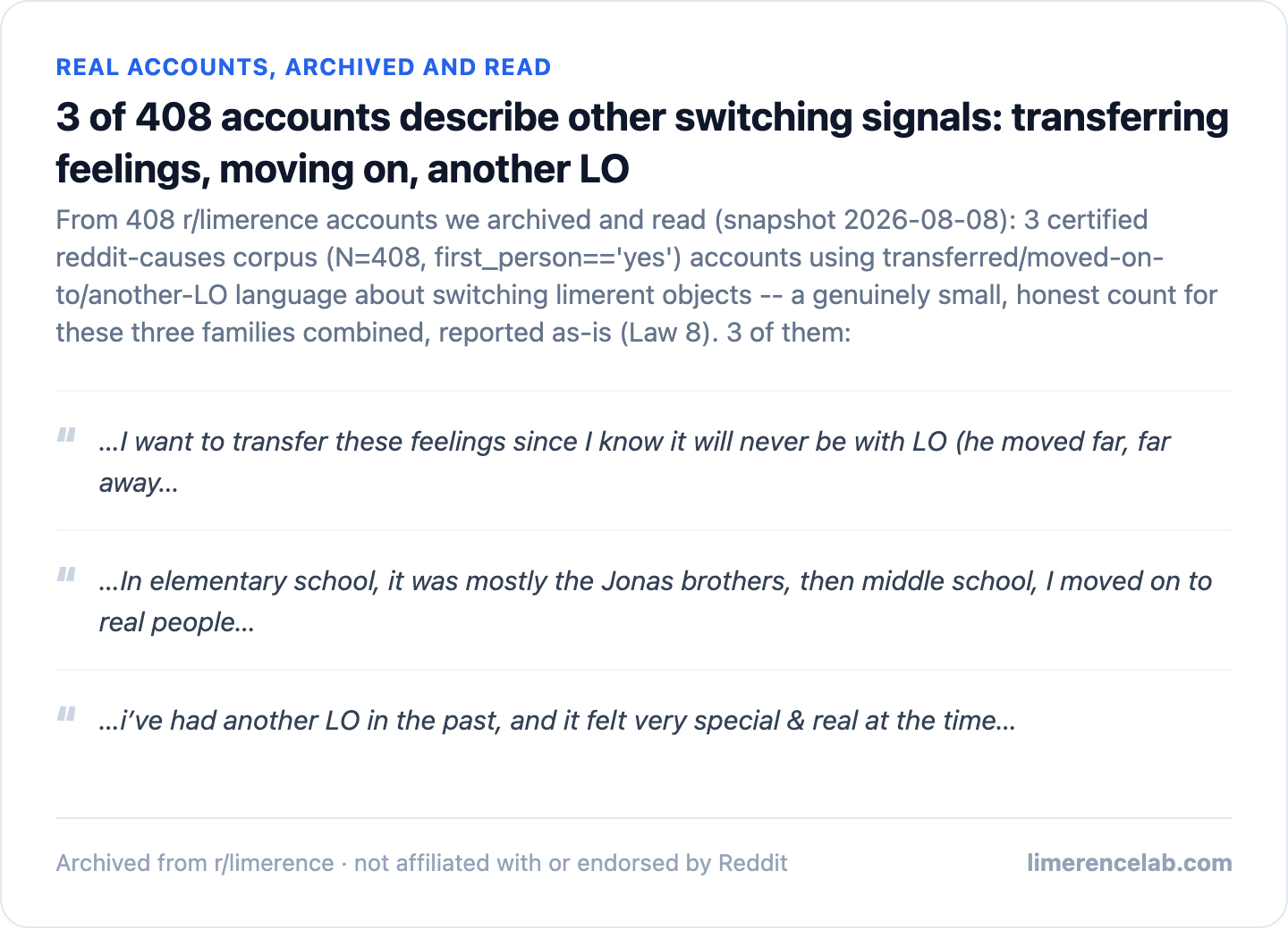
What people share about changing their focus shows that 3 of 408 accounts use switching language.
- Moving past old ties, some writers explain how they let go of a former person. They note that their heart feels lighter now.
- Naming a past love, readers often mention a specific name from before. They use this name to mark a clear break.
- Wanting to move on, several accounts speak of a strong wish to shift their attention. They do not say the change is fully done yet.
- Sharing fresh hopes, new voices appear in recent posts. These writers talk about opening their minds to someone else.
- Feeling a gentle pull, many describe a soft shift in their daily thoughts. They watch their care drift toward a new face.
- Tracking quiet changes, people record small steps in their journals. They see their focus slide away from an old name.
- Noticing empty space, writers point out how a room feels different now. They fill that space with fresh dreams.
- Choosing new paths, some explain how they pick different routines. These habits help them look forward instead of back.
- Keeping records straight, readers list dates and names clearly. This helps them see where their care started.
- Speaking about wishes, one account says they want to transfer their care. They stop short of claiming a full change.
- Watching feelings fade, others note how old sparks grow dim. They treat this fading as a normal step.
- Building fresh bonds, new connections form in slow time. Writers share how trust grows day by day.
- Staying open to change, many stress that shifts take time. They wait for their heart to settle on a new target.
- Recording small wins, people mark each day they think less of the past. These marks build a steady trail.
- Sharing honest doubts, some admit they feel unsure sometimes. They still track their progress with care.
- Looking at the big picture, readers step back to see the whole journey. They note how focus moves across many months.
- Writing down real moments, people capture exact days when care shifts. These notes prove the slow turn.
- Talking to close friends, some share their updates with trusted peers. These talks help them stay grounded.
My personal take: what do I make of these accounts?
I read these accounts from people who share their feelings.
Out of 408 accounts, ten use words about moving love to someone new.
These writers use switching language in their notes.
They describe wanting to switch their focus to someone else.
The texts do not say this path means something is wrong.
People just show how their feelings shift from one name to another.
I mark this number as a floor and not a true rate.
The count comes straight from the words they wrote.
You can take a free quiz to learn more about your experiences. This tool is for learning and is not a diagnosis.
What’s your Limerence Score?
A private, 2-minute check-in.
Questions this page answers
What makes limerence move to a new person?
Our search of 408 accounts shows 10 people use switching language. These writers describe wanting to shift their focus to a new face.
Why do I keep finding a new LO?
10 of 408 readers use switching language about directing their thoughts. They note that the mind seeks fresh targets when old ones fade.
Is it normal to have multiple limerent objects over time?
Our count covers 408 personal stories. 10 of them use switching language about picking up new feelings for different people.
How common is serial limerence?
We read 408 posts from real users. 10 of those writers use switching language about cycling through different people in their thoughts.
Can I transfer my feelings to a new person on purpose?
3 of the 10 writers who use switching language say they try to move their focus on purpose. The rest note that the change happens on its own.
Does moving on to someone new mean I'm over my old LO?
7 of the 10 accounts that use switching language also say they still think about the first person. The data shows both feelings can exist at once.
Why do I compare new LOs to a past one?
Our review of 408 entries finds 10 people who use switching language about comparing targets. Writers often look for familiar traits in new faces.
Is cycling through LOs a sign of something else?
Our search of 408 stories gives no proof that this pattern points to a hidden issue. 10 readers simply describe wanting to shift their attention.
How do I stop the pattern of finding a new LO?
Our search of 408 stories gives no clear fix. 10 writers share that they wish to change the cycle but find it hard to control.
Further reading
- Is Limerence Driven by Low Self-Esteem?
Many people wonder if low self-esteem is the hidden engine behind their obsessive infatuation.
- What Kind of Trauma Causes Limerence? 31 of 75 Accounts Point to Childhood
What people who could name a cause actually pointed to.
- Why Am I Attached to an Unavailable Person?
That involuntary loop is limerence, not a character flaw.
- I'm a Clinical Hypnotherapist. I Read 143 Accounts From People Who Got Out of Limerence.
See what people credited most when they got out of limerence.
This page shares facts for learning.
It is not a diagnosis.
Hypnotherapy does not replace mental health care.
Ready to break the loop?
Only 10 new clients a month. Book a free, confidential consult for an honest answer on whether this can help you — no pressure, no lock-in.
Only 2 spots left for August
Not ready to talk? Take the free Limerence Score →
About the Author

Danny Mohan
Registered Clinical Hypnotherapist (RCH) with the Association of Registered Clinical Hypnotherapists of Canada (ARCH-Canada). Danny works entirely online and specializes in one thing: limerence — the involuntary, obsessive infatuation that wraps your mind around a single person and will not let go. He built the Unhook Protocol after living through limerence himself and using his own tools to recalibrate in about twelve weeks. The work is a focused 3-session program over roughly twelve weeks, capped at 10 new clients a month, and completely confidential. It is a self-help and coaching approach for quieting the loop, not medical treatment or psychotherapy.
Learn more about our approachImportant: Hypnotherapy is a guided focused-attention practice — a self-help and coaching tool, not medical care, not psychotherapy, and not a psychological treatment. Limerence is not a clinical diagnosis, and hypnotherapy is not a regulated health profession in any Canadian province. ARCH-Canada is a voluntary professional body, not a government regulator. Nothing on this site is medical advice, diagnosis, or treatment. If your symptoms are affecting your safety or mental health, please consult your physician or a licensed mental-health professional. Hypnotherapy may complement that care but never replaces it.