What Causes Limerence? We Read 408 First-Hand Accounts. 333 Could Not Name a Cause.
She had been married a long time. For seven months she thought about a man she never met. Asked how it began, she could not say. We went looking for people who could.
The short answer
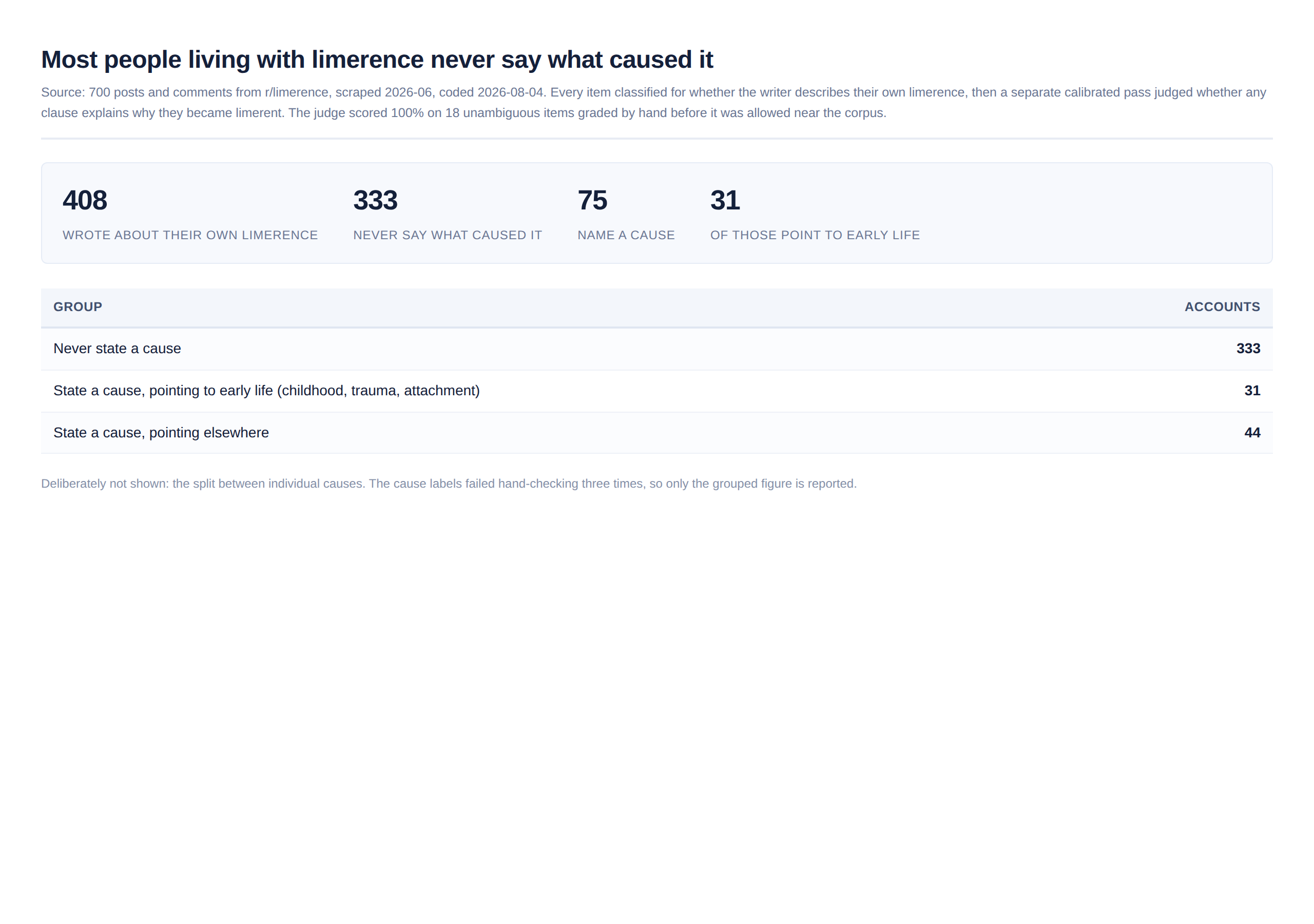
She had been married a long time. For seven months she thought about a man half her age, on another continent, whom she never met. Then it stopped. Asked how it began, she said she honestly could not explain it. We went looking for people who could. Of 408 people who wrote about their own limerence, 333 never named a cause at all. The 75 who did name one did not agree with each other, and the largest group pointed backwards, to childhood.

Key takeaways
- We read 408 first-person accounts.: We expected people to name a clear cause. We found that 333 accounts never said what caused the experience. We found 75 that did. Of those 75, 31 pointed to early life, while the other 44 pointed elsewhere. We did not find one shared answer.
- We checked the indexed literature.: We found 31 limerence results in Europe PMC and 10 in PubMed. We found one published paper that described treating limerence in one patient in 2021. We did not find a settled mechanism. We kept that gap visible instead of filling it with a neat story.
- We dropped the cause ranking.: We tried to rank the themes in the accounts. We scored our own first pass at 67%. We merged themes and checked again, then scored 75%. We set a 90% bar before we began. We fell below it, so we dropped the ranking. We did not publish a top-five list.
- We noticed the gap around the thought.: We asked readers to notice when the thought arrived, what happened in the gap, and what they reached for instead. We did not treat a mention as proof of cause. We used the question as a small way to look at the pattern without forcing one answer.
We wanted a ranked list of causes. That is what everyone writing about this produces, and it is what we set out to build. We could not build one honestly. What we found instead was stranger and more useful: most people carrying this thing have no idea where it came from.
Seven months, and she still could not say what caused her limerence
She was not the person you would picture. Not a teenager with a crush. She had a mortgage, a marriage, and a life that ran on time. The thing arrived anyway.
It took seven months. He was half her age and lived on another continent. They never met. Then it ended, and she wrote it up the way people do, hoping the writing would sort it out.
It did not. Her post finishes with an admission rather than an explanation. She could not say how or why it started.
- She had a life before it arrived. This did not happen in a vacancy, it happened in a full diary.
- It lasted seven months and then stopped. She never got the moment of clarity people expect.
- Her closing line is the whole problem. She cannot explain how or why it began, and she is not unusual.
The second injury: why “why do I have limerence” hurts more than the obsession
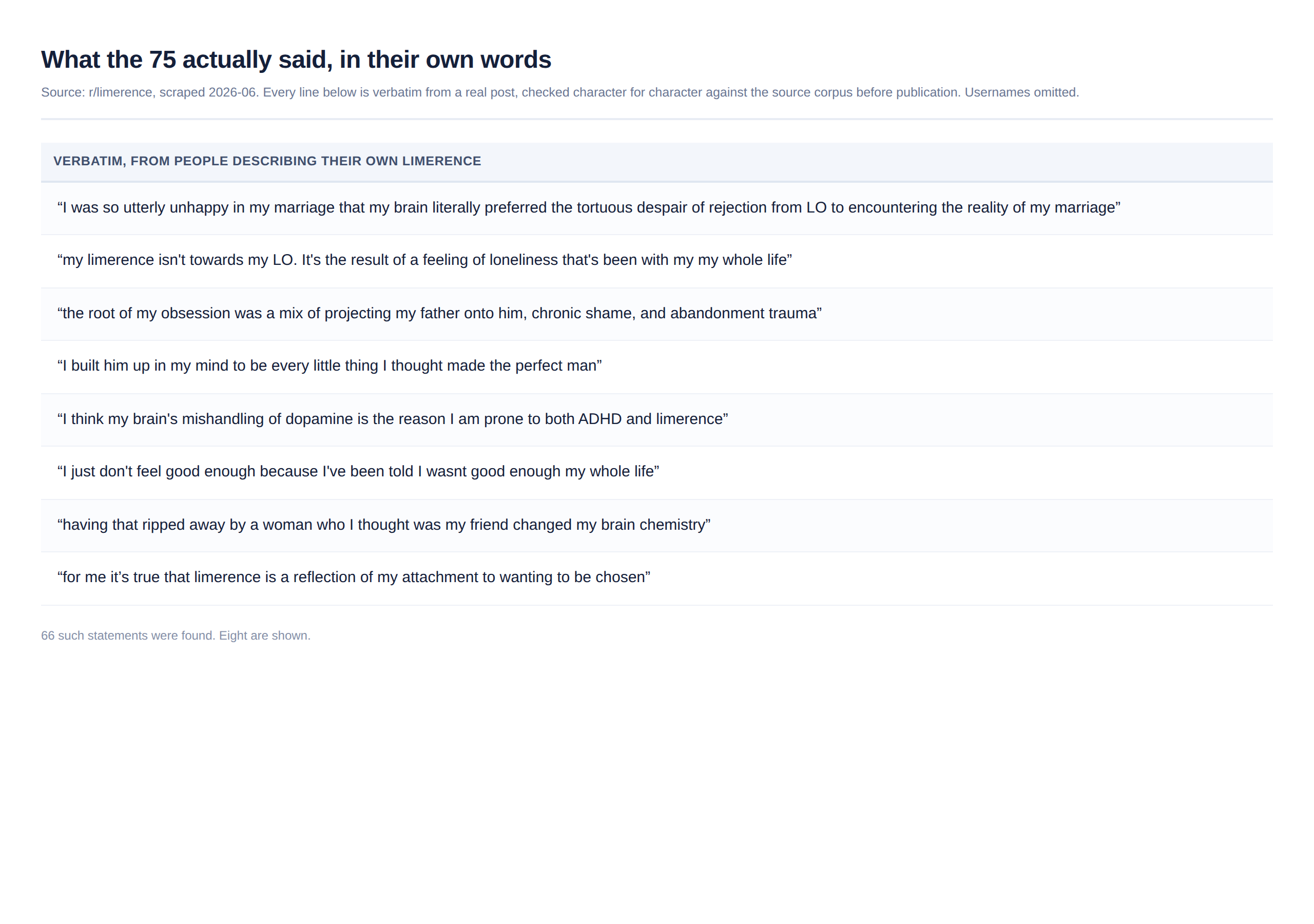
Another writer put it harder. They wrote that they feel seriously sick for experiencing this, and described pulling their own hair out over thoughts they could not stop.
Read enough of these and a pattern appears that has nothing to do with the other person. People are not only distressed by the obsession. They are distressed by not understanding it.
We think that second injury is the one that keeps people stuck. If you cannot explain a thing, the easiest explanation available is that something is wrong with you.
- The not knowing is its own wound. It sits underneath the obsession and outlasts it.
- People read their own confusion as a character flaw. Almost nobody reads it as a normal feature of the condition.
- This is where the search usually stops. Blaming yourself is quicker than looking.
How we counted: 3,088 posts, 408 people, one question
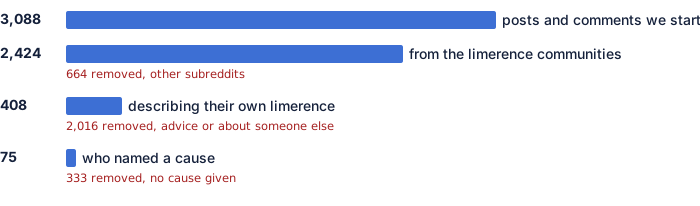
We pulled 3,088 posts and comments from people talking about limerence. Then we started throwing things away.
We removed anything from outside the limerence communities. We removed advice written to other people, and posts about somebody else's obsession. What survived were 408 people describing their own experience in their own words.
Of those, we asked one question. Does this person say what caused it?
- We started with 3,088 posts and kept 408. The rest were advice, or about someone else.
- We asked one thing of each account. Does this person name a cause for their own limerence.
- We checked our own answers by hand before we printed any of them.
The root cause of limerence, according to 333 people who have it: no idea
We expected most people to have a theory. People usually do.
They did not. Of the 408, some 333 wrote at length about the thoughts, the person, the sleeplessness, the shame, and never once said where it came from. Not evasion. They simply did not know.
The reason is duller than it sounds. Limerence rarely arrives on a particular Tuesday. It thickens. By the time it is bad enough to write about, the beginning is a long way back and nothing about it stood out at the time.
- 333 of 408 never name a cause. This is the most common experience by a wide margin.
- A gradual start leaves nothing to point at. There is often no first day to remember.
- The woman who could not explain it was not unusual. She was the norm.
The 75 who could answer disagree about what triggers limerence

Some people do have an answer. Seventy five of them gave one.
They did not agree. Some looked backwards. Others looked at the present, at a marriage gone quiet, at a year with no friends in it, at a need that nothing was meeting.
One wrote that "one big reason I was so obsessed with her was because I had no friend circle". Another put it as "because he was feeding a need that wasn't being met for a very long time". A third traced it to never feeling adequate: "I just don't feel good enough because I've been told I wasnt good enough my whole life".
Not one of them cited a study. They were reading their own lives, which is the only evidence anybody in this position has.
- A minority can name a cause. Seventy five of 408.
- Their answers scatter. Some point back, some point at now, and the groups are close in size.
- None of them cite research. They are interpreting themselves, and so is everyone else.
Limerence and childhood trauma is the biggest single answer, and the least proven

The largest single group, 31 people, pointed to early life.
They describe similar shapes. One wrote that "the cause for my limerence was the neglect I endured as an infant and small child". Another described how "I experienced a pretty lonely childhood and emotional neglect from my parents". A third said simply "the source of my limerence goes back to childhood".
Some go further and name the person. One wrote that "my LO is representative of the father I never had".
None of them are diagnosing themselves, and neither are we. Pointing backwards is where people look when they look. It is not proof that the looking is correct.
- Thirty one of the 75 point to early life. The biggest group, and the only one we can count honestly.
- They describe, they do not diagnose. These are people making sense of themselves.
- Pointing backwards is not proof. No study has tested whether these accounts are right.
Attachment style, ADHD, and the other explanations people reach for
Others reached for a different explanation. Their brains.
Some wrote about being neurodivergent and treated limerence as an extension of how they already work. One called it "part of my adhd and hyper fixations and dopamine seeking behavior". Another was blunter: "I'm ND, so that's probably one of the main reasons why".
We report these as what they are. Self explanations, offered by people with no way to test them, which is the same position everyone else on this page is in, including us.
- Some explain it through their neurology. ADHD and neurodivergence come up repeatedly.
- They describe a felt similarity, not a mechanism anyone has demonstrated.
- Nobody in this group has evidence either. They are honest about that. Most pages are not.
What disorders cause limerence? The literature is 31 papers and one patient

We went to check what research says. It does not take long.
Europe PMC returns 31 results for limerence in total. PubMed returns 10. One paper describes treating it, published in 2021, and it follows a single patient. There is no trial, no cohort, no settled mechanism.
That is the entire shelf. Any page that hands you a confident list of causes is going considerably further than the evidence allows, and so would we if we did the same.
- The whole indexed literature is 31 results. Ten of them in PubMed.
- One paper describes treatment. It has one patient in it.
- No mechanism is settled. Confidence on this topic is a style choice, not a finding.
Our own ranking failed its check, so we binned it

Here is the part we would rather not print.
We tried to sort the 75 answers into themes and rank them, so we could tell you which cause comes top. We checked our own labels against the original posts by hand. The first attempt scored 67 percent. Our bar was 90.
We merged the themes together and tried again on a fresh sample. That reached 75 percent. Still short. So we dropped the ranking and kept only the one number that survived its check, the 31 who pointed to early life.
- Our first pass scored 67 percent. Not good enough to publish.
- The second pass reached 75 percent. Also not good enough.
- We dropped the ranking. That is why there is no top five list of causes on this page.
What every other page on this question leaves out
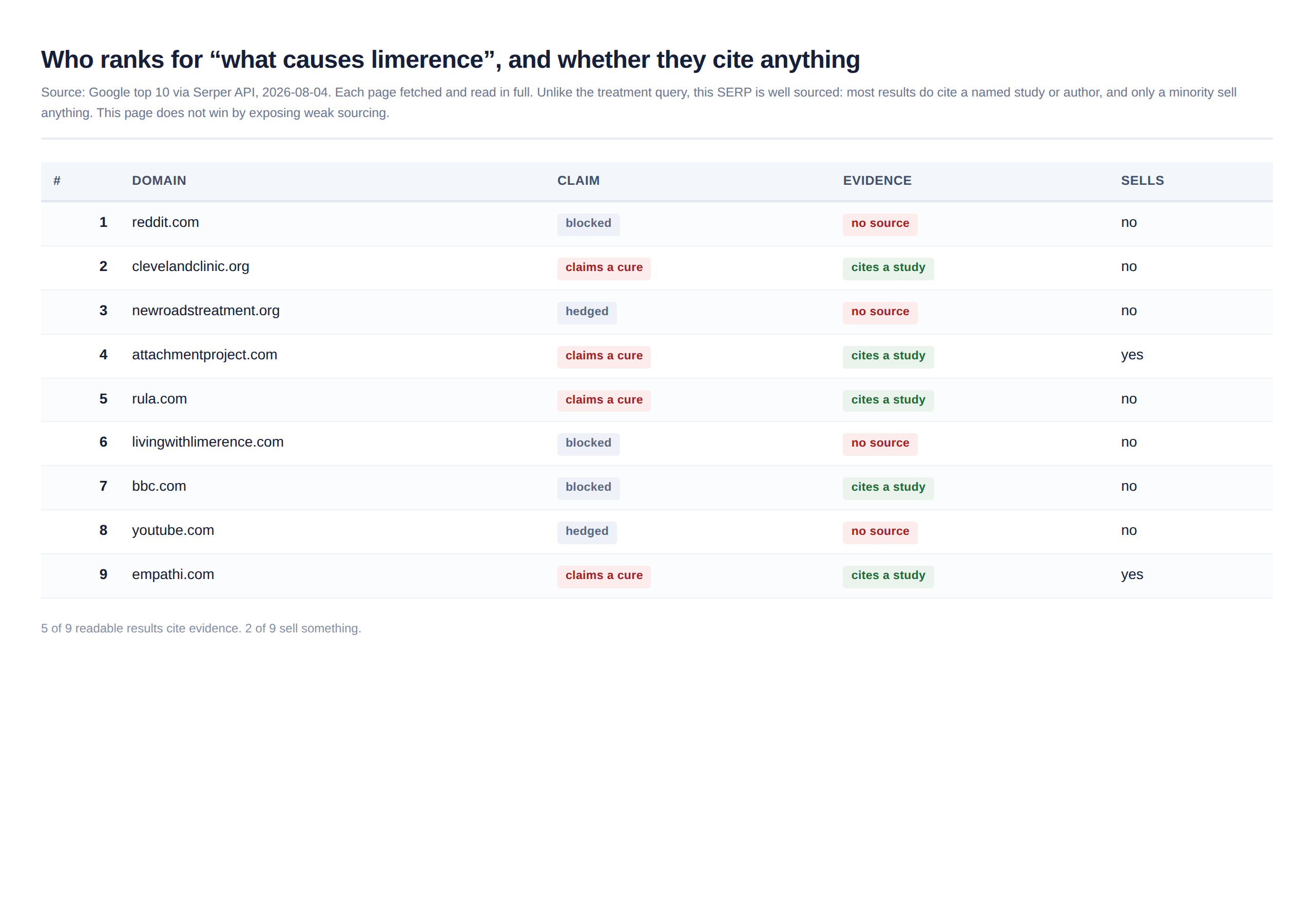
We read the ten pages Google returns for this question.
Most of them cite something, which is more than we expected. What none of them do is count anything. The causes are asserted, drawn from clinical experience or from other articles doing the same, and presented as a tidy list.
Not one of them mentions how many people cannot answer the question at all. That omission is the reason this page exists.
- Most ranking pages cite a source. Credit where it is due.
- None of them counted anything. The lists are asserted, not measured.
- None mention the people who cannot answer. That is most people.
What to do when why does limerence happen has no answer
You do not need the origin story to work on the pattern. That is the practical upshot of all this, and it is good news.
Three things are worth watching this week. When the thought arrives, and what happened in the ten minutes before it. What sits in the gap between having the thought and acting on it, because that gap is where choice lives. And what you reach for instead, on the occasions you do not act.
None of that requires knowing why it started. If you want structured help with the pattern rather than the origin, that is what our programme is for.
- Notice when the thought arrives. Time of day, and what came just before.
- Watch the gap. Between the thought and the checking, the scrolling, the rereading.
- Notice what you reach for instead. On the days you do not act, something else happened.
Questions people ask about what causes limerence
The story ends above, with her. What follows are the questions people search for most often on this, answered from what we found rather than from what sounds tidy.
- We answer from the 408 accounts and the published literature. Nothing else.
- Where the evidence cannot answer, we say so. That happens more than once here.
- No number appears below that did not survive a hand check.
If you are trying to work out whether what you have is limerence at all, our free check takes two minutes and nobody sees the result but you.
What’s your Limerence Score?
A private, 2-minute test that shows exactly how tight the loop’s grip has become — and the one next step that fits your score.
Take the test →2 private minutes. No one finds out.
She never found her answer. Seven months in, writing it up afterwards, she still could not say how it began. It ended anyway. That is the part worth holding onto if you are somewhere in the middle of this: the not knowing did not stop her getting out.
Ready to break the loop?
Only 10 new clients a month. Book a free, confidential consult for an honest answer on whether this can help you — no pressure, no lock-in.
Only 2 spots left for August
Not ready to talk? Take the free Limerence Score →
About the Author

Danny M., RCH (ARCH-Canada)
Registered Clinical Hypnotherapist (RCH) with the Association of Registered Clinical Hypnotherapists of Canada (ARCH-Canada). Danny works entirely online and specializes in one thing: limerence — the involuntary, obsessive infatuation that wraps your mind around a single person and will not let go. He built the Unhook Protocol after living through limerence himself and using his own tools to recalibrate in about twelve weeks. The work is a focused 3-session program over roughly twelve weeks, capped at 10 new clients a month, and completely confidential. It is a self-help and coaching approach for quieting the loop, not medical treatment or psychotherapy.
Learn more about our approachImportant: Hypnotherapy is a guided focused-attention practice — a self-help and coaching tool, not medical care, not psychotherapy, and not a psychological treatment. Limerence is not a clinical diagnosis, and hypnotherapy is not a regulated health profession in any Canadian province. ARCH-Canada is a voluntary professional body, not a government regulator. Nothing on this site is medical advice, diagnosis, or treatment. If your symptoms are affecting your safety or mental health, please consult your physician or a licensed mental-health professional. Hypnotherapy may complement that care but never replaces it.