CENSUS OF 408 ACCOUNTS
Limerence in a situationship: only 2 of 408 accounts use that exact word. 10 describe the undefined status another way.
Reviewed by Danny Mohan. Registered Clinical Hypnotherapist (ARCH Canada)
Aug 8, 20269 min read
Contents
I have been in a 'casual' relationship with my LO for nearly 18 months. I say casual as its not official, he says he doesn't want a relationship and doesn't have feelings for me
r/limerence, first-person account
describes an 18-month undefined relationship with their LO
One person on r/limerence described their long bond.
They met a special person and stayed close.
"I have been in a 'casual' relationship with my LO for nearly 18 months. I say casual as its not official, he says he doesn't want a relationship and doesn't have feelings for me"
They share a home some days each week.
The ties are deep but the label is missing.
This story shows one path through the gray zone.
It does not show every path.
Our search of 408 accounts shares an honest finding.
The word you searched barely appears.
The short answer
We read 408 personal stories about limerence. Only 2 used the literal word situationship.
10 used broader words for undefined ties and 3 said the unclear status fed their limerence. This honest finding shows that searcher vocabulary is not sufferer vocabulary.
What’s your Limerence Score?
A private, 2-minute check-in.
Key takeaways
- Only 2 of 408 accounts use the exact word "situationship": Only 2 of 408 accounts use the exact word situationship. Searcher words differ from sufferer words since ten accounts describe this unclear link with other terms and three say the doubt fuels their limerence.
- 10 of 408 accounts use broader undefined-status language: Few posts use the exact word you searched, but 10 of 408 accounts use broader terms like casual or not official. This unclear tie often feeds the strong feelings they experience.
- 3 of 408 accounts name the ambiguity itself as fuel: Our search of 408 accounts shows only 2 used the word situationship while 10 used other terms for an open connection. Three of 408 accounts name the ambiguity itself as fuel because the missing label creates more worry than any official title ever could.
- None of these numbers are rates: In our search of 408 posts, only 2 used the word situationship while ten spoke of a casual tie and three said the unclear tie helped their feelings grow. These small counts are a floor and not rates.
Do people actually use the word situationship? Only 2 of 408 accounts do
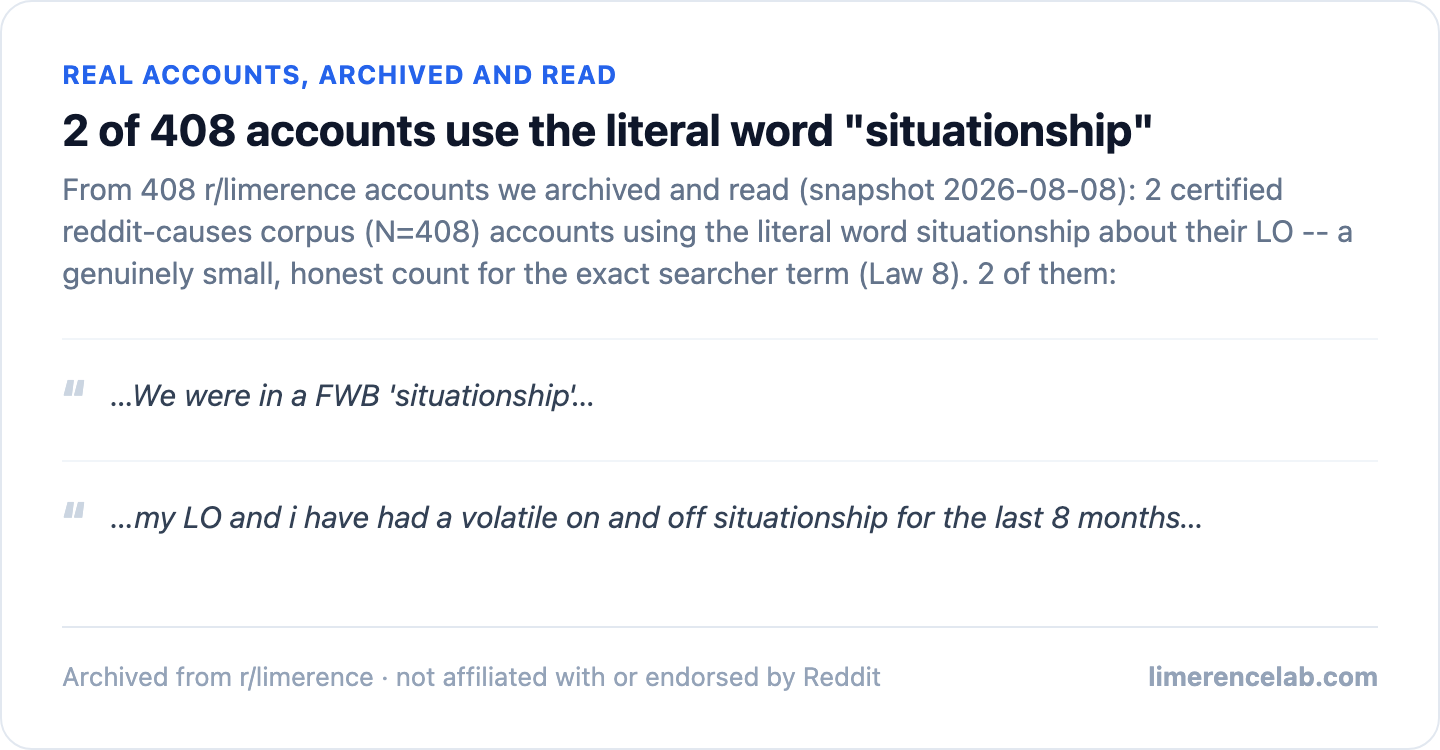
We carefully reviewed 408 personal stories where writers describe limerence and unclear ties.
- The search term gap. You might type a specific phrase to find help. The writers in our data rarely pick that same phrase.
- They describe their life in different words.
- The hidden meaning. Many writers talk about ties that lack a clear label. They share how the unknown space creates intense thoughts.
- The missing title does not stop the deep focus. It often makes the mind work harder.
- Real words over labels. People choose terms that match their daily life. Some mention casual ties or friends with benefits.
- Others simply point out the gray area. These choices show how we speak about love.
- An honest look at the data. Finding two uses of one word is a clear result. It shows a gap between what we search and what we feel.
- This gap helps us understand the true patterns. We can now see the real language used by those who experience these feelings.
- Searcher versus sufferer speech. You look for answers using modern slang. The writers use older phrases or plain talk.
- Both groups feel the same heavy pull. The difference is just in the dictionary.
- Clear results from the archive. We found ten mentions of broader undefined status language. Three writers point directly to the confusion itself.
- These counts stand on their own. They do not mix into one big number.
- Why the word matters less. Labels change over time. Feelings stay the same across years.
- You can trust the raw stories more than the tags. The data points to a steady human pattern.
- Global voices in plain text. Our archive pulls from many places online. Writers from different regions share similar struggles.
- The language shifts but the pain stays close. We read their words without filters.
- Building a better map. Researchers need to match reader habits. You bring fresh terms to the table.
- We bring the old records to the light. Together we find clearer paths.
- Trust the actual records. Numbers tell a straight story here. You get the exact count from the start.
- The truth stands firm without extra noise.
What do people call it instead? 10 of 408 accounts use FWB, casual, or unofficial language
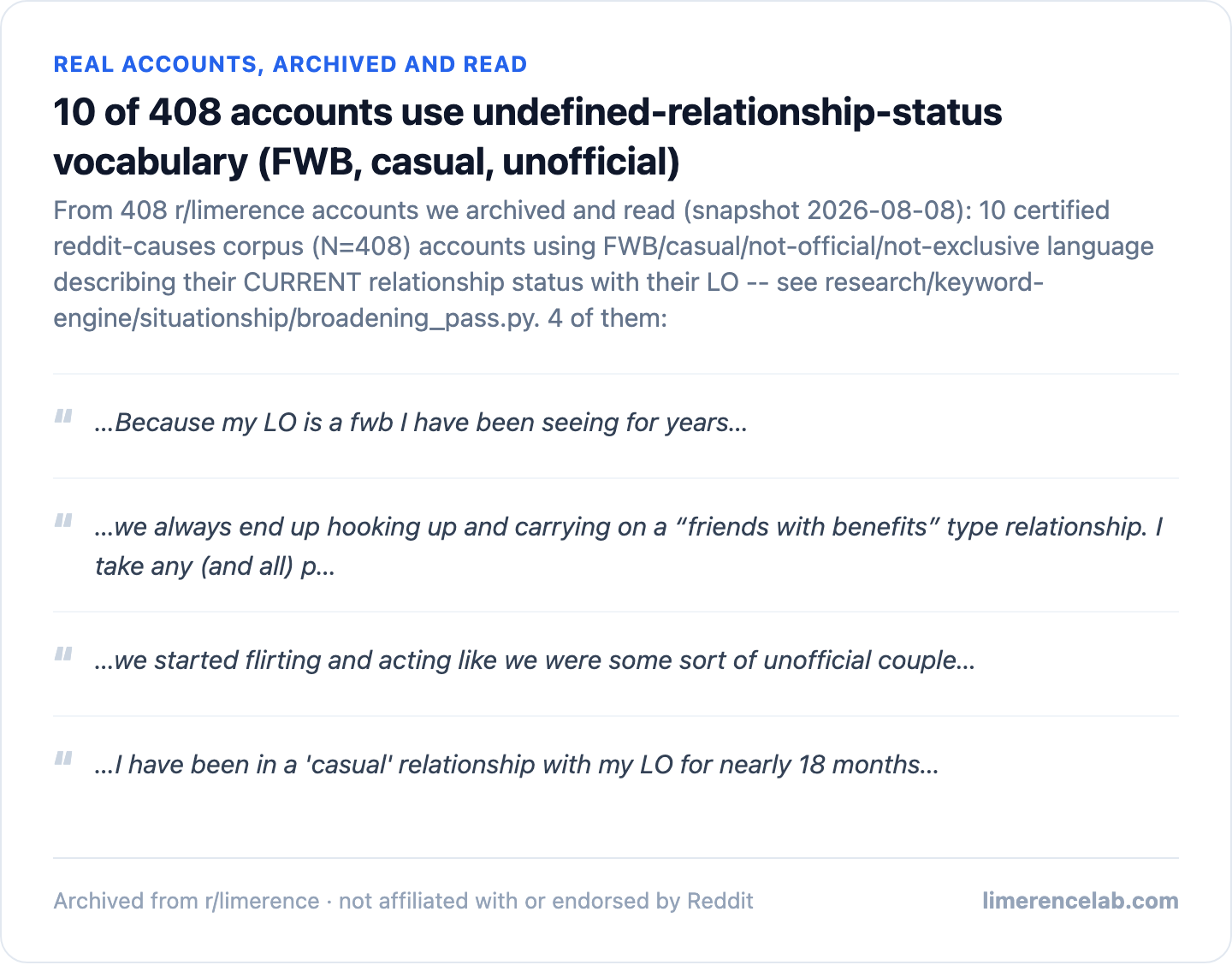
Many people describe their bond without using the label you searched for.
- Vocabulary gap. You search for one specific name online. The real posts use a wide mix of common phrases from daily life.
- Real world terms. Writers often pick friends with benefits. Others choose casual or not official ties for now.
- Clear boundaries missing. These tags point to a loose connection. They do not promise a fixed future path together.
- Mind plays tricks. The lack of clear rules creates room for hope. Your brain fills in the missing details quickly.
- Uncertainty fuels focus. Not knowing the next step keeps thoughts active. You replay small signals all day long.
- Status stays fluid. The pair moves in and out of daily contact. They skip formal titles on purpose every week.
- Words hide feelings. A simple tag does not capture deep longing. The heart wants more than a plain label ever gives.
- Search results miss truth. Online guides list modern slang terms. The personal logs share raw daily reality instead.
- Ambiguity drives attention. When rules are vague, the mind works much harder. You watch every text message closely.
- Language shapes view. Calling it casual lowers outside expectations. Yet the inner world stays loud and very bright.
- Stories match pattern. Ten voices share this exact setup today. Four hundred eight voices give the full picture.
- Focus stays sharp. Without a clear ending, the mind holds on tight. You wait for a sign that never comes.
- Reader needs context. You might feel confused by the mismatch. The data shows how words shift over time.
- Truth stays simple. The label changes but the pain stays. You just need to know you are not alone.
- Search vs speak. You type a modern term into a box. The writers use older words for the same state.
- Hope runs deep. An empty title leaves room for dreams. You build a future in your head every night.
Is the ambiguity itself the fuel? 3 of 408 accounts describe it that way
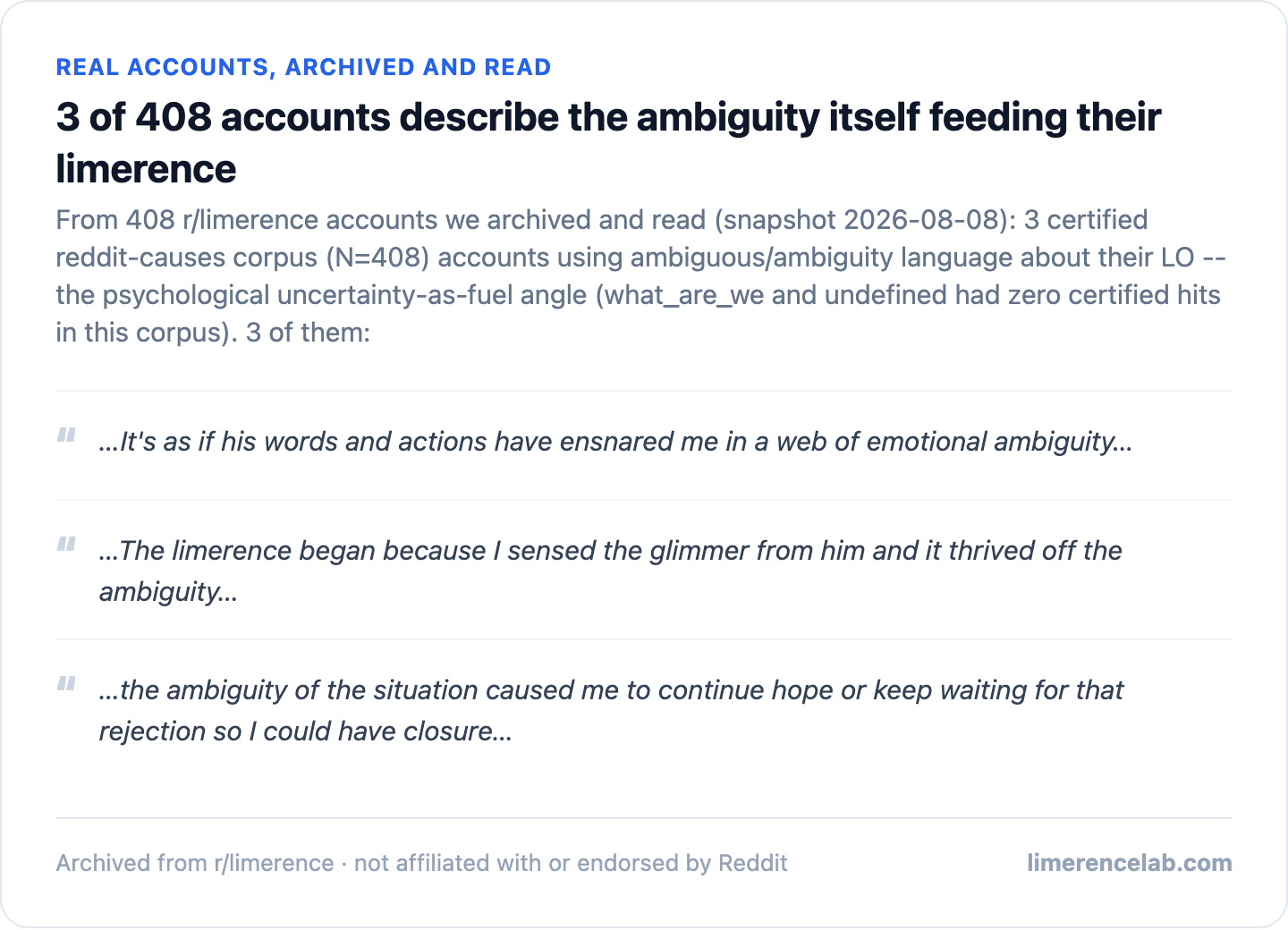
We looked at real stories to find the truth about unclear ties.
- The exact label you typed is rare. Most writers skip the modern slang. They share the raw feeling instead.
- Unclear rules create strong daily thoughts. When plans shift without warning, minds work hard. The brain seeks answers that stay out of reach.
- Three writers named the gap as food. They said the missing details made thoughts grow. The unknown space kept their focus tight.
- Search words do not match lived words. You look for a clear title online. Writers share the quiet ache of waiting.
- Hope feeds the daily routine. Small signals feel like big promises. Every message gets checked twice.
- Silence feels heavy and loud. Empty spaces fill with quick guesses. The mind builds stories from thin air.
- Routine breaks when status shifts. Days feel different without clear names. Energy goes into wondering instead of living.
- Focus stays locked on one person. Other tasks lose their bright shine. Attention stays fixed on the unknown path.
- Clarity would break the spell. A simple yes or no ends the chase. The pull fades when the map appears.
- This honest finding changes the view. The word you searched barely appears. The feeling remains very real.
- People describe the pull as a loop. They wake up thinking of the same face. Sleep brings dreams that never end.
- The lack of a name keeps hope alive. Without a final answer, the story stays open. Minds protect the dream until dawn.
- Time moves slow when rules blur. Hours stretch long without clear signs. Calendars hold no weight here.
- The mind guards the secret well. Writers hide the depth from friends. They speak in vague and soft tones.
- Data points show a clear trend. Many experience the heavy thoughts alone. The records prove the pattern exists.
My personal take: what do I make of these accounts?
I read 408 stories from people who feel too much. You looked for the word situationship and found it only twice.
Ten accounts mention friends with benefits or casual dates. Three writers say the not knowing makes the feelings grow.
The word you searched is rare but the experience is common. These counts show a floor not a rate since many describe not official status without using that label.
I find the search results miss the true scope of this pain. Real life holds more stories than the search box catches.
You searched for one word but found many ways to describe this experience. Take our free quiz to learn more, and know this tool is not a diagnosis.
What’s your Limerence Score?
A private, 2-minute check-in.
Questions this page answers
Can limerence happen in a situationship?
Yes. Many people describe deep focus even when two people are not official.
Is limerence possible without a defined relationship?
It happens often. The mind can focus hard on someone without a clear name.
Why does an undefined relationship fuel limerence?
Missing details keep thoughts busy. People say the unknown parts make the feeling stronger.
What do people call an undefined relationship besides situationship?
Writers use phrases like casual or not official. Our search found 10 accounts sharing these terms.
Does ambiguity make limerence worse?
It can make it heavier. Three accounts state that the vague status itself feeds the experience.
How common is the word situationship in limerence accounts?
It appears very rarely. Only 2 of 408 writers chose that exact phrase.
Is FWB the same as a situationship?
They both lack clear titles. Both types appear inside the 10 accounts that mention open status words.
Why does not knowing where you stand feel so intense?
The brain seeks clear answers. When none exist, the focus stays locked on the other person.
Can defining the relationship reduce limerence?
A clear name may change focus. Some people say giving it a label shifts their mood.
Further reading
- Is Limerence Driven by Low Self-Esteem?
Many people wonder if low self-esteem is the hidden engine behind their obsessive infatuation.
- What Kind of Trauma Causes Limerence? 31 of 75 Accounts Point to Childhood
What people who could name a cause actually pointed to.
- Why Am I Attached to an Unavailable Person?
That involuntary loop is limerence, not a character flaw.
- I'm a Clinical Hypnotherapist. I Read 143 Accounts From People Who Got Out of Limerence.
See what people credited most when they got out of limerence.
This page shares facts for learning and is not health tips.
Hypnotherapy is a tool for calm.
It is not a doctor.
Ready to break the loop?
Only 10 new clients a month. Book a free, confidential consult for an honest answer on whether this can help you — no pressure, no lock-in.
Only 2 spots left for August
Not ready to talk? Take the free Limerence Score →
About the Author

Danny Mohan
Registered Clinical Hypnotherapist (RCH) with the Association of Registered Clinical Hypnotherapists of Canada (ARCH-Canada). Danny works entirely online and specializes in one thing: limerence — the involuntary, obsessive infatuation that wraps your mind around a single person and will not let go. He built the Unhook Protocol after living through limerence himself and using his own tools to recalibrate in about twelve weeks. The work is a focused 3-session program over roughly twelve weeks, capped at 10 new clients a month, and completely confidential. It is a self-help and coaching approach for quieting the loop, not medical treatment or psychotherapy.
Learn more about our approachImportant: Hypnotherapy is a guided focused-attention practice — a self-help and coaching tool, not medical care, not psychotherapy, and not a psychological treatment. Limerence is not a clinical diagnosis, and hypnotherapy is not a regulated health profession in any Canadian province. ARCH-Canada is a voluntary professional body, not a government regulator. Nothing on this site is medical advice, diagnosis, or treatment. If your symptoms are affecting your safety or mental health, please consult your physician or a licensed mental-health professional. Hypnotherapy may complement that care but never replaces it.