CENSUS OF 408 ACCOUNTS
Limerence and CPTSD: 3 of 408 accounts name it directly, 5 more describe the symptoms
Reviewed by Danny Mohan. Registered Clinical Hypnotherapist (ARCH Canada)
Aug 8, 20269 min read
Contents
with a history of childhood CPTSD - I latched on to these things like a desperate child
r/limerence, first-person account
describes a childhood CPTSD history while recounting a limerent episode
One person on r/limerence shared a personal story.
They felt strong love for their piano teacher.
This feeling brought up old fears from growing up.
They wrote that they came "with a history of childhood CPTSD - I latched on to these things like a desperate child".
This single post shows how past pain can shape new bonds.
It does not prove that trauma causes limerence for every person.
Some writers name the medical label right away.
Others describe the fear of abandonment and dissociation without using any labels.
We read 408 posts to see how people speak about this pain.
We now look at the gap between naming a diagnosis and describing an experience.
The short answer
We reviewed 408 certified first-person accounts of limerence. Three writers name complex trauma or CPTSD directly.
Five others describe a fear of being left alone or feeling disconnected. They never use the medical name.
What’s your Limerence Score?
A private, 2-minute check-in.
Key takeaways
- Only 3 of 408 name CPTSD or complex trauma directly: Only 3 of 408 stories named CPTSD or complex trauma. Most writers shared feelings of fear or spacing out rather than a medical label.
- 5 more describe the symptoms without naming the diagnosis: Five people write about fear of being left alone and feeling spaced out. Only three use the exact name for their pain across four hundred eight shared stories.
- This page never diagnoses you: This page never diagnoses you. CPTSD is a real clinical diagnosis that only a licensed professional can make.
- Both counts are a floor, not a rate: Both counts are a floor, not a rate. Three of the 408 limerence posts named the term while five shared stories of deep fear and spacing out, showing what people chose to write rather than a controlled survey.
How many accounts name CPTSD or complex trauma directly? Only 3 of 408
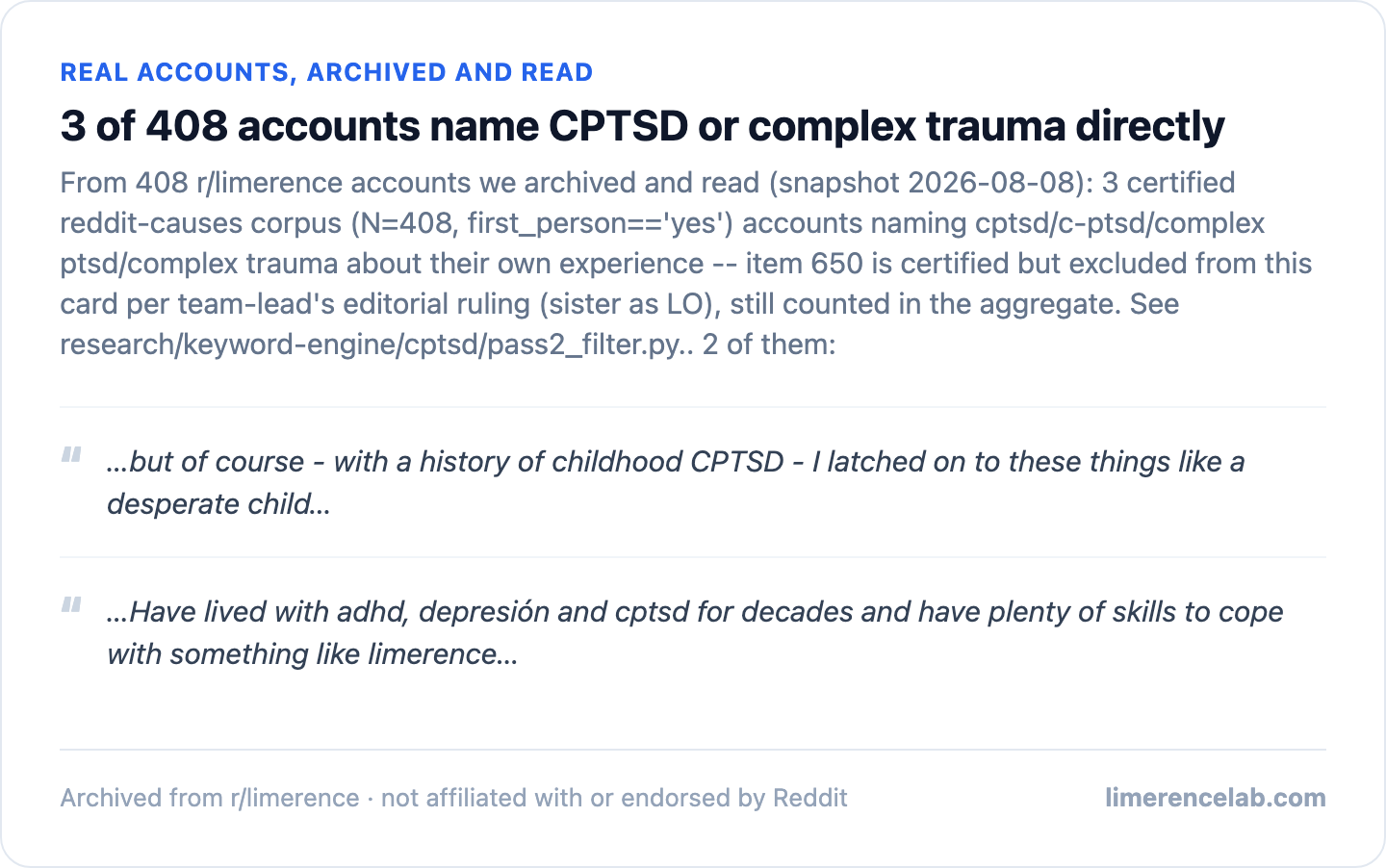
We looked at 408 personal stories to see how people talk about their past.
- Only 3 writers used the exact medical label. These few chose to write the letters cptsd or complex trauma in their own words.
- Many others describe feelings instead of labels. They share fears of leaving alone or sudden mind blanks.
- This count measures word choice in self chosen posts. It only tracks how many of 408 self selected accounts used this vocabulary.
- 3 of them named the diagnosis clearly. The rest described the weight they carry quietly.
- We only counted what was written on our site. We did not check outside sources or hidden files.
- A missing label does not mean the hurt is small. People feel fear and loss without knowing the right name.
- They still face hard days and lonely nights. Their stories hold the same truth as any report.
- Doctor care remains important for those who seek it. A licensed expert can give a clear answer about past stress.
- You do not need a label to deserve support. Your feelings matter on their own terms always.
- Our page shares what we found in our own site. We read each post to count the words used.
- We kept the numbers simple and clear today. 3 names the term and 408 voices speak here.
- We invite you to read with care and kindness. Every story here comes from a real life.
- Some find comfort in shared words online. Others find peace in quiet reflection alone.
- Both paths are valid for everyone who reads. Limerence stays a strong feeling for many people.
- The gap shows how pain speaks in plain words. Real struggles often lack a perfect title.
- Your journey stands on its own worth. You do not need a group to belong.
What trauma-symptom language shows up without naming the diagnosis? 5 of 408 describe it
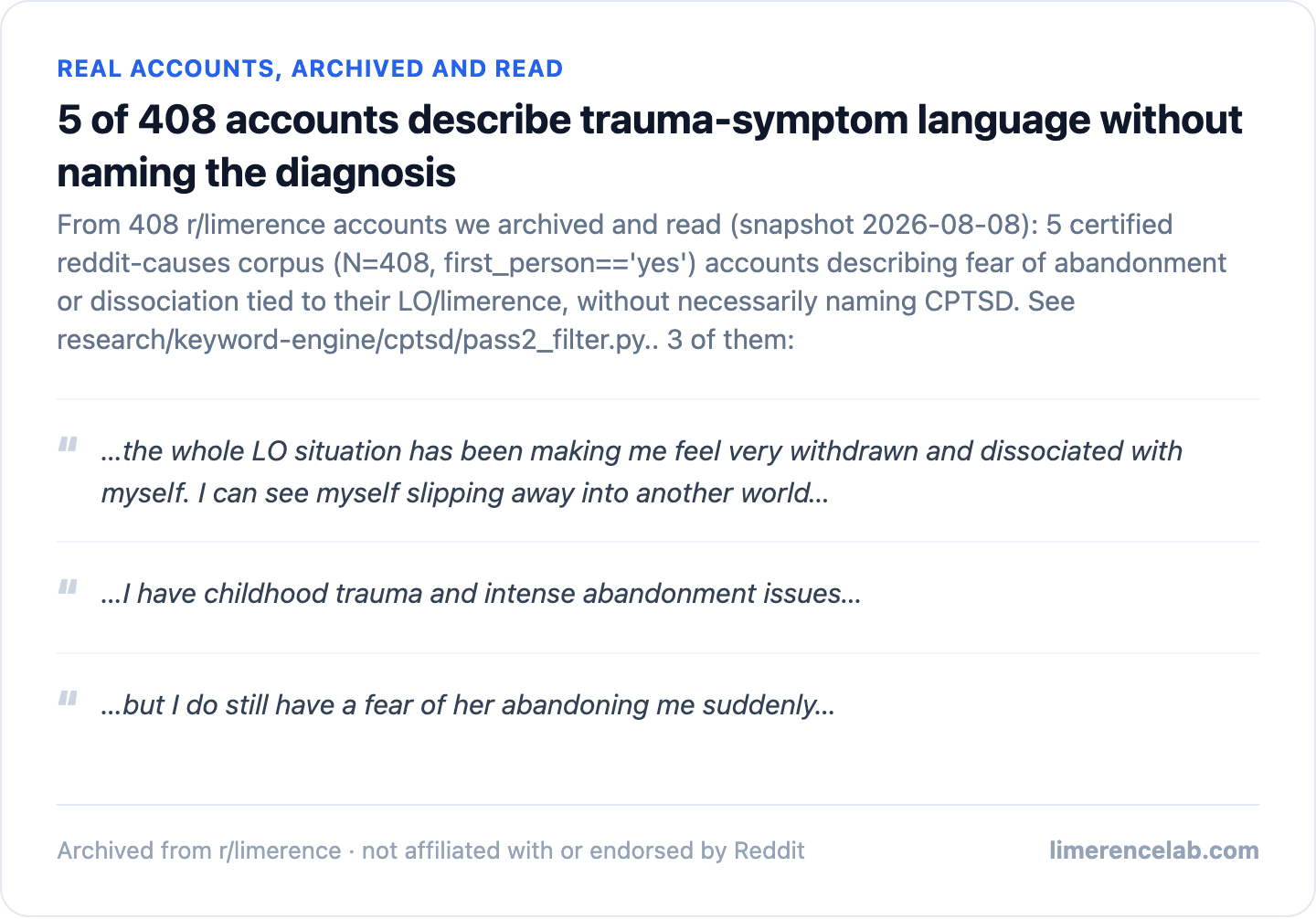
Many people share deep pain without using medical terms.
- Fear of loss drives much of their daily struggle. They worry their loved one will leave forever.
- Mind gaps appear when stress becomes too high. Their thoughts may fade during hard moments.
- Quiet panic lives in their chest at night. They check messages for signs of distance.
- Heavy shadows fall over simple routines. They replay past events in their head.
- Soft voices carry loud warnings inside. They hear criticism that never arrived.
- Clear labels are rare in these personal stories. 5 writers out of 408 show these patterns.
- Search results often look for clinical terms. Our review found only 5 accounts with this language.
- Self chosen posts reflect personal coping styles. Writers pick words that match their inner world.
- Professional views require trained experts to decide. Only licensed doctors can assign mental health labels.
- Real stories matter more than exact terms. 5 accounts reveal common fears and mind shifts.
- Plain words build stronger bridges between readers. Simple phrases capture heavy emotions clearly.
- Daily life holds the truest proof of care. People describe actions instead of using big names.
- Safe spaces allow honest sharing without judgment. Readers find comfort in shared human experiences.
- Wide context comes from 408 posts. Each voice adds a unique piece to the puzzle.
- Final notes remind us that feelings stand alone. You do not need a title to be valid.
- Deep bonds create strong emotional ties. People guard these links with great care.
- Small signs trigger big reactions inside. A quiet phone feels like a loud warning.
- True healing starts with gentle acceptance. We learn to trust our own steady heart.
- Gentle steps help rebuild trust over time. Small actions speak louder than perfect plans.
My personal take: what do I make of these accounts?
I read 408 stories from people sharing their feelings.
Three writers used the word CPTSD to name their pain while five others wrote about fear of being left alone and mind going blank without using that name.
These counts show a starting point not a full count from stories people chose to share.
CPTSD is a real diagnosis only a licensed professional can make.
The three names and five descriptions stand apart as separate findings.
This page shares what was found in our search of online accounts.
Reading these words helps us see how people describe hard times.
We never claim limerence is a disorder needing treatment or tell you what you have.
You can take a free quiz to learn more about your feelings. This activity is for learning only and is not a diagnosis.
What’s your Limerence Score?
A private, 2-minute check-in.
Questions this page answers
Is limerence a sign of complex trauma?
We looked at four hundred eight personal stories from our site. Three writers named complex trauma directly while five others described their pain without that label.
How often do people with limerence also have complex trauma?
Our search of four hundred eight self selected accounts found very few direct mentions. Three accounts used the term complex trauma while five accounts described related fears without naming it.
How does fear of loss differ from complex trauma?
Fear of loss is a common feeling that many people share. Our search of four hundred eight stories shows three writers used the medical label while five focused on their fear instead.
Can you feel spaced out while experiencing limerence?
Yes some people feel spaced out when they focus on another person. Our search found five writers who described this feeling clearly while three writers chose the medical term instead.
Did early life stress create these intense feelings?
We cannot say what causes these strong feelings. Our review of four hundred eight stories records three names for complex trauma and five descriptions of daily fear.
Are complex trauma and CPTSD the same label?
Many people use these words to mean the same past hurt. Our search of four hundred eight personal notes shows three writers picked one phrase and five picked another.
Should I seek a formal diagnosis for complex trauma?
Only a licensed mental health worker can make that choice for you. Our page shares four hundred eight voices showing three speakers named complex trauma and five spoke about their fear instead.
How does complex trauma differ from regular PTSD?
Doctors use different labels for different types of past stress. Our search of four hundred eight first person accounts recorded three names for complex trauma and five descriptions of daily fear.
Could hypnotherapy ease limerence tied to past stress?
We do not give advice about treatments or healing methods. Our goal is to share four hundred eight real stories showing three writers used the medical word and five shared their inner fear.
Further reading
- What Kind of Trauma Causes Limerence?
31 of the 75 people who could name a cause pointed to childhood -- a different question from this page's symptom profile.
- What Is Limerence?
The plain definition of limerence, no jargon.
- Why Do I Obsess Over Unavailable People?
What the corpus shows about attraction to people who can't reciprocate.
- I'm a Clinical Hypnotherapist. I Read 143 Accounts From People Who Got Out of Limerence.
See what people credited most when they got out of limerence.
This page shares learning tools.
It does not give a diagnosis.
Only a licensed expert can name CPTSD.
Hypnotherapy does not replace care from a trauma therapist.
Ready to break the loop?
Only 10 new clients a month. Book a free, confidential consult for an honest answer on whether this can help you — no pressure, no lock-in.
Only 2 spots left for August
Not ready to talk? Take the free Limerence Score →
About the Author

Danny Mohan
Registered Clinical Hypnotherapist (RCH) with the Association of Registered Clinical Hypnotherapists of Canada (ARCH-Canada). Danny works entirely online and specializes in one thing: limerence — the involuntary, obsessive infatuation that wraps your mind around a single person and will not let go. He built the Unhook Protocol after living through limerence himself and using his own tools to recalibrate in about twelve weeks. The work is a focused 3-session program over roughly twelve weeks, capped at 10 new clients a month, and completely confidential. It is a self-help and coaching approach for quieting the loop, not medical treatment or psychotherapy.
Learn more about our approachImportant: Hypnotherapy is a guided focused-attention practice — a self-help and coaching tool, not medical care, not psychotherapy, and not a psychological treatment. Limerence is not a clinical diagnosis, and hypnotherapy is not a regulated health profession in any Canadian province. ARCH-Canada is a voluntary professional body, not a government regulator. Nothing on this site is medical advice, diagnosis, or treatment. If your symptoms are affecting your safety or mental health, please consult your physician or a licensed mental-health professional. Hypnotherapy may complement that care but never replaces it.