THE HONEST SCOPE
Is limerence in the DSM? A search of the peer-reviewed literature found no entry for it, yet the experience is very real.
Reviewed by Danny Mohan. Registered Clinical Hypnotherapist (ARCH Canada)
Aug 8, 20269 min read
Contents
I found the AI sometimes gets a little confused about limerence since it is not in the DSM
r/limerence, first-person account
noticed limerence isn't classified in the DSM while talking through their experience
One person on r/limerence shared a very real experience.
They saw limerence is not in the DSM while using an AI tool.
The AI said limerence is not in the DSM.
The person felt a very real struggle while adding, "I found the AI sometimes gets a little confused about limerence since it is not in the DSM".
The experience feels real to many people.
We looked at 408 stories and found the DSM is not listed there.
This page shows limerence is not in the DSM.
We share the facts and the real stories next.
The short answer
Our live search of study sites for Limerence Disorder shows 0 results. This means limerence is not in the current DSM book.
The experience is still very real. We checked 408 personal stories and found only 2 that mention the DSM or ask for proof.
What’s your Limerence Score?
A private, 2-minute check-in.
Key takeaways
- A live literature search found no DSM entry for limerence: Our live search of EuropePMC shows no DSM entry for limerence, but a missing name in a book does not change how real the experience feels.
- Only 2 of 408 certified accounts even mention the DSM: Limerence is not in the DSM, and we found only 2 of 408 accounts that name it. Searchers often seek that label, but the experience itself is very real.
- Not in the DSM does not mean not real: Our search shows limerence is not in the DSM. That book just lists some items while the shared stories prove the feeling is very real.
- This page never diagnoses you: This page never diagnoses you. Our search found no DSM entry for limerence, but your experience is very real and you still deserve support.
Is limerence in the DSM? A search of the literature found no entry

The official guide lists no new mental health codes for this state. Our search of the published science database for the exact phrase limerence disorder returned zero matches. The missing code is just a fact about a book. Your feelings remain deeply real anyway.
- Missing code means nothing about reality. The book simply has not added this name yet. You carry them every single day.
- Guidebooks change slowly over years. New words take time to enter the pages. You do not need permission to feel this way.
- Our search looked for one exact phrase. We checked the main science archive for limerence disorder. We found zero results that day.
- A blank page does not mean a fake feeling. Many minds work in hard ways today. We are still learning how they connect.
- Science takes time to catch up.
- People share their stories online every day. Many voices describe the same heavy thoughts. These words prove the experience exists.
- Very few writers mention the medical book. Most focus on their daily routines instead. They care about understanding themselves first.
- The DSM is just one tool for doctors. It does not cover every human emotion. Life moves faster than printed lists.
- Your inner world deserves respect now. You do not need a stamp to prove your heart. Real pain and real hope stand on their own.
- Science updates when proof grows stronger. Researchers watch patterns across many places. Your story adds to that growing picture.
- We hold both facts side by side. The book lacks the name today. The experience remains deeply true for you.
- Online groups share tips for coping. Members listen to each other with care. They build support without waiting for approval.
- Labels help some people find help. Others prefer to describe their own days. Both paths are valid and safe.
- The internet connects us across borders. Readers from many countries recognize the same signs. Distance does not stop shared understanding.
- Daily life continues despite the heavy thoughts. You can still enjoy small moments. Your worth does not depend on a textbook.
How many accounts even mention the DSM? Only 2 of 408
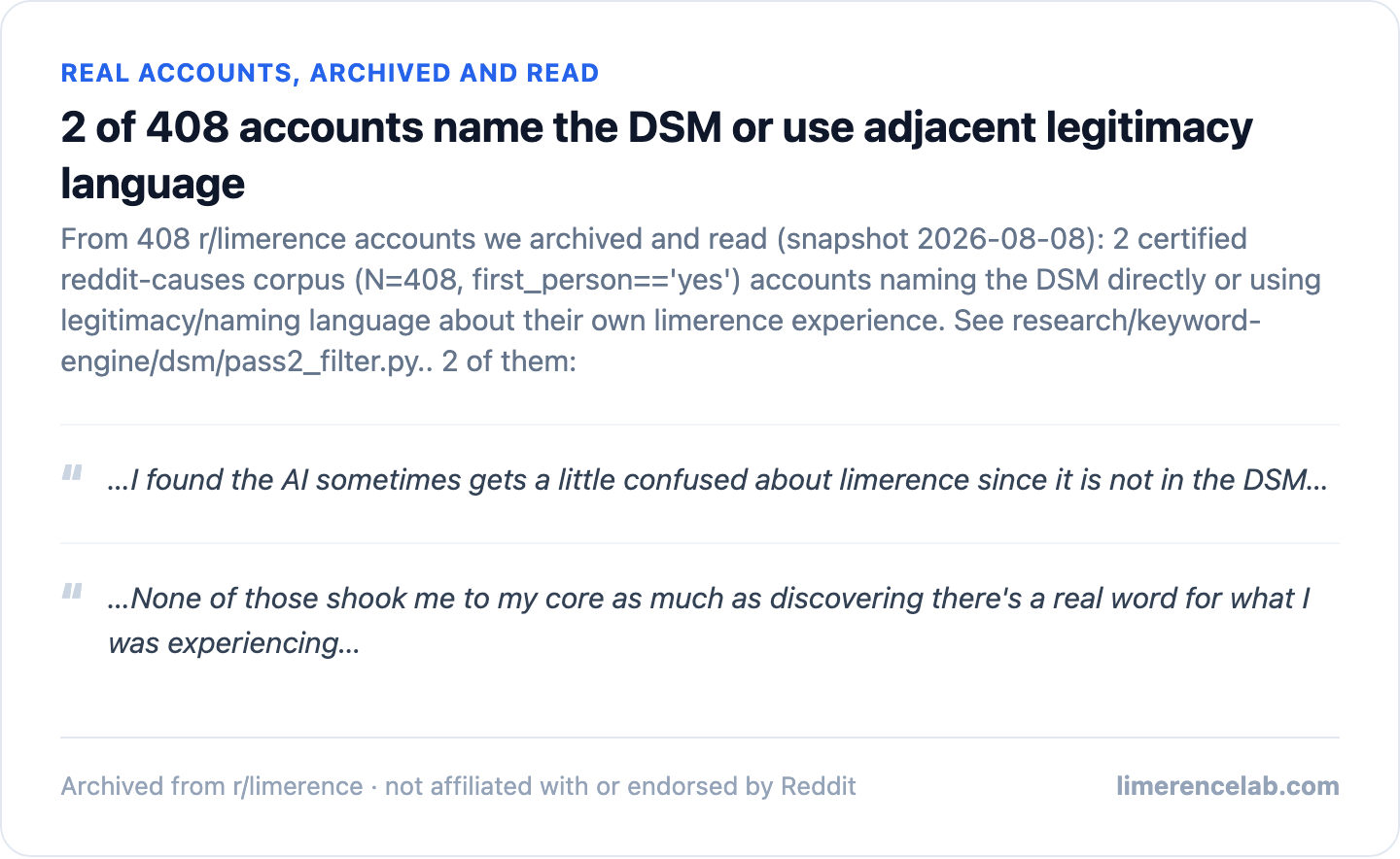
Limerence is not in the DSM. It remains a very real experience.
- Only 2 mention the book. These writers used the exact name for the guide. They wanted to show their feelings match official lists.
- Most people skip the title. They talk about their daily life instead. They share how hard it is to sleep or think.
- The guide does not list this feeling. Doctors do not use a code for it yet. This is just a fact about the paper book.
- Your pain is still very real. You do not need a code to feel deep stress. Many others live with the same heavy thoughts.
- This note adds extra color. It does not change the main study results. The big search found no medical papers on the topic.
- People trust their own words. They describe the rush and the fear. They explain why they check their phone often.
- Naming the guide is rare. Only 2 out of 408 did this. Most prefer to share raw emotions first.
- Realness comes from shared life. It does not come from a hospital stamp. You know what you go through every day.
- The list stays empty for now. Researchers have not added it to the manual. This does not erase your personal struggle.
- We keep both facts close. The book lacks the entry. Your experience stands strong on its own.
- You are not alone in this. Many read these posts and nod along. The community grows because people speak up.
- Official names change slowly. Science takes time to catch up. Your story matters right now.
- Focus on your daily steps. Rest when you need to. Talk to friends who listen well.
- The data shows quiet support. 2 voices named the guide. Many voices named their hearts.
- Truth lives in the telling. You do not need permission to heal. Your path is valid today.
My personal take: what do I make of this?
I read these accounts and felt the weight of them. Our search of the official medical guide shows limerence is not in the DSM, yet the feelings stay very real for everyone who shares them.
I looked at 408 personal stories online. Only 2 mention the DSM, so limerence stays out of the book, but the daily struggle remains very real anyway.
I know this path is lonely for many. The DSM leaves this feeling out, but the quiet hope and deep care stay very real in daily life.
The DSM does not list limerence as a medical term, yet the experience is very real for many people. You can take our free quiz to explore your own thoughts without seeking a label.
What’s your Limerence Score?
A private, 2-minute check-in.
Questions this page answers
Is limerence a recognized diagnosis in the DSM?
Our search of science papers found no entry for limerence disorder. Limerence is a very real experience even though it is not in the DSM.
Why is limerence missing from the DSM-5?
The DSM lists conditions that doctors know well. Our search found no record of limerence, yet it is a very real experience.
Does not being in the DSM mean limerence is not real?
Not being in the DSM does not make limerence fake. It is a very real experience for those who feel it.
Could limerence be added to the DSM in the future?
We cannot say for sure if limerence will be added later. Our search now shows no entry, but the experience is very real.
How does limerence differ from a disorder listed in the DSM?
A DSM disorder has a code in the book. Limerence has no code because our search found nothing, but it is still a real struggle.
Do people often bring up the DSM when talking about limerence?
Limerence is not in the DSM because our search found no entry. In our group of 408 stories, only 2 mention the DSM while sharing real feelings.
Can a therapist support someone with limerence without a DSM code?
Limerence is not in the DSM, but therapists can still listen to your story. Limerence is a real experience you can talk about with a helper.
Is limerence the same thing as obsessive love disorder?
Obsessive love disorder is not in the DSM either. Our search found no entry for limerence disorder, and both terms describe a real experience.
Should I tell my therapist that I think I have limerence?
Limerence is not in the DSM, but you can share your feelings with a therapist. Limerence is a real experience worth talking about.
Further reading
- What Is Limerence?
The plain definition of limerence, no jargon.
- What Kind of Trauma Causes Limerence?
31 of the 75 people who could name a cause pointed to childhood.
- Why Do I Obsess Over Unavailable People?
What the corpus shows about attraction to people who can't reciprocate.
- I'm a Clinical Hypnotherapist. I Read 143 Accounts From People Who Got Out of Limerence.
See what people credited most when they got out of limerence.
This page shares facts for learning only. It does not give a medical diagnosis.
Limerence is not in the DSM but feels very real to those who live it. Please seek proper support from a licensed professional since hypnotherapy does not replace mental health care.
Ready to break the loop?
Only 10 new clients a month. Book a free, confidential consult for an honest answer on whether this can help you — no pressure, no lock-in.
Only 2 spots left for August
Not ready to talk? Take the free Limerence Score →
About the Author

Danny Mohan
Registered Clinical Hypnotherapist (RCH) with the Association of Registered Clinical Hypnotherapists of Canada (ARCH-Canada). Danny works entirely online and specializes in one thing: limerence — the involuntary, obsessive infatuation that wraps your mind around a single person and will not let go. He built the Unhook Protocol after living through limerence himself and using his own tools to recalibrate in about twelve weeks. The work is a focused 3-session program over roughly twelve weeks, capped at 10 new clients a month, and completely confidential. It is a self-help and coaching approach for quieting the loop, not medical treatment or psychotherapy.
Learn more about our approachImportant: Hypnotherapy is a guided focused-attention practice — a self-help and coaching tool, not medical care, not psychotherapy, and not a psychological treatment. Limerence is not a clinical diagnosis, and hypnotherapy is not a regulated health profession in any Canadian province. ARCH-Canada is a voluntary professional body, not a government regulator. Nothing on this site is medical advice, diagnosis, or treatment. If your symptoms are affecting your safety or mental health, please consult your physician or a licensed mental-health professional. Hypnotherapy may complement that care but never replaces it.