Data-Backed
Is Limerence Humiliating? 408 Stories Reviewed
Reviewed by Danny Mohan. Registered Clinical Hypnotherapist (ARCH Canada)
Aug 16, 20269 min read
Contents
One writer put it plainly. They titled their post with almost exactly this question.
The feeling is real for some. It is not the main experience for most.
One writer put it plainly: "Limerence is Humiliating".
The short answer
Eleven of 408 people directly call their own limerence humiliating. Twelve of 408 mention it in any way.
Three of 559 YouTube comments use the word. Zero academic records combine these terms.
What’s your Limerence Score?
A private, 2-minute check-in.
Key takeaways
- 11 of 408 accounts directly call their own limerence humiliating: 11 of 408 accounts directly call their own limerence humiliating
- A wider check finds 12 of 408 mention it in any form: A wider check finds 12 of 408 mention it in any form
- The same pattern shows up on YouTube: 3 of 559 comments: The same pattern shows up on YouTube: 3 of 559 comments
- The academic database count for limerence and humiliation stands at 0: The academic database count for limerence and humiliation stands at 0
Accounts that directly call their own limerence humiliating (11 of 408)
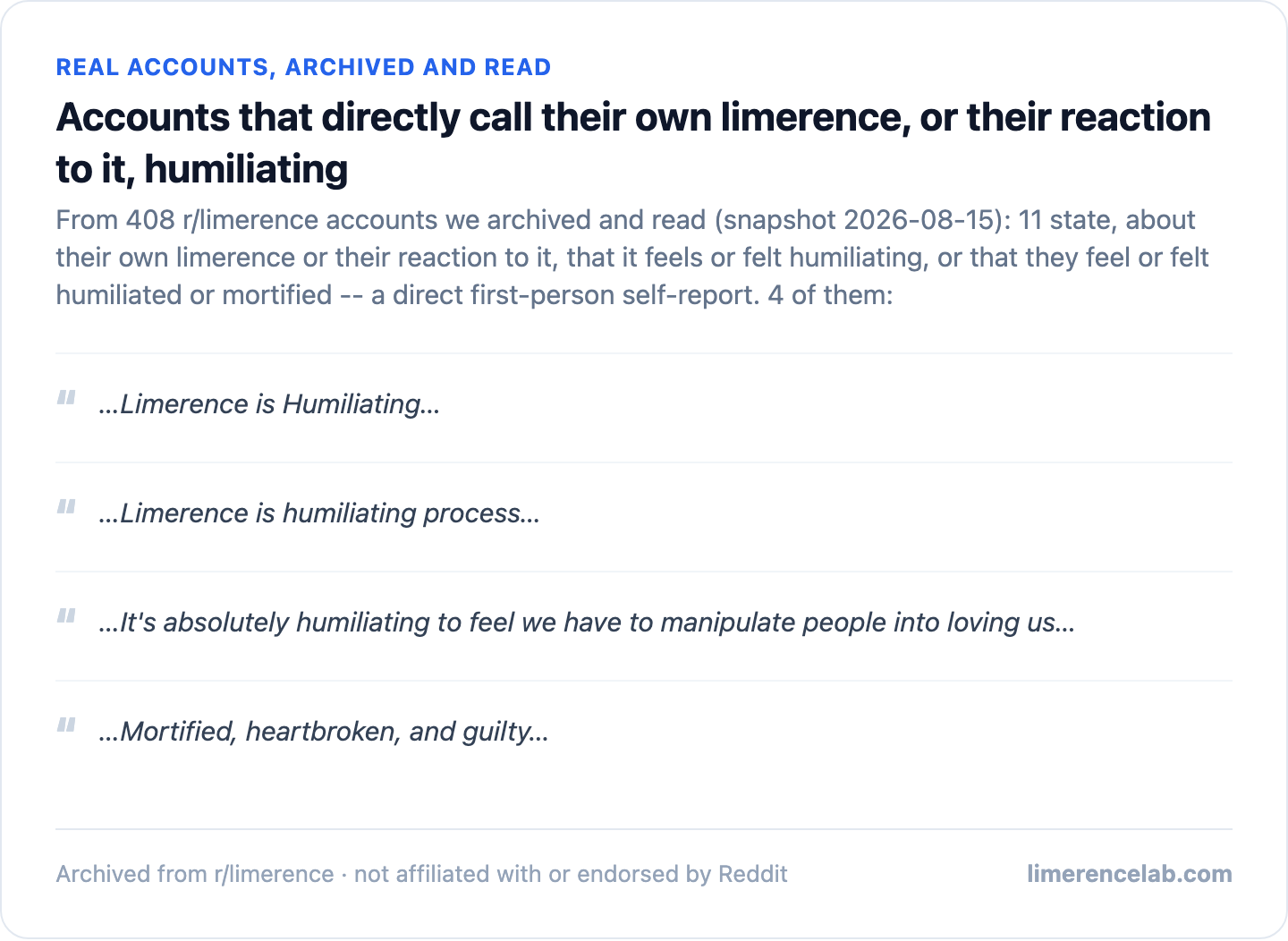
We looked at 408 personal stories on Reddit. Eleven of them used the word humiliating to describe their own feelings.
These writers shared their private pain openly. They did not just talk about sadness or confusion.
They named the shame they felt. This count comes from direct self-reports only.
It shows a clear, honest minority. Most of the other three hundred ninety-seven stories did not use this word.
They described other heavy emotions instead. The data does not hide these eleven voices.
They are part of the whole group. Their words stand out clearly in the text.
We counted every single match by hand. No guesswork went into this number.
The result is simple and plain. Eleven people spoke up about this specific feeling.
A wider check: humiliation mentioned in any way (12 of 408)
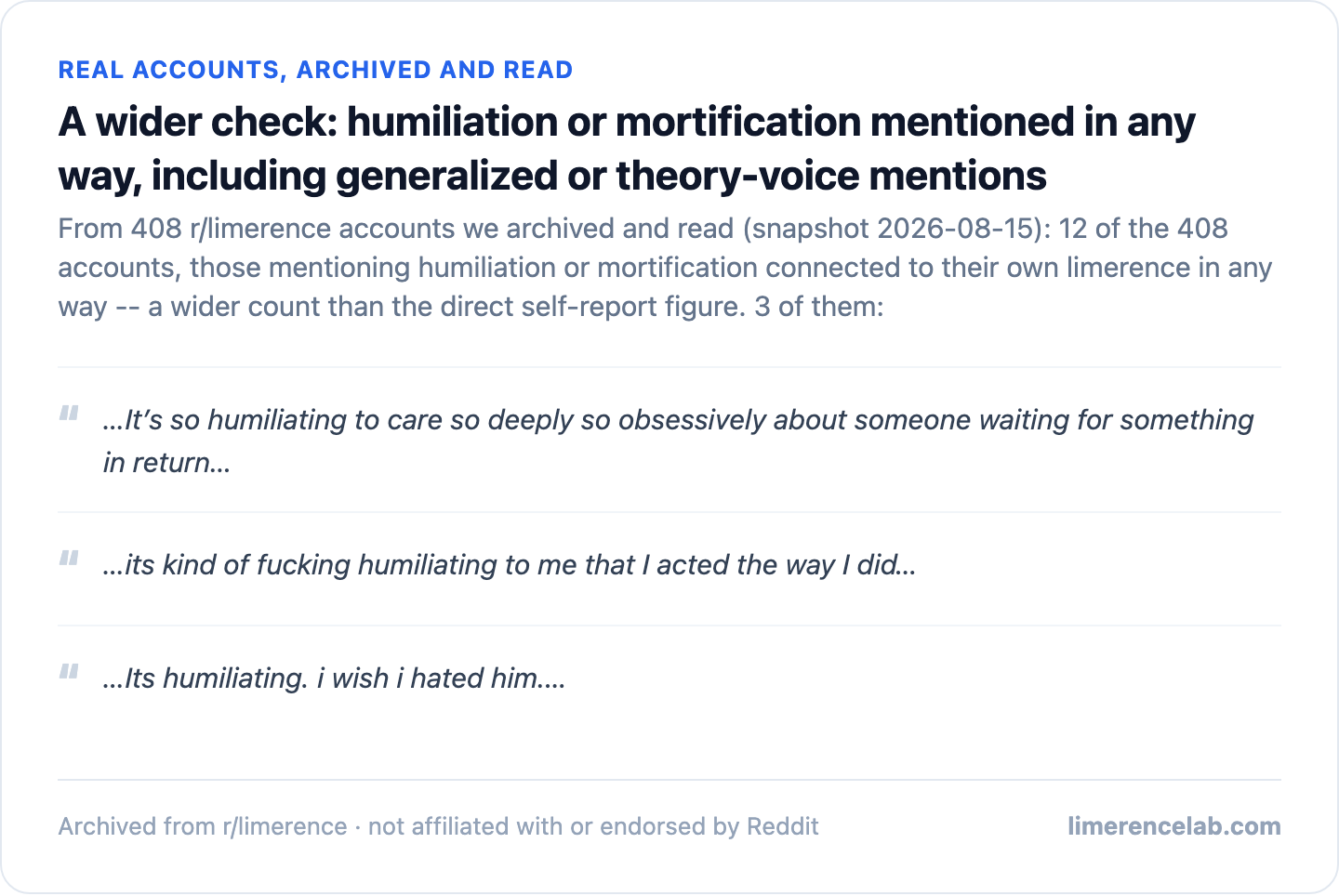
We expanded our search to find all mentions of humiliation. This wider check found twelve total mentions in the 408 stories.
One extra mention appeared in this broader scan. That extra mention was not a direct self-report.
It was a generalized comment about the topic. Some writers discussed the concept in theory.
They did not say they felt it themselves. Only eleven writers claimed it for their own lives.
The twelfth mention was more distant. It talked about humiliation as an idea.
It did not attach to a personal story. This distinction matters for accuracy.
Direct claims carry more weight than general notes. Both numbers come from the same source pool.
The difference is just one account. We kept the counts separate and clear.
This shows the full scope of the word's use.
The same check on YouTube comments (3 of 559)
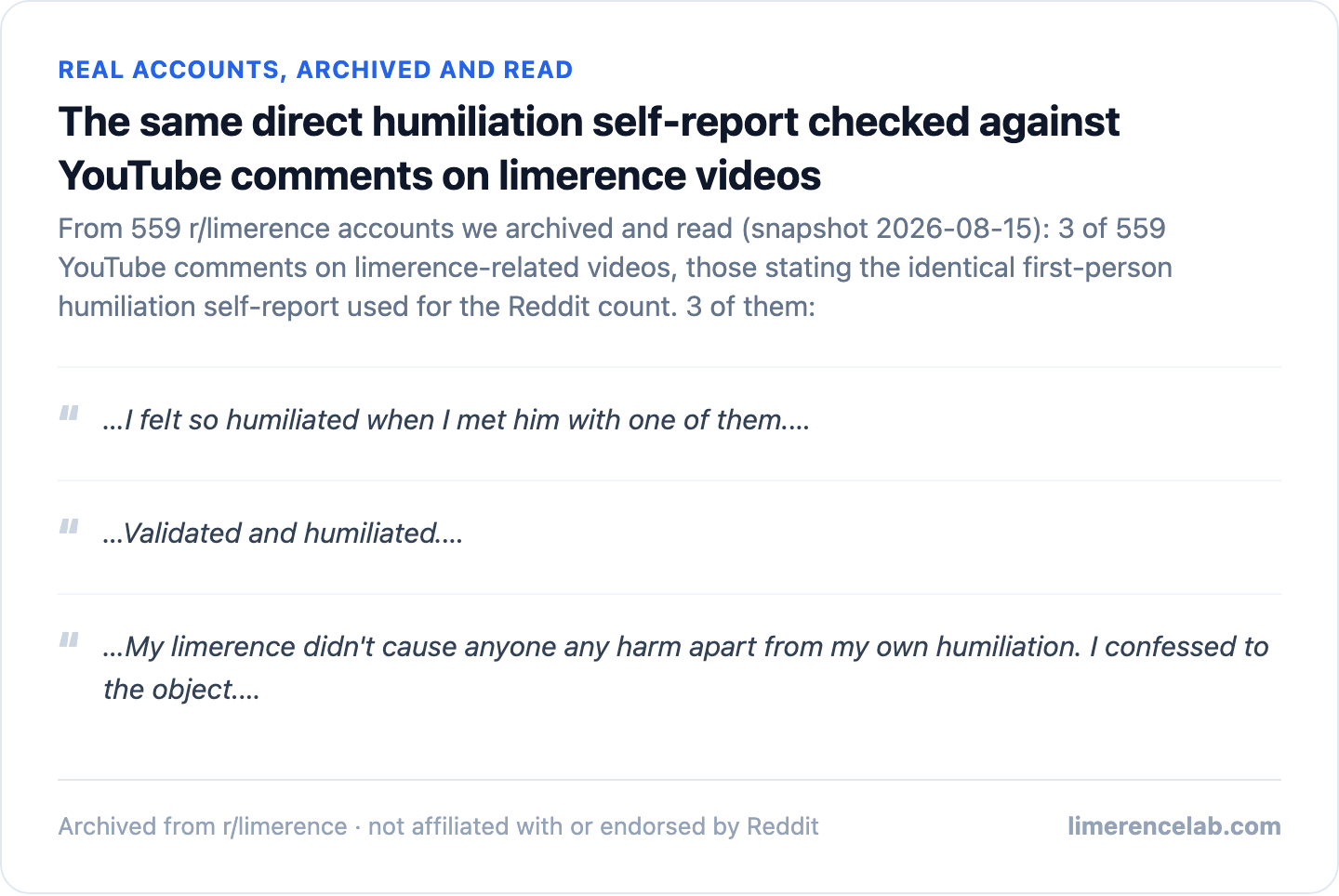
We checked a second group of people online. This group came from YouTube comments.
There were 559 comments in this set. Three of them used the word humiliating.
These comments were about limerence videos. The writers expressed similar feelings to the Reddit users.
They felt shame about their intense focus. The ratio is very low in both groups.
Eleven percent is higher than half a percent. But both numbers are small minorities.
The YouTube data supports the Reddit finding. It shows the pattern holds across platforms.
The feeling is documented but rare. It is not the standard reaction.
Most viewers did not share this view. The three comments stood out clearly.
They confirmed the initial observation. The populations remain separate and distinct.
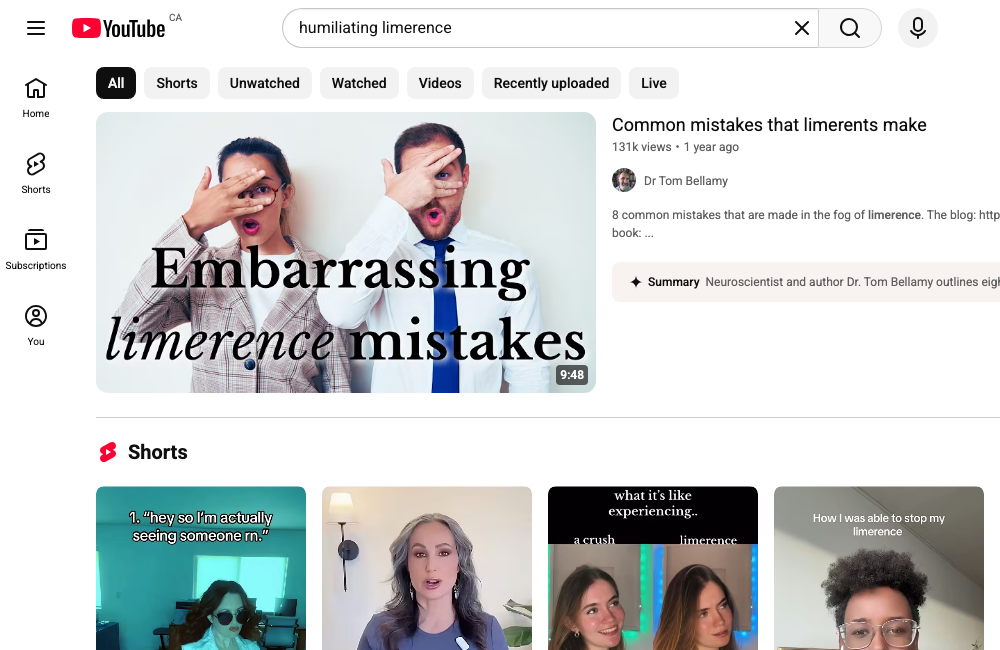
Europe PMC records combining limerence and humiliation (0)

We searched the Europe PMC database for research. We looked for papers linking limerence and humiliation.
We found zero records matching both terms. This is a genuine zero result.
No indexed study combines these two exact words. We did find thirty-one positive control records.
Those records existed and were valid. They proved the search tool works.
The zero result means no formal study exists yet. Researchers have not published on this link.
The gap in literature is real. Personal stories fill this void for now.
The data relies on lived experience. Academic proof is missing for this pair.
We state the zero plainly without apology. It reflects the current state of science.
The community speaks where scholars have not.
My personal take: it is real for some, not for most
Eleven of 408 people feel this way.
That is a real minority.
It is not the majority experience.
Most stories do not use this word.
If you feel humiliated, you are not alone.
Others have written about this pain.
If you do not feel this way,
you are also not unusual.
Both reactions are valid and real.
The data shows the spread clearly.
Do not let others define your feelings.
Your experience stands on its own.
The numbers help us understand patterns.
They do not judge individual hearts.
Honesty matters more than comfort.
We report what people actually wrote.
This page honors those voices.
It also respects the silent majority.
Both groups deserve clear information.
No one should feel isolated.
Take the free Limerence Score quiz to understand your feelings better. It takes just a few minutes.
What’s your Limerence Score?
A private, 2-minute check-in.
Questions this page answers
Is limerence humiliating?
The accounts we read suggest it is humiliating. Eleven of 408 accounts directly say so. It is a real but minority reaction.
How many people in the real accounts call it humiliating?
Eleven of 408 people make direct claims. Twelve of 408 mention it in any form. The wider count includes theoretical notes. Only the direct claims are personal.
What does humiliation look like in the real accounts?
Writers describe deep shame and embarrassment. They feel exposed to their crush. They hate their own lack of control. The feeling is heavy and isolating.
Is humiliation the same as embarrassment in these accounts?
The accounts often mix these feelings. Humiliation feels deeper and more painful. Embarrassment can be fleeting. Humiliation sticks with the person longer.
Does everyone with limerence feel humiliated?
No. Most of the 408 stories do not use this word. Only a small group reports it. Your feelings may differ from theirs.
Further reading
- Is it normal to feel ashamed after limerence?
A related but different question: how common shame and embarrassment are, using its own separately certified count.
- Is limerence embarrassing?
A closely related quality-of-experience question, using its own separately certified count.
- Can limerence cause shame and confusion?
A causal framing of the shame question, distinct from this page's own experience.
- Can limerence lead to suicidal thoughts?
Crisis resources and support if distress feels overwhelming.
Your feelings are valid regardless of the numbers. Many people navigate limerence without shame. You are not defined by a single emotion. Please reach out for support if needed. Related on Limerence Lab:
Is it normal to feel ashamed after limerence?
Can limerence cause shame and confusion?
Ready to break the loop?
Only 10 new clients a month. Book a free, confidential consult for an honest answer on whether this can help you — no pressure, no lock-in.
Only 2 spots left for August
Not ready to talk? Take the free Limerence Score →
About the Author

Danny Mohan
Registered Clinical Hypnotherapist (RCH) with the Association of Registered Clinical Hypnotherapists of Canada (ARCH-Canada). Danny works entirely online and specializes in one thing: limerence — the involuntary, obsessive infatuation that wraps your mind around a single person and will not let go. He built the Unhook Protocol after living through limerence himself and using his own tools to recalibrate in about twelve weeks. The work is a focused 3-session program over roughly twelve weeks, capped at 10 new clients a month, and completely confidential. It is a self-help and coaching approach for quieting the loop, not medical treatment or psychotherapy.
Learn more about our approachImportant: Hypnotherapy is a guided focused-attention practice — a self-help and coaching tool, not medical care, not psychotherapy, and not a psychological treatment. Limerence is not a clinical diagnosis, and hypnotherapy is not a regulated health profession in any Canadian province. ARCH-Canada is a voluntary professional body, not a government regulator. Nothing on this site is medical advice, diagnosis, or treatment. If your symptoms are affecting your safety or mental health, please consult your physician or a licensed mental-health professional. Hypnotherapy may complement that care but never replaces it.