Community Voices
Is Limerence Embarrassing? 408 Stories Reviewed
Reviewed by Danny Mohan. Registered Clinical Hypnotherapist (ARCH Canada)
Aug 16, 20269 min read
Contents
- Accounts that directly call their own limerence embarrassing (15 of 408)
- A wider check: embarrassment mentioned in any way (16 of 408)
- The same check on YouTube comments (7 of 559)
- Europe PMC records combining limerence and embarrassment (2)
- Side by side: Reddit and YouTube counts
- My personal take: it is real for some, not for most
Limerence brings strong feelings. One writer put it plainly.
"The most embarrassing moment of my life is finally over." This shows the weight of the experience.
The short answer
Yes, some people find it embarrassing. But most do not.
Only a small group shares this feeling.
What’s your Limerence Score?
A private, 2-minute check-in.
Key takeaways
- 15 of 408 accounts directly call their own limerence embarrassing: 15 of 408 accounts directly call their own limerence embarrassing
- A wider check finds 16 of 408 mention it in any form: A wider check finds 16 of 408 mention it in any form
- The same pattern shows up on YouTube: 7 of 559 comments: The same pattern shows up on YouTube: 7 of 559 comments
- The academic database count for limerence and embarrassment stands at 2: The academic database count for limerence and embarrassment stands at 2
Accounts that directly call their own limerence embarrassing (15 of 408)
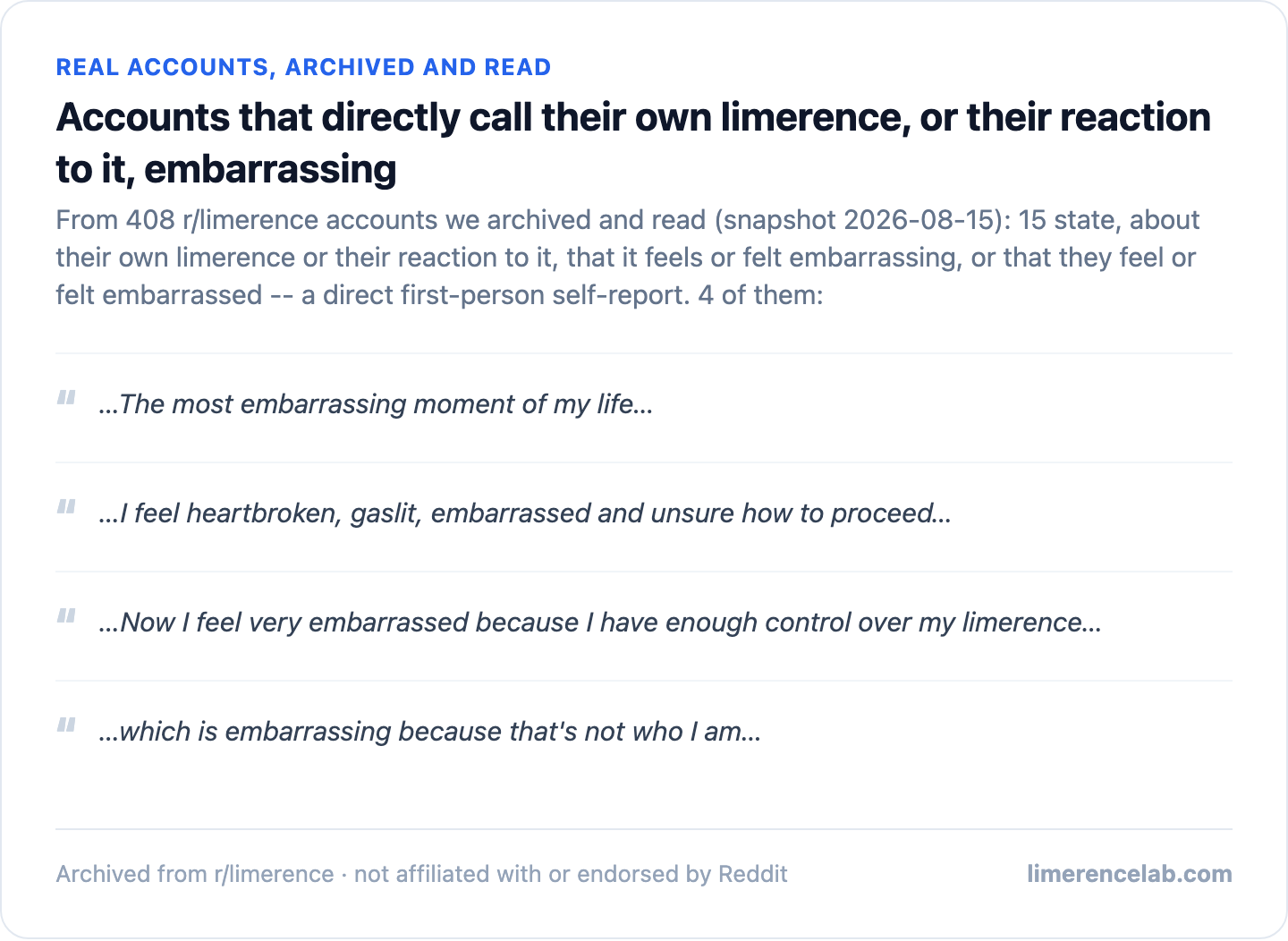
We read 408 stories on Reddit. These posts came from real users.
They shared their personal experiences with limerence. We looked for specific words about shame or awkwardness.
Fifteen of these stories used the word embarrassing to describe their own situation. This number is clear and direct.
It shows a genuine minority experience. Most writers did not use this word.
They described other feelings instead. The count stands on its own.
It does not prove a general rule. It only shows what these fifteen people felt.
A wider check: embarrassment mentioned in any way (16 of 408)
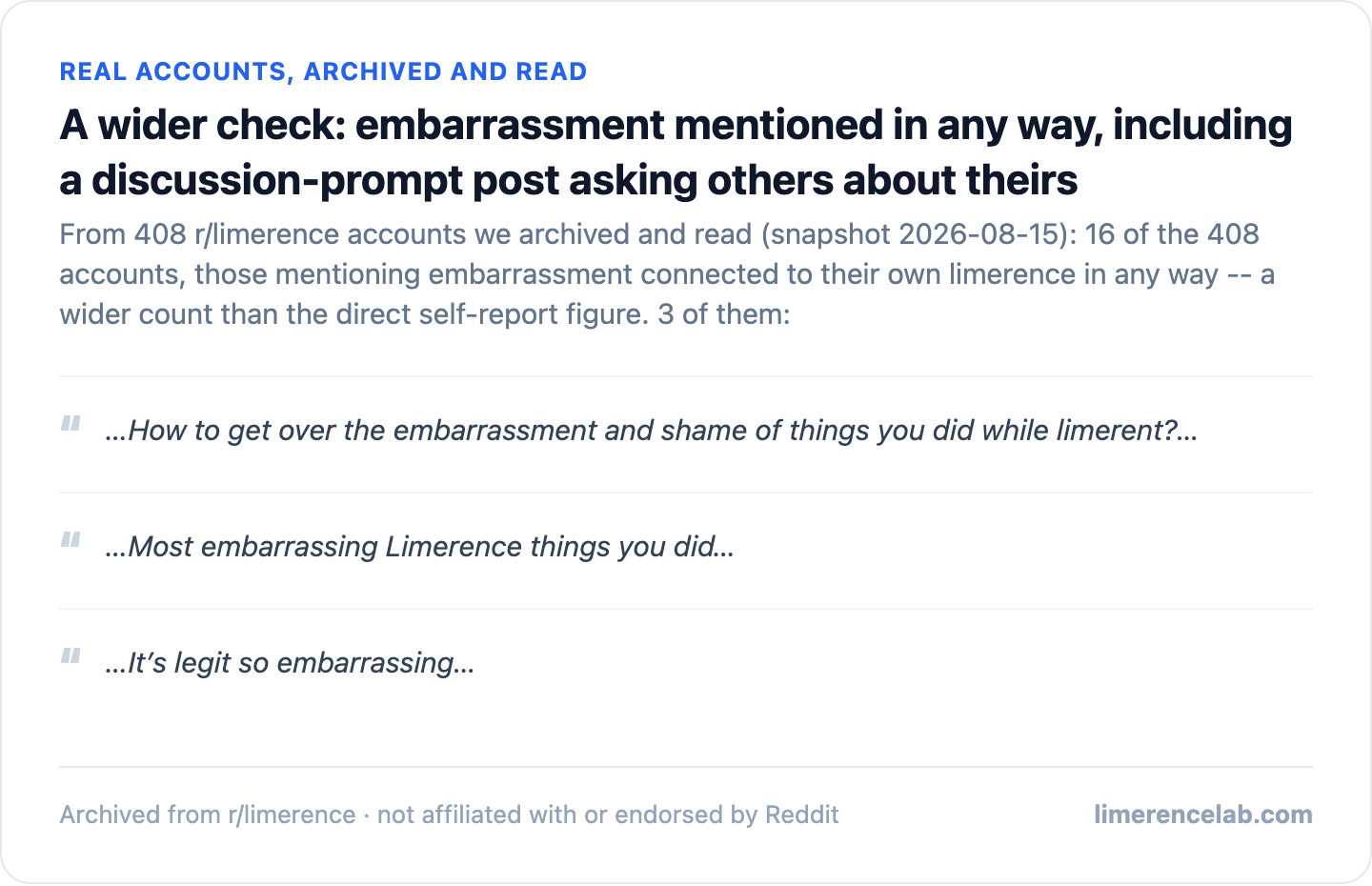
We expanded our search slightly. We looked for any mention of embarrassment.
This count rose to sixteen of 408 stories. The extra story comes from a different type of post.
It was a discussion prompt. The author asked others about their own moments.
This post itself did not claim embarrassment. It just opened the door for others to speak.
So we have fifteen direct claims. We have one indirect mention in a prompt.
Both numbers are small. They show that talking about embarrassment is rare.
It is not the main topic for most writers. The difference between fifteen and sixteen is small.
It highlights how specific the direct reports are.
The same check on YouTube comments (7 of 559)
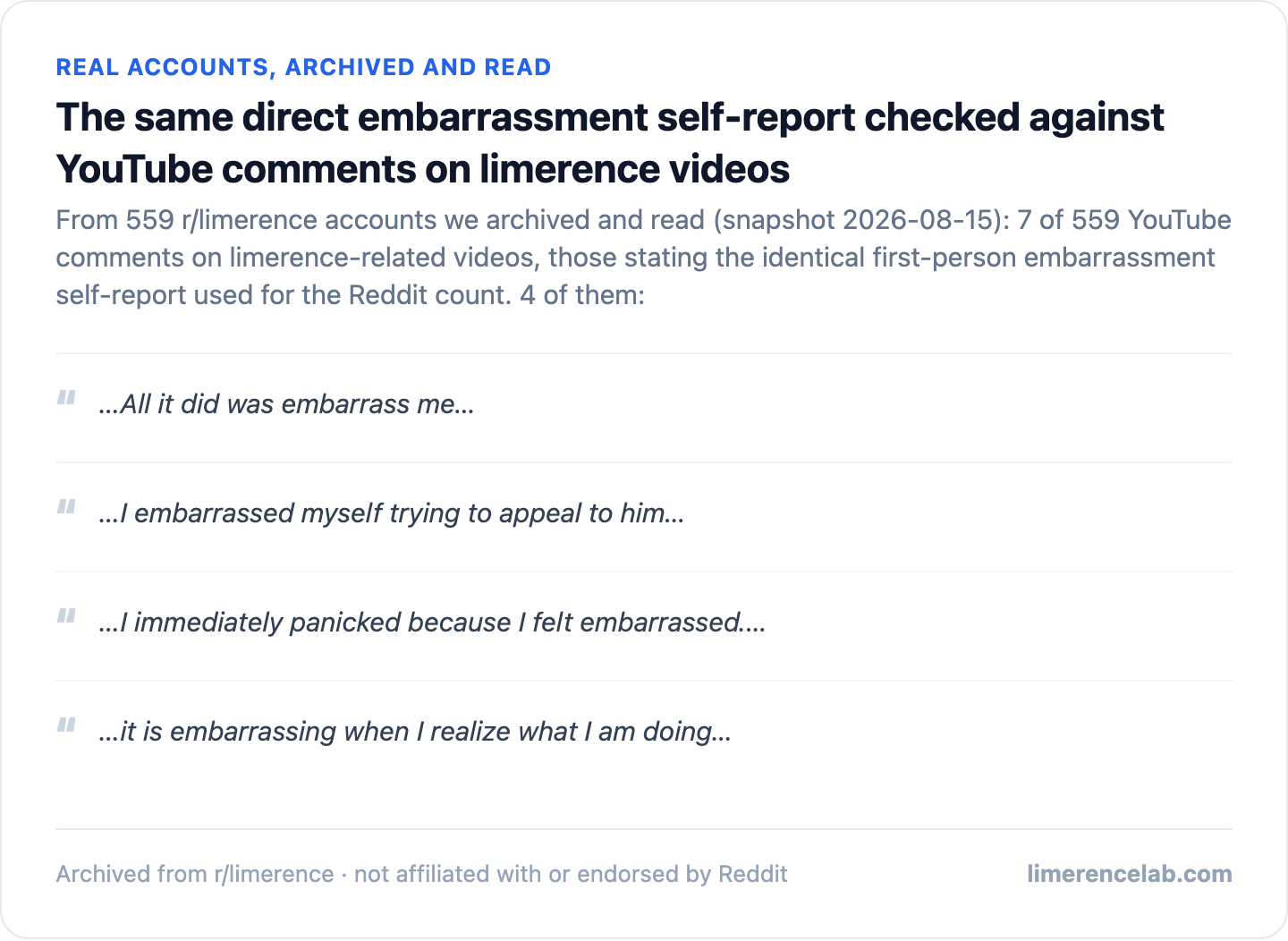
We checked a second source. We looked at YouTube comments.
There were 559 comments on limerence videos. We searched for the same word.
Seven comments used the word embarrassing. This matches the pattern from Reddit.
The number is low in both places. YouTube has more total comments than Reddit stories.
Yet the ratio stays similar. This suggests the feeling is not unique to one platform.
It appears across different types of online spaces. The seven comments stand alone.
They do not blend with the Reddit data. Each platform has its own separate count.
This keeps the findings clear and honest.
Europe PMC records combining limerence and embarrassment (2)
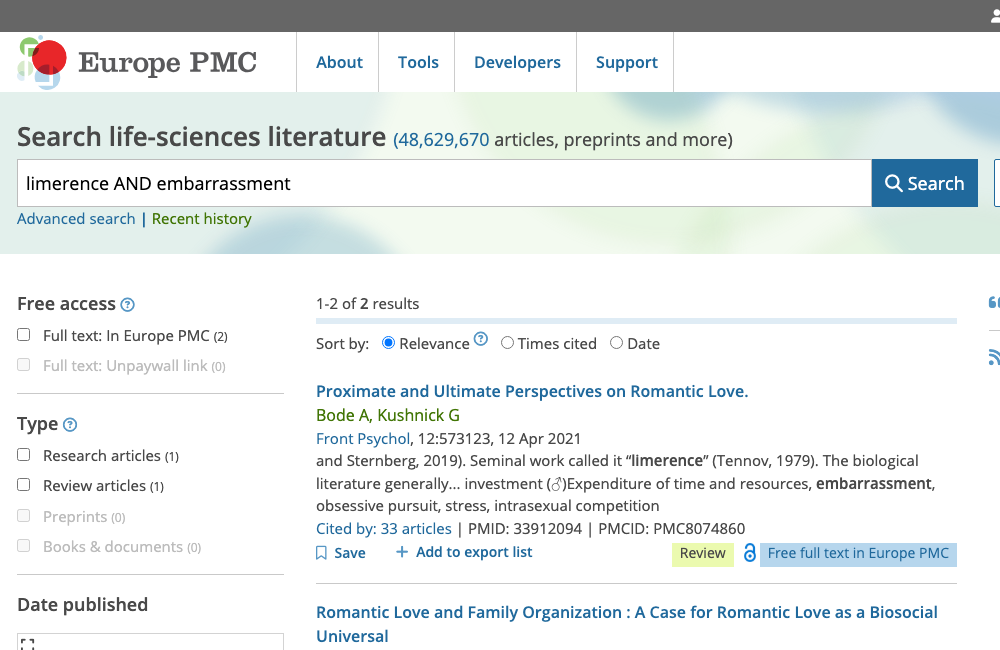
We searched academic databases too. We used Europe PMC for this search.
We looked for papers with both words. We found two records.
Neither record studies this exact question. They do not focus on embarrassment in limerence.
They just happen to contain both terms. This is a positive control result.
It shows the database has thirty-one related records. But only two mix these specific topics.
The academic literature does not ignore the topic completely. It just does not center on it.
The two records exist as a footnote. They do not provide deep analysis here.
They simply mark the edge of current research.
Side by side: Reddit and YouTube counts
We place the two community counts next to each other. Reddit had 408 stories.
Seventeen mentioned embarrassment in some form. YouTube had 559 comments.
Seven mentioned it directly. The Reddit number is higher in total mentions.
This includes the discussion prompt. The YouTube number is lower overall.
Both groups show a small minority. The populations are separate.
We never add them together. Each source tells its own part of the story.
The consistency between them is notable. Different platforms yield similar results.
This strengthens the finding. It shows the pattern is stable.
It is not an artifact of one site.
My personal take: it is real for some, not for most
I see the numbers clearly. Fifteen of 408 is a real group.
Their feelings matter. They are not imagining things.
But they are not the majority. The accounts we read do not show this word.
If you feel embarrassed, you are not alone. You are part of a small group.
If you do not feel this way, you are normal too. Your experience is valid.
Do not judge yourself for your reaction. The data supports both views.
Some feel shame. Others feel joy or pain.
All reactions are part of the human experience. We report what was written.
We do not tell you how to feel. Trust your own heart.
Listen to your own mind. The numbers are just a guide.
They show the landscape. They do not define your path.
What’s your Limerence Score?
A private, 2-minute check-in.
Wondering where you stand? Take our free Limerence Score quiz to understand your feelings better.
What’s your Limerence Score?
A private, 2-minute check-in.
Questions this page answers
Is limerence embarrassing?
Some people find it embarrassing. Fifteen of 408 Reddit accounts say so. Seven of 559 YouTube comments agree. It is a real feeling for a few.
How many people in the real accounts call it embarrassing?
Fifteen of 408 direct self-reports use the word. Sixteen of 408 mention it in any way. This includes one discussion prompt.
What does embarrassment look like in the real accounts?
People describe awkward moments. They talk about hiding their feelings. One writer called it the most embarrassing moment. The feelings are personal and intense.
Is embarrassment the same as shame in these accounts?
The accounts use the word embarrassing. They do not always use shame. The feelings overlap but are distinct. We stick to the words people chose.
Does everyone with limerence feel embarrassed?
No. Most of the 408 stories do not use this word. The feeling is a minority experience. Many people feel other emotions instead.
Further reading
- Is it normal to feel ashamed after limerence?
A related but different question: how common shame and embarrassment are, using its own separately certified count.
- Is limerence humiliating?
A closely related quality-of-experience question, using its own separately certified count.
- Can limerence cause shame and confusion?
A causal framing of the shame question, distinct from this page's own experience.
- Can limerence lead to suicidal thoughts?
Crisis resources and support if distress feels overwhelming.
Your feelings are valid. Whether you feel embarrassment or not, you are not alone. Many people navigate these complex emotions. You can seek support if you need it. A free consultation might help you understand your path better. Related on Limerence Lab:
- Is it normal to feel ashamed after limerence? - Is limerence humiliating? - Can limerence cause shame and confusion?
Ready to break the loop?
Only 10 new clients a month. Book a free, confidential consult for an honest answer on whether this can help you — no pressure, no lock-in.
Only 2 spots left for August
Not ready to talk? Take the free Limerence Score →
About the Author

Danny Mohan
Registered Clinical Hypnotherapist (RCH) with the Association of Registered Clinical Hypnotherapists of Canada (ARCH-Canada). Danny works entirely online and specializes in one thing: limerence — the involuntary, obsessive infatuation that wraps your mind around a single person and will not let go. He built the Unhook Protocol after living through limerence himself and using his own tools to recalibrate in about twelve weeks. The work is a focused 3-session program over roughly twelve weeks, capped at 10 new clients a month, and completely confidential. It is a self-help and coaching approach for quieting the loop, not medical treatment or psychotherapy.
Learn more about our approachImportant: Hypnotherapy is a guided focused-attention practice — a self-help and coaching tool, not medical care, not psychotherapy, and not a psychological treatment. Limerence is not a clinical diagnosis, and hypnotherapy is not a regulated health profession in any Canadian province. ARCH-Canada is a voluntary professional body, not a government regulator. Nothing on this site is medical advice, diagnosis, or treatment. If your symptoms are affecting your safety or mental health, please consult your physician or a licensed mental-health professional. Hypnotherapy may complement that care but never replaces it.