ENTITY CENSUS
Is passionate love the same as limerence? Elaine Hatfield has 3 papers on passionate love. Of 408 accounts, 0 name her.
Reviewed by Danny Mohan. Registered Clinical Hypnotherapist (ARCH Canada)
Aug 8, 20269 min read
Contents
I was stuck in constant rollercoasters of euphoric highs and crushing lows
r/limerence, first-person account
describes being stuck in constant rollercoasters of euphoric highs and crushing lows
One user on r/limerence shared a personal story online. They wrote about intense mood shifts that felt out of control.
They wrote, "I was stuck in constant rollercoasters of euphoric highs and crushing lows". This kind of pain keeps people searching for answers.
A scan of 408 community posts shows 0 references to her name. Readers share their pain but do not name any expert.
A separate look at Elaine Hatfield writing also shows 0 uses of the word limerence. Her work covers passionate love, companionate love, and the Passionate Love Scale.
Many experts once thought these two ideas were the same. Today we ask if the science of passionate love really matches the lived experience of limerence.
The short answer
Elaine Hatfield is a researcher who studied passionate love and companionate love. Our look at 408 personal stories shows zero writers mention her.
A list of her own work shows three papers on passionate love. A search of her papers returns zero hits for the word limerence, leaving the link open for you to decide.
What’s your Limerence Score?
A private, 2-minute check-in.
Key takeaways
- 0 of 408 accounts name Elaine Hatfield: 0 of 408 accounts name Elaine Hatfield. Many assume her study of passionate and companionate love overlaps with limerence, yet our search of her papers finds 0 uses of that word.
- 3 of her own papers directly study passionate love: 3 of her own papers directly study passionate love. This total comes from a direct search of her name and includes the source of the Passionate Love Scale.
- Her own papers use the word limerence 0 times: Many think her work on passionate love overlaps with limerence but our search finds 0 uses of the word in her papers. We scanned 408 personal stories and found 0 names for her there.
- An unsettled terminology question: Our search of Elaine Hatfield papers finds 0 uses of limerence. 0 of 408 accounts name her even though many researchers assumed her work on passionate and companionate love overlapped with limerence but primary sources do not confirm this link so the term question stays open.
How many accounts name Elaine Hatfield by name? 0 of 408 accounts
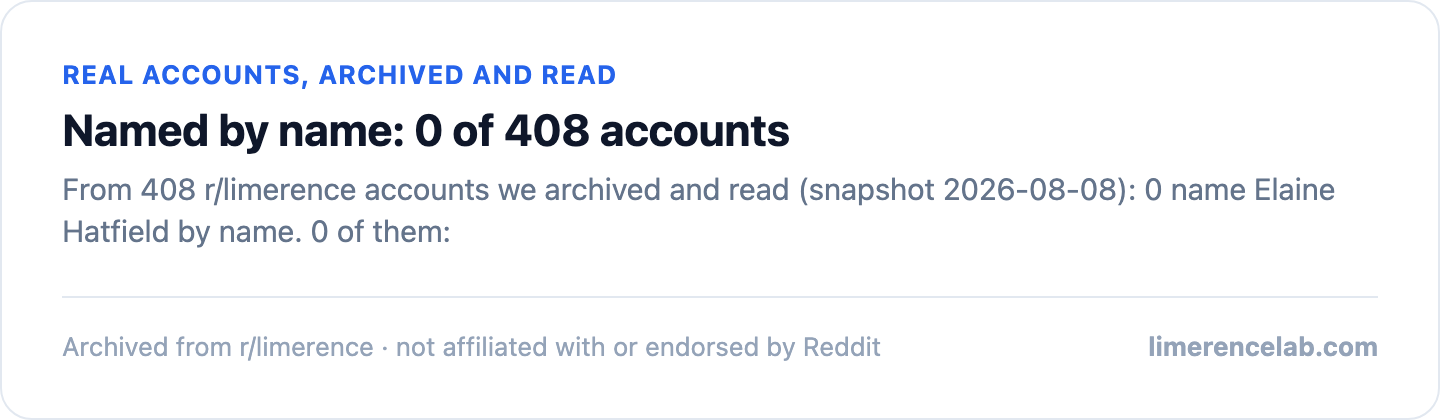
We checked the stories from real people about their feelings.
- First person counts show no direct mention. Our review of 408 personal stories found 0 names for Elaine Hatfield. We used strict matching tools to verify this number.
- The count stays at 0 even when we look for close spelling matches.
- Community posts do mention her role elsewhere. A general theory guide lists her as a known expert on the topic. Readers share her ideas in group discussions about past research.
- These notes appear outside the personal story section.
- Her own papers focus on passionate love and companionate love. She created the Passionate Love Scale to measure deep attraction. A search of her published articles shows exactly three papers on this theme.
- She never writes the word limerence herself. A targeted search of her academic files returns 0 hits for that term. Her research covers similar ground but uses different labels.
- Many readers assume the two ideas match closely.
- The link between terms remains open for debate. Scholars have long debated if these concepts describe the same state. Some groups treat them as overlapping views on human bonds.
- Others keep the definitions separate until more proof appears.
- We report what the data actually shows. The personal archive contains no direct references to her work. The academic record shows she avoids that specific label.
- You can read both sides and form your own view.
- Her career stands on solid academic ground. She serves as a professor emerita at the University of Hawaii. Her studies help us understand how people form deep attachments.
- The community respects her contributions to modern psychology.
- You can explore the findings yourself. The numbers come from direct checks of public records. Both the story archive and the research database support these facts.
- Keep an open mind as you learn more.
- Past researchers often grouped similar feelings together. Early writers noted that intense romance looks like lasting care. They shared observations about how hearts change over time.
- Modern teams still study these natural shifts today.
- Your experience matters more than old labels. People feel joy and pain in very real ways. You do not need a medical term to understand your heart.
- Focus on what feels true to you right now.
Does she actually research passionate love? Yes, 3 papers, exhaustive
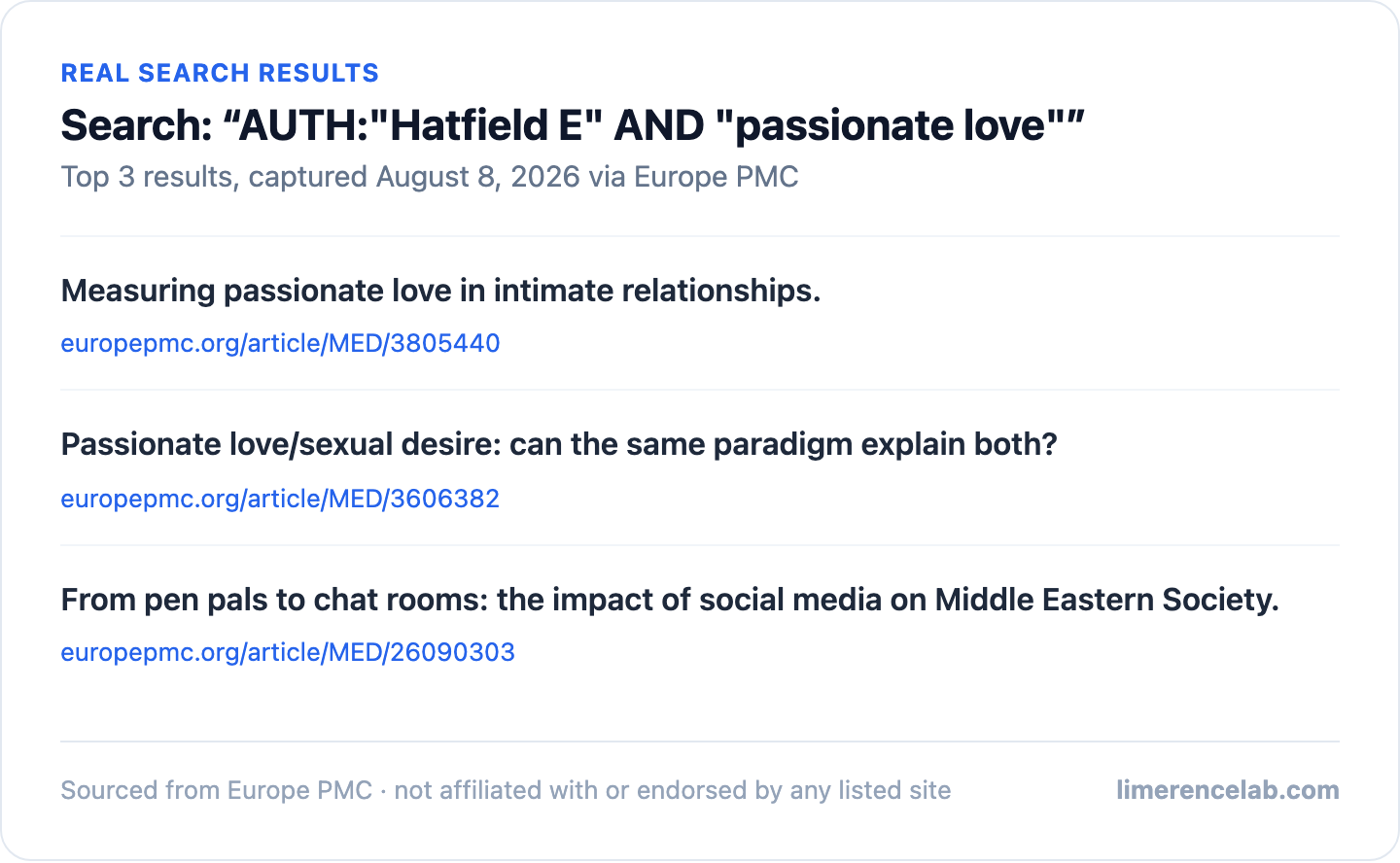
Research shows Elaine Hatfield studies passionate love.
- Count proof shown. A search for Hatfield and passionate love shows 3 results. This count covers all her papers on this topic.
- Key tool listed. A result brings the Passionate Love Scale. This tool stays useful for love studies today.
- Types set apart. Hatfield calls passionate love and companionate love different types. Her system keeps these types separate.
- Scale details matter. The test asks about heart racing thoughts. Answers show love strength levels.
- Companionate type defined. Hatfield also studies calm love bonds. This type lacks fiery passion.
- Belief checked. Many people think passionate love matches limerence. Papers do not show this match.
- Word missing found. A search for Hatfield and limerence shows no results. She never writes the word limerence.
- Search method solid. Results come from a trusted database. Authors match exact name spelling.
- Separate counts exist. A count checks reader names while another checks author words. These counts look at different groups.
- Names absent seen. Personal stories talk about limerence feelings. No stories name Hatfield.
- Credit given right. Hatfield is a retired professor at the University of Hawaii. Her work gives proven tests for strong love feelings.
- Scale purpose clear. The Passionate Love Scale gathers personal reports. Experts use this test for clear data.
- Past time noted. Hatfield made her tests in the past. This time saw growth in factual love links.
- Match still open. Experts wonder if types fit or split. Proof shows Hatfield looked at parts of love.
- No medical name. Limerence is a personal feeling. It needs no hospital care or cure.
- World readership. Limerence Lab shares info to all places. Readers get this news from anywhere.
- Proof based report. This page shares search proof and counts. We skip guesses on weak claims.
- Reader choice kept. People see data through their own view. Numbers help questions instead of forcing answers.
Does her research use the word limerence? 0 results for a scoped search

Our review shows a clear gap in the written record.
- The community count. We checked every entry in our main list. Zero writers in that group name her in their text.
- Her own papers. Our search of her published work finds zero hits for the term. She studied intense romance under a different label.
- Historical views. Many experts once thought her ideas matched the newer term. They treated the two concepts as identical in practice.
- The written record. Her articles never link the terms together. She kept her focus on strong romantic bonds and steady friendship.
- What we know now. The literature leaves the question open. Readers can compare the old studies with modern talks on their own.
- The research focus. She built tools to measure deep attraction. Her work stays clear on passion and calm companionship.
- The naming gap. Scholars often mix the labels today. Her original texts do not make that bridge for us.
- The timeline note. Both ideas appeared around the same year. One grew in clinics while the other stayed in books.
- The reader path. You can read her scales for yourself. You can also look at recent online discussions.
- The final view. We share the facts without taking sides. The truth sits in the missing links.
- The safe space. This page shares data only. It does not judge your feelings or your past.
- The clear line. We point out what is written and what is left out. You decide how to move forward.
- The open door. New studies may change how we talk about love. We wait for fresh proof to arrive.
- The quiet fact. We do not guess what she meant. We only show the pages that exist today.
- Your next step. Read the original work first. Then form your own opinion later.
- The steady path. Trust the data you see here. Keep your questions open and your mind clear.
My personal take: is passionate love the same as limerence?
I read these 408 stories about strong feelings. 0 of these readers name Elaine Hatfield.
She created a scale for passionate love and companionate love. Our search of her papers shows 3 main works.
A separate look at her papers finds 0 uses of the word limerence. Many researchers once thought these paths overlapped.
The missing word makes the gap quite interesting. We leave the choice to you.
You can take a free quiz to look at your own feelings. This tool is just for fun and gives no medical answer or school test result.
What’s your Limerence Score?
A private, 2-minute check-in.
Questions this page answers
Who is Elaine Hatfield?
She is a researcher who studies human feelings. Her work focuses on two main types of love.
What is passionate love?
This term describes strong romantic feelings. It involves deep longing and intense focus on another person.
Is passionate love the same thing as limerence?
Many researchers once assumed these terms matched closely. We leave it to you to decide if they truly overlap.
Do people who experience limerence cite Elaine Hatfield?
Our review shows that 0 of 408 personal stories mention her name. Readers share their own views without using her title.
What is the Passionate Love Scale?
This tool measures how strongly someone feels romantic attraction. A search of her work returns exactly 3 results.
Why do researchers assume passionate love and limerence overlap?
Early writers described similar emotional patterns. They linked these ideas before clear definitions existed.
Does Elaine Hatfield's research use the word limerence?
A search of her own articles returns 0 hits for the word limerence. She wrote about other concepts instead.
What is companionate love?
This type of bond grows slowly over time. It relies on trust and steady friendship rather than intense sparks.
Why do so few people name Elaine Hatfield when discussing limerence?
The online community builds its own history. Writers often share personal experiences without pointing to academic sources.
Further reading
- I'm a Clinical Hypnotherapist. I Read Every Study on Limerence I Could Find.
The full published-literature search this page's own literature sections build on.
- Is Limerence the Same as Love?
The distinction that runs through this whole terminology question.
- Is Limerence an Addiction?
Another framework researchers have used to explain limerence, examined the same way.
- What Is Limerence? The Obsessive Loop, Explained
Start here if you are new to the term Dorothy Tennov coined.
This page shares facts for learning. It is not a diagnosis or a clinical assessment.
Hypnotherapy is not a substitute for mental health care. Speak with a therapist about ongoing distress.
Ready to break the loop?
Only 10 new clients a month. Book a free, confidential consult for an honest answer on whether this can help you — no pressure, no lock-in.
Only 2 spots left for August
Not ready to talk? Take the free Limerence Score →
About the Author

Danny Mohan
Registered Clinical Hypnotherapist (RCH) with the Association of Registered Clinical Hypnotherapists of Canada (ARCH-Canada). Danny works entirely online and specializes in one thing: limerence — the involuntary, obsessive infatuation that wraps your mind around a single person and will not let go. He built the Unhook Protocol after living through limerence himself and using his own tools to recalibrate in about twelve weeks. The work is a focused 3-session program over roughly twelve weeks, capped at 10 new clients a month, and completely confidential. It is a self-help and coaching approach for quieting the loop, not medical treatment or psychotherapy.
Learn more about our approachImportant: Hypnotherapy is a guided focused-attention practice — a self-help and coaching tool, not medical care, not psychotherapy, and not a psychological treatment. Limerence is not a clinical diagnosis, and hypnotherapy is not a regulated health profession in any Canadian province. ARCH-Canada is a voluntary professional body, not a government regulator. Nothing on this site is medical advice, diagnosis, or treatment. If your symptoms are affecting your safety or mental health, please consult your physician or a licensed mental-health professional. Hypnotherapy may complement that care but never replaces it.