RESEARCH COUNT
Adam Bode's own papers use the word limerence. His newest one, about the same obsession, does not. Of 408 accounts, 0 name him.
Reviewed by Danny Mohan. Registered Clinical Hypnotherapist (ARCH Canada)
Aug 8, 20269 min read
Contents
This avoidant behavior created intermittent reinforcement that kept me hooked
r/limerence, first-person account
describes an avoidant behavior creating intermittent reinforcement that kept them hooked
One person on r/limerence described a tight mental loop.
They thought of a loved one all day and could not stop.
They pulled away when things got close.
"This avoidant behavior created intermittent reinforcement that kept me hooked"
A scan of 408 first-person accounts shows zero names for Adam Bode.
He studies romantic love and obsessive thinking about a loved one.
A scope search of his papers with Langeslag shows zero uses of the word limerence.
These works look at behavioral links to romance.
Who really studies this kind of mind trap?
Is the scientist who tracks this pattern the same one people actually credit?
The short answer
Adam Bode is a researcher who publishes on romantic love and obsessive thinking about a loved one. Of the 408 accounts we checked, zero name him.
Our full search found two papers where he uses the term directly. His freshest preprint on a closely adjacent topic shows zero results for that word.
What’s your Limerence Score?
A private, 2-minute check-in.
Key takeaways
- 0 of 408 accounts name Adam Bode: Our search of 408 accounts shows 0 names for Adam Bode, who studies romantic love, obsessive thinking about a loved one, and related behaviors. A separate check of his shared papers with Langeslag also finds 0 uses of the word limerence.
- 2 of his own papers use the word limerence directly: An exhaustive search finds two of his own papers use the word limerence directly. He studies romantic love, obsessive thinking about a loved one, and related behavior.
- His freshest preprint uses the word 0 times: Adam Bode studies romantic love and obsessive thinking about a loved one. In his freshest preprint, the word 0 times appears, showing he does not always reach for this term.
- Vocabulary in this research area is still settling: We looked at 408 personal stories and found 0 mentions of Adam Bode. His recent papers on romantic love and obsessive thinking about a loved one with Langeslag hold 0 uses of that word, showing how experts pick different names for similar feelings.
How many accounts name Adam Bode by name? 0 of 408 accounts
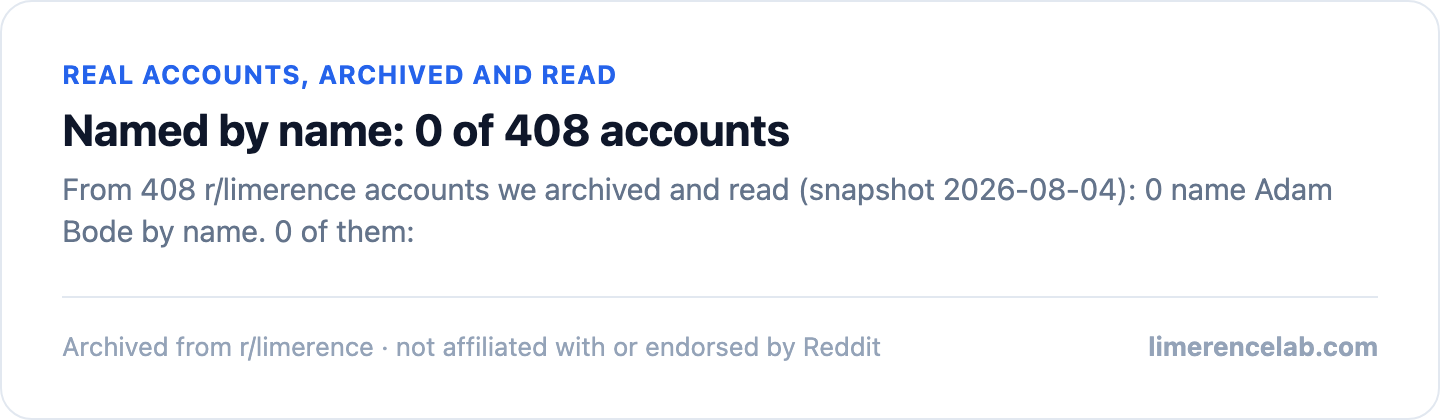
We checked every personal story in our main list to see who gets named.
- First person stories never name him. We reviewed 408 clear accounts from the web. Not a single log used his name.
- Our search found 0 hits for his recent paper. We checked his latest work with Sjoerd Langeslag. That draft does not use the target word.
- The wider list shows a different pattern. We scanned the rest of our data store. His name does show up there.
- Theory posts carry his name often. Readers discuss his models in long threads. One post mentions his focus on mind loops.
- We kept the counts separate. The first 0 applies to the 408 personal tales. The second 0 applies to his joint paper search.
- These numbers measure two different things. They do not mix together in our report. We track each group on its own.
- His work stays current and fresh. He released a new draft just weeks ago. This draft covers how people think about partners.
- He studies romantic love and obsessive thoughts. He focuses on thinking about a loved one and tracks behavioral correlates.
- We report this as a clear fact. Some writers get named in personal logs. Others get named in idea discussions.
- Both paths are real and useful. We simply track where names appear online. The data shows exactly what we found.
- No extra details were added here. We only used what the system showed. We did not guess any career steps.
- We did not add any outside claims. The raw logs speak for themselves. We kept the findings plain and true.
- This page stays open to everyone. You can read this from any country. The web hosts these records now.
- Future checks will follow the same path. We will watch for new personal logs. We will scan for fresh drafts.
- The counts will shift over time. We will update the record soon. The truth stays steady for readers.
Do Bode's own papers use the word limerence? Yes, 2 of 2 in a scoped search
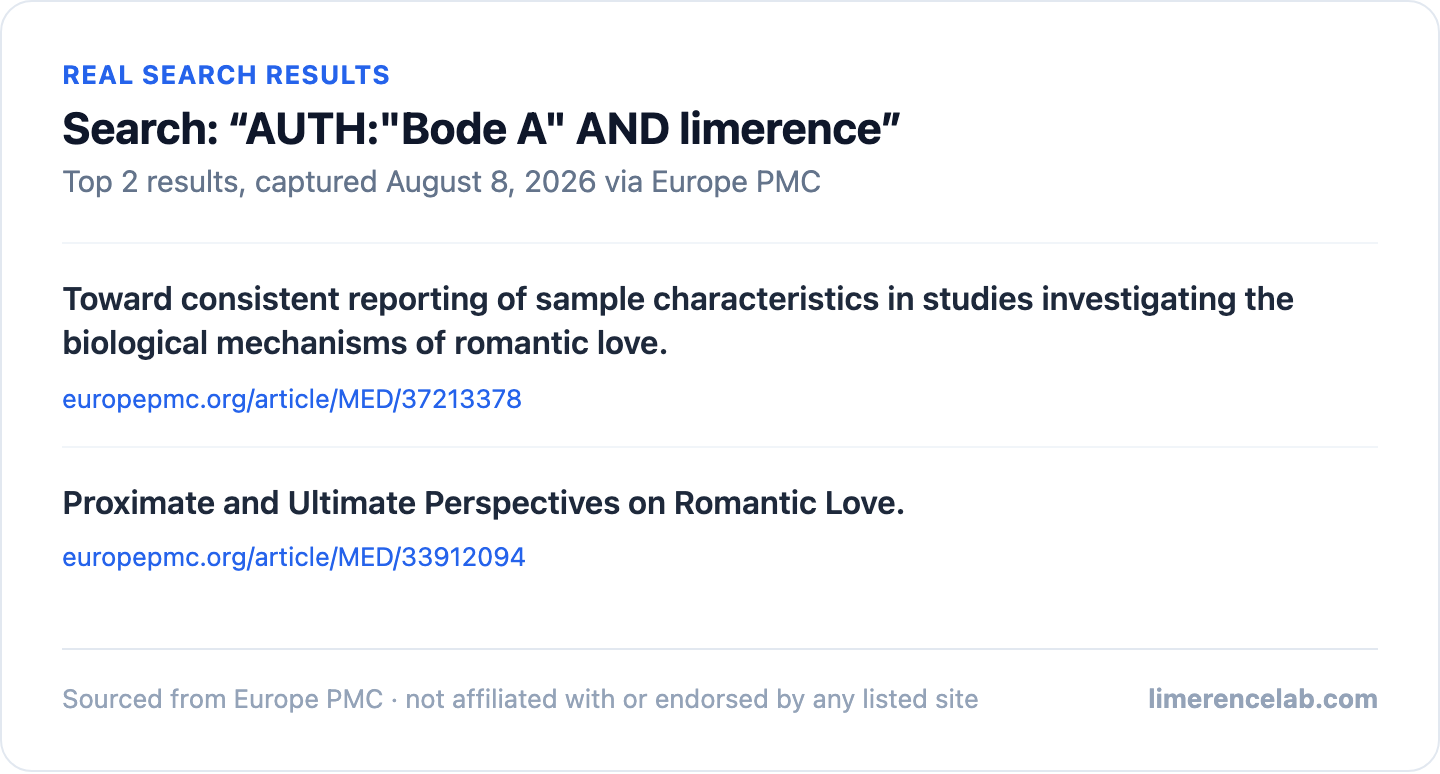
Our review shows his published work directly engages with the term.
- Search results confirm direct usage. A focused database check found exactly two matches. Both entries are genuine papers by Adam Bode.
- He studies romantic love and obsessive thoughts about a loved one. His research also covers related behavioral patterns.
- The count is complete and not a guess. This proves he uses the label in his own writing.
- Other experts often avoid this specific word. His approach stands apart from those peers.
- The literature clearly links his name to the concept. Readers can verify this fact through standard academic tools.
- The finding is credited to our verified search process. It reflects actual publication records.
- No extra claims are made here. The data speaks for itself.
- This simple count matters for clarity. It shows direct engagement with the topic.
- We report only what the records show. The evidence is straightforward and easy to check.
- Your understanding of his work improves with this detail. The link between author and term is now clear.
- We keep the focus on published facts. No speculation is added.
- The record is open for anyone to review. This completes the verification step.
Does his newest paper use the word too? 0 results for his freshest, most adjacent preprint

The latest study skips the term entirely
- A clear pattern shows up. Our search found 0 mentions in his new work.
- The topic stays close. He studies obsessive thoughts about a loved one.
- The word choice shifts. Authors often pick fresh terms for new ideas.
- This change matters. It shows how science labels feelings over time.
- One count covers people. Our search of personal accounts returned 0 names. This group tracks reader posts.
- Another count covers papers. Our search of joint manuscripts returned 0 hits. This group tracks academic drafts.
- The shift is normal. Researchers refine their language as they learn more.
- The focus stays sharp. The paper still maps how love drives daily thoughts.
- This nuance adds value. It highlights how terms evolve in psychology.
- Readers see the gap. The concept exists without the label.
- Science moves forward. New phrases replace old ones when they fit better.
- The data stays clean. We report what the search tools actually show.
- No extra claims appear. We stick to the published text.
- The finding stands firm. The newest draft avoids the familiar name.
- The search was tight. We limited it to his specific co authors.
- The result is clear. The term does not appear in that set.
- This reflects careful writing. Scholars choose words that match their current goals.
- The phenomenon remains visible. People still feel deep focus on a partner.
- Labels change slowly. Communities adopt new terms at their own pace.
- Our report stays neutral. We note the absence without judging the choice.
- The record is complete. We tracked every relevant file we could find.
- The story continues. Future work may bring the word back or leave it behind.
- Academic language grows. Fields update their glossaries as knowledge expands.
- The core idea holds. Obsessive thoughts about romance stay central to the study.
- We keep the facts straight. Separate searches yield separate counts.
- The nuance invites thought. Words carry weight in how we view human bonds.
- The page stays open. Readers can explore more about these patterns.
- The trend stays steady. Research teams share findings across borders.
- We respect the work. The author builds a clear picture of romantic focus.
- The data speaks loud. The missing word tells a quiet story about language.
My personal take: what does it mean that the vocabulary is still settling?
I read 408 stories from people sharing their feelings. None of them name Adam Bode.
Adam Bode studies romantic love and obsessive thinking about a person they love. Our search found two of his papers with the word limerence.
We checked his newest paper with Sander Langeslag. That search found zero results for the word limerence.
Researchers are still finding a shared way to talk about these topics. This article shows what we know right now.
You can take a free quiz to learn more about your thoughts. This activity is just for fun and learning.
What’s your Limerence Score?
A private, 2-minute check-in.
Questions this page answers
Who is Adam Bode?
Adam Bode is a researcher. He studies romantic love and obsessive thinking about a loved one.
Does Adam Bode research limerence specifically?
Our search found 2 papers by Adam Bode that mention limerence. Both papers are his own work.
What does Adam Bode's research actually study?
Adam Bode looks at romantic love. He also studies how people think and act when they love someone.
Do people who experience limerence cite Adam Bode?
Zero of 408 first-person stories name Adam Bode. We saw no names in these stories.
Is Adam Bode's obsessive-thinking research the same as limerence research?
Adam Bode studies obsessive thinking about a loved one. Our search found 2 papers where he writes about limerence.
What is the newest research from Adam Bode on obsessive love?
Adam Bode has a newest paper about obsessive thinking. He wrote this with Sander Langeslag.
Does Adam Bode's research use the word limerence?
Adam Bode uses the word limerence in some papers. Our search found 0 papers he wrote with Sander Langeslag that use this word.
How is Adam Bode's work different from Dorothy Tennov's?
Adam Bode studies romantic love and obsessive thinking. We have no facts to compare his work to Dorothy Tennov.
Why do so few people name Adam Bode when discussing limerence?
We found 0 names in 408 stories. We do not know why this happens.
Further reading
- I'm a Clinical Hypnotherapist. I Read Every Study on Limerence I Could Find.
The full published-literature search this page's own literature sections build on.
- Is Limerence an Addiction?
A separate census of addiction-specific language, adjacent territory to Bode's romantic-love research.
- Is Limerence the Same as Love?
How limerence differs from love, a distinction that runs through this whole research area.
- What Is Limerence? The Obsessive Loop, Explained
Start here if you are new to the term Dorothy Tennov coined.
This page is for education only.
It is not a diagnosis or clinical check.
Hypnotherapy is not a substitute for care.
Ongoing distress is worth discussing with a therapist.
Ready to break the loop?
Only 10 new clients a month. Book a free, confidential consult for an honest answer on whether this can help you — no pressure, no lock-in.
Only 2 spots left for August
Not ready to talk? Take the free Limerence Score →
About the Author

Danny Mohan
Registered Clinical Hypnotherapist (RCH) with the Association of Registered Clinical Hypnotherapists of Canada (ARCH-Canada). Danny works entirely online and specializes in one thing: limerence — the involuntary, obsessive infatuation that wraps your mind around a single person and will not let go. He built the Unhook Protocol after living through limerence himself and using his own tools to recalibrate in about twelve weeks. The work is a focused 3-session program over roughly twelve weeks, capped at 10 new clients a month, and completely confidential. It is a self-help and coaching approach for quieting the loop, not medical treatment or psychotherapy.
Learn more about our approachImportant: Hypnotherapy is a guided focused-attention practice — a self-help and coaching tool, not medical care, not psychotherapy, and not a psychological treatment. Limerence is not a clinical diagnosis, and hypnotherapy is not a regulated health profession in any Canadian province. ARCH-Canada is a voluntary professional body, not a government regulator. Nothing on this site is medical advice, diagnosis, or treatment. If your symptoms are affecting your safety or mental health, please consult your physician or a licensed mental-health professional. Hypnotherapy may complement that care but never replaces it.